
Webinar "Vietnam – Cuba Hydrogen": VAHC and University of Camagüey to Sign MoU, Opening Strategic Cooperation in the Hydrogen Value Chain
16 November 2026
Annie Nguyễn
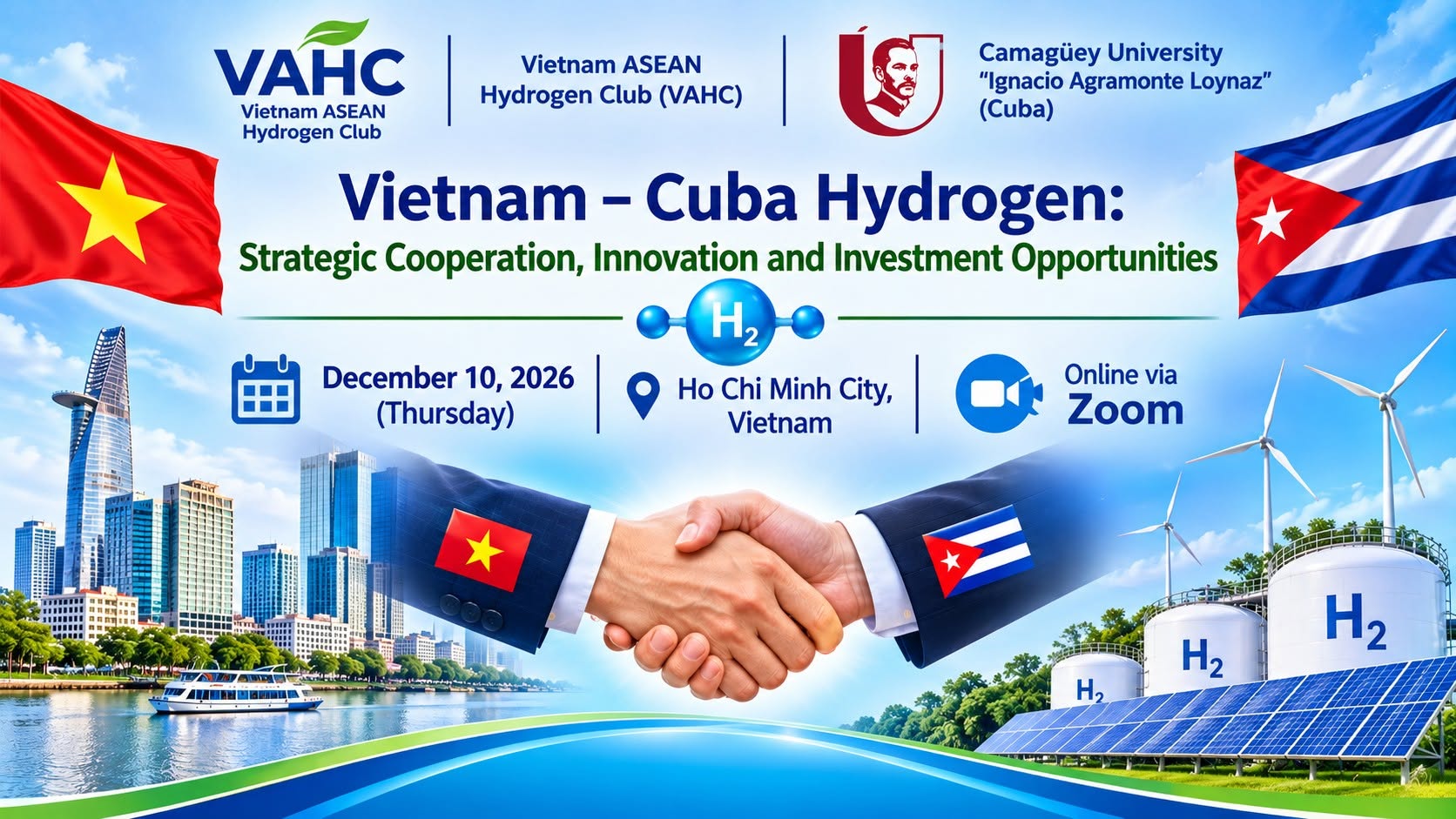
Ho Chi Minh City – On 10 December 2026, the Vietnam ASEAN Hydrogen Club (VAHC), in collaboration with the University of Camagüey "Ignacio Agramonte Loynaz" (Cuba), will hold a Zoom webinar titled "Vietnam – Cuba Hydrogen: Strategic Cooperation, Innovation and Investment Opportunities."
Basis in Vietnam–Cuba Relations
Vietnam and Cuba share a special traditional friendship, elevated to a Comprehensive Strategic Partnership during the official visit of General Secretary and President To Lam to Cuba in September 2025. The two countries have established intergovernmental cooperation mechanisms on economy, trade, science and technology, and energy. As Cuba seeks to diversify its energy supply and attract foreign investment, cooperation with Vietnam – a country with experience in renewable energy development and a national hydrogen strategy – is expected to open a new path for both sides.
National Hydrogen Strategy Basis
-
Vietnam: On 7 February 2024, the Prime Minister approved the Strategy for Hydrogen Energy Development to 2030, with a vision to 2050 (Decision No. 165/QĐ-TTg), aiming to develop a hydrogen ecosystem based on renewable energy, targeting 100,000–500,000 tonnes of hydrogen per year by 2030. In addition, PDP8 and the Action Programme on Green Energy Transition (Decision 876/QĐ-TTg) provide the legal framework for hydrogen development in transport and industry.
-
Cuba: The H2M Cuba Hub 2026–2032 strategy positions Cuba not as a passive aid recipient but as an active strategic partner, offering a testing platform ("tropicalization"), high-quality scientific human resources and flexible financial mechanisms. Cuba aims to become a hub for R&D, hydrogen technology testing and export of hydrogen and green ammonia to BRICS+ and EU markets.
Cuba's Energy Needs and Advantages
Cuba faces severe electricity shortages, an outdated grid and dependence on imported fuels. The H2M Cuba Hub strategy identifies unique competitive advantages:
-
Geological (white) hydrogen: Cuba possesses one of the Caribbean's largest ophiolite complexes (ancient oceanic crust exposed at the surface), rich in olivine and pyroxene. When hot groundwater meets ultramafic rocks, serpentinization occurs, continuously releasing free hydrogen. The provinces of Matanzas, Camagüey, Holguín and Guantánamo record free hydrogen concentrations above 30% in deep fault zones. Estimated production cost is below US$1/kg – the lowest on the planet.
-
Renewable energy: Cuba has significant solar and wind potential, especially in coastal provinces. The H2M Cuba Hub strategy proposes building 25 MWp solar farms and 20 MW electrolysis plants in Camagüey, combined with off-grid solutions for remote areas.
-
Strategic geographical position: The ports of Nuevitas, Mariel, Matanzas and Santiago de Cuba are natural gateways connecting Cuba with Caribbean, Latin American, BRICS+ and EU markets, facilitating hydrogen and green ammonia exports.
-
Human resources: Cuba has the highest ratio of engineers and scientists per capita in Latin America. The recent election of Dr. Martha Lucía Barreto Argilagos (University of Camagüey) to the World Academy of Sciences (TWAS) is evidence of the locality's R&D quality.
Webinar Agenda
The webinar is expected to run from 14:00–15:45 (Vietnam Time) / 08:00–09:45 (Cuba Time), with the following sessions:
-
Opening & Orientation (15 mins): Introduction to the webinar's objectives; welcoming Dr. Martha Lucía Barreto Argilagos.
-
Session 1: Cuba's Hydrogen Potential (20 mins): H2M Cuba Hub 2026 strategy; geological advantages; Nuevitas port location; financial sandbox mechanism.
-
Session 2: Vietnam's Experience and Capabilities (20 mins): Vietnam's hydrogen roadmap (PDP8, Decision 165/QĐ-TTg); experience of Vietnamese enterprises.
-
Session 3: Panel Discussion: Multilateral Cooperation Models (20 mins): Investment opportunities in "tropicalization" markets; South-South cooperation within BRICS+; green finance and carbon credits.
-
MoU Signing Ceremony: VAHC & University of Camagüey (15 mins): Signing of a Memorandum of Understanding on R&D cooperation for hydrogen "tropicalization," academic exchange, pilot project development and capacity building.
-
Q&A and Conclusion (15 mins): Proposal to establish a Vietnam–Cuba Joint Working Group on Hydrogen.
Significance
The webinar and MoU signing mark a concrete step in realising the Vietnam–Cuba Comprehensive Strategic Partnership in the field of new energy, while opening opportunities for Vietnamese enterprises to participate in the global hydrogen value chain through the Cuban market – a gateway to the Caribbean and Latin America.
#hydrogen #VAHC #Cuba #Vietnam #MoU #energytransition #greenhydrogen