

VINATech and VINAFCM – Two Strategic Links in South Korea's Hydrogen Fuel Cell Ecosystem
June 18, 2026
Annie Nguyễn
Overview of VINATech Group
VINATech is one of the world's leading manufacturers of supercapacitors and green energy solutions. Founded on July 26, 1999, the company is headquartered in Jeonju, South Korea, with production facilities in Wanju, South Korea, and three factories in Bac Ninh, Bac Giang, and Ha Nam, Vietnam.
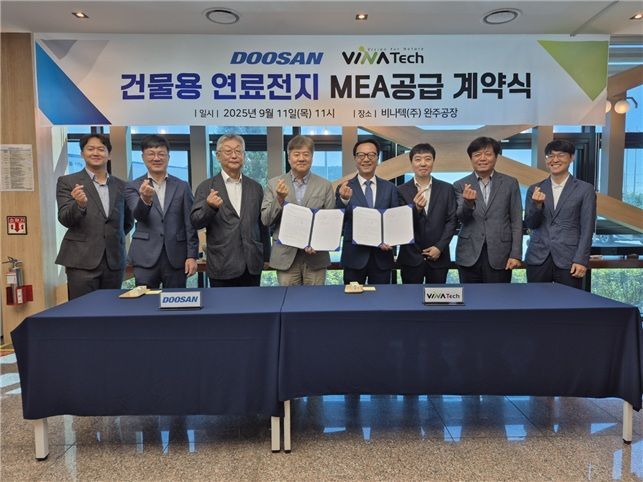
VINATech operates a multi-business model encompassing four main segments: supercapacitors, power solutions, polymer and hybrid capacitors, and fuel cells. The company employs 217 people in South Korea, including 59 in research and development, and 768 in Vietnam, including 33 in research and development.
Core Technology – Vertically Integrated Value Chain
Supercapacitors
VINATech is the world's leading mid-sized supercapacitor manufacturer, with diverse applications in smart metering, automotive electronics, data centres, and logistics automation systems. The company has successfully developed 3.0V supercapacitors, achieving 23 percent higher energy density compared to traditional 2.7V models, and is expanding into new product lines such as Lithium Ion Capacitors and pouch-type capacitors.
Hydrogen Fuel Cells – Complete Value Chain
VINATech is the only company in the world with the capability to mass-produce the entire value chain of hydrogen fuel cell materials and components.
First, carbon support serves as the base material for catalysts, directly affecting fuel cell efficiency and durability. VINATech is the exclusive supplier of carbon supports for Hyundai Motor Company's hydrogen fuel cell vehicles.
Second, the catalyst technology controls metal particle size and platinum loading, reducing cost and stack size. VINATech has accumulated over 24 years of research and development experience in proton exchange membrane fuel cells.
Third, the Membrane Electrode Assembly, or MEA, is the core component of the fuel cell stack, customisable for applications in automotive, building power generation, drones, and construction machinery.
Fourth, the carbon bipolar plate is a component that reduces stack volume and weight, developed by subsidiary VINAFCM with proprietary metal thin-film coating technology, ensuring excellent corrosion resistance and electrical conductivity.
Key Projects and Applications
VINATech and VINAFCM are participating in several large-scale fuel cell system development projects.
In building power generation, they are meeting Korea's renewable energy policies with over 80 percent market share and nine years of mass production.
For commercial vehicles such as trucks and buses, they are developing fuel cells in collaboration with overseas automotive parts companies since 2018.
In maritime and aviation, they are meeting environmental regulations of the International Maritime Organization and the International Civil Aviation Organization.
For Urban Air Mobility and military applications, they are developing high-performance fuel cell systems for urban mobility and military auxiliary power units.
VINAFCM – Centre for Carbon Bipolar Plate Technology
VINAFCM, a subsidiary of VINATech, was established on October 5, 2015, specialising in the development and manufacturing of carbon composite bipolar plates for hydrogen fuel cells.
Carbon Bipolar Plate Technology
VINAFCM possesses micro-molding technology for gas diffusion and water discharge channels, with a channel pitch of 1.6 millimetres or less. The bipolar plate has a thickness of 1 millimetre, reinforced with carbon fibre to enhance flexural strength. Key specifications exceed US Department of Energy targets.
Electrical conductivity reaches 161 siemens per centimetre against a Department of Energy target of at least 100. Hydrogen permeability is below 2.01 times ten to the minus tenth power, compared to a Department of Energy target of below 2 times ten to the minus sixth power. Flexural strength reaches 76.2 megapascals against a target above 40. Areal specific resistance is 0.00935 ohm-centimetres squared against a target below 0.01.
Thin Bipolar Plate Technology
VINAFCM is developing thin bipolar plate technology with thickness below 1 millimetre, targeting 0.2 millimetres for mobility applications, increasing stack volumetric energy density.
Fuel Cell System Development Projects
For the FCEV system for medium-heavy trucks covering 2025 to 2028, the target is 52 percent rated efficiency and 25,000-hour durability, equivalent to 1,000,000 kilometres.
For the low-cost, long-life PEMFC stack covering 2025 to 2028, the project uses 0.18 millimetre thin carbon bipolar plates, achieving volumetric power density of 4.8 kilowatts per litre and gravimetric power density of 3.5 kilowatts per kilogram.
For the hydrogen forklift and charging facility covering 2024 to 2027, the project develops a 2.5 kilowatt fuel cell system, integrating supercapacitor-battery-fuel cell hybrid technology.
Outlook and Development Direction
VINATech and VINAFCM are pursuing a Vision 2030 strategy, targeting one trillion Korean won in revenue through global market expansion and next-generation fuel cell technology development. The company aims to produce 100 million MEA units annually by 2030.
With the world's only vertically integrated value chain, from carbon support, catalyst, and MEA to carbon bipolar plates, VINATech and VINAFCM are positioning themselves as indispensable strategic partners in the global hydrogen fuel cell ecosystem.