

Vietnam's National Hydrogen Strategy Roadmap Should Account for Clean Hydrogen Demand in Explosives for Mineral Mining (Coal, Construction Stone)
July 9, 2026 | VAHC Secretariat
Vietnam is developing its National Hydrogen Energy Development Strategy with ambitious targets: 100,000-500,000 tons/year of green hydrogen production by 2030 and 10-20 million tons/year by 2050. However, a critical component often overlooked in these calculations is the demand for clean hydrogen and ammonia for industrial explosives production serving coal and construction stone mining – the two largest explosives-consuming sectors in Vietnam. This article analyzes the scale of this demand and proposes its integration into the national hydrogen roadmap.
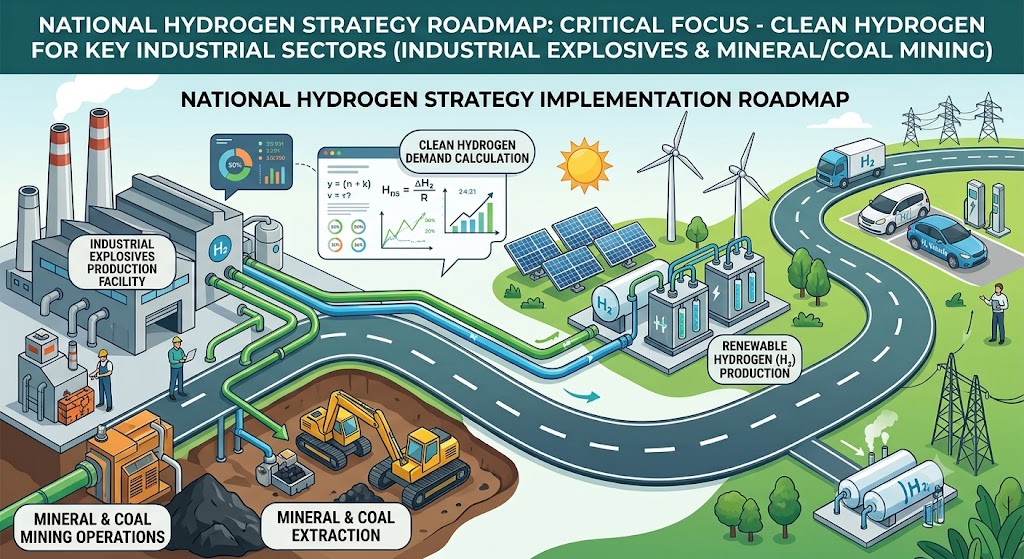
1. The Role of Ammonia in Industrial Explosives Production
Ammonia (NH₃) is a key input for producing ammonium nitrate (NH₄NO₃) – the primary oxidizer in industrial explosives. Global market analysis shows ammonium nitrate dominates the mining and quarrying sectors due to safety advantages in transport and storage. ANFO explosives (ammonium nitrate + fuel oil) are widely used in coal, stone, and tunnel construction mining.
Globally, metal mining accounts for 38%, coal mining 36%, and construction stone mining 13% of total explosives consumption. Vietnam follows this trend, with coal and construction stone mining as the two largest ammonium nitrate consumers.
2. Ammonia Demand for the Coal Mining Sector
Operational data from Vinacomin (Vietnam National Coal – Mineral Industries Group) provides a clear picture of consumption scale.
Q1/2025: Vinacomin produced 16,100 tons of ammonium nitrate and consumed 17,900 tons. During the same period, explosives production reached 7,500 tons with consumption of 9,700 tons.
April 2026: Ammonium nitrate consumption reached 157.1% of the monthly plan, reflecting actual demand far exceeding forecasts.
First 6 months of 2026: Vinacomin produced 14,000 tons of ammonium nitrate and supplied 9,100 tons of explosives.
Multi-month consolidated data shows monthly ammonium nitrate production typically ranges 16,000-17,000 tons. Annual ammonium nitrate consumption for the coal sector is estimated at approximately 170,000-200,000 tons/year.
Converting from ammonium nitrate to ammonia at a ratio of 1 ton NH₃ → 2.27 tons NH₄NO₃, the ammonia demand for the coal sector is approximately 75,000-88,000 tons NH₃/year.
3. Ammonia Demand for Construction Stone and Granite Mining
Construction stone and granite mining is the second-largest consuming sector. Globally, this segment accounts for 13% of the explosives market, with forecast growth of approximately 1.1% per year. In Vietnam, construction stone demand is estimated at approximately 10-10.5 million m³/year, corresponding to explosives demand of approximately 8,160 tons/year (at a rate of 0.8 kg/m³).
With ammonium nitrate comprising approximately 94% of explosives , ammonium nitrate demand for the stone sector is approximately 7,670 tons/year. Converting to ammonia: approximately 3,380 tons NH₃/year.
4. Total Current Ammonia Demand for Both Sectors
| Sector | Explosives Demand (tons/year) | Estimated NH₄NO₃ (tons/year) | Converted NH₃ (tons/year) |
|---|---|---|---|
| Coal mining | ~77,000 | ~170,000-200,000 | ~75,000-88,000 |
| Construction stone, granite mining | ~8,160 | ~7,670 | ~3,380 |
| Total | ~85,160 | ~177,670-207,670 | ~78,380-91,380 |
Current ammonia demand for these two sectors is approximately 80,000-91,000 tons NH₃/year. Note that Vinacomin's ammonium nitrate data also includes demand beyond the coal sector, so the actual figure may be at the higher end of this estimate.
5. Implications for the National Clean Hydrogen Roadmap
5.1. Stable and Significant Demand Scale
Ammonia demand for explosives production currently accounts for approximately 16-18% of the 2030 green hydrogen production target (100,000-500,000 tons/year) and approximately 0.4-0.9% of the 2050 target (10-20 million tons/year). Though the percentage share decreases over time, this remains a stable consumption market that can serve as a "bridge" for the hydrogen industry in its early stages.
5.2. Opportunity to Replace Imported Ammonia with Domestic Green Ammonia
According to an Australian anti-dumping investigation report, MICCO (Vinacomin Mining Chemical Industry Holding Corporation Ltd) is currently exporting ammonium nitrate to Australia. This indicates Vietnam has existing ammonia and ammonium nitrate production capacity. However, current production technology relies on natural gas or coal, generating significant CO₂ emissions. Switching to green ammonia (from renewable hydrogen) would reduce emissions across the entire value chain.
5.3. Future Demand Growth
With major infrastructure projects and Vinacomin's coal production targets remaining high (over 36 million tons/year), explosives and ammonia demand could grow 1-2% per year, consistent with global forecasts.
5.4. Recommendations for Integration into the National Hydrogen Strategy
-
Identify the mineral mining sector as a "first mover" for green ammonia consumption, similar to Germany's strategy with green hydrogen in oil refineries.
-
Develop a transition roadmap: Target 5-10% green ammonia by 2030, increasing to 50% by 2040 and 100% by 2050 for the explosives sector.
-
Integrate with Power Development Plan VIII: Utilize surplus renewable electricity from solar and wind projects in mining provinces (Quang Ninh, Binh Thuan) to produce green hydrogen for local ammonia production.
6. Conclusion
Ammonia demand for explosives production in Vietnam's coal and construction stone mining currently stands at approximately 80,000-91,000 tons NH₃/year, corresponding to a clean hydrogen consumption potential of approximately 14,000-16,000 tons H₂/year (at a ratio of 1 ton H₂ → 5.67 tons NH₃). This represents a significant and stable market, warranting detailed consideration in Vietnam's National Hydrogen Strategy implementation roadmap. Transitioning to green ammonia for the explosives sector would not only reduce emissions from the mining industry but also create initial demand for the clean hydrogen supply chain, supporting Vietnam's Net Zero target by 2050.