

Vietnam National Hydrogen Strategy and Some Suggestions to Build the Roadmap
A Presentation by Dr. Oanh (VAHC) at the "Hydrogen Horizons" Workshop, March 31, 2026, USTH, Hanoi
April 3, 2026 by Annie Nguyễn
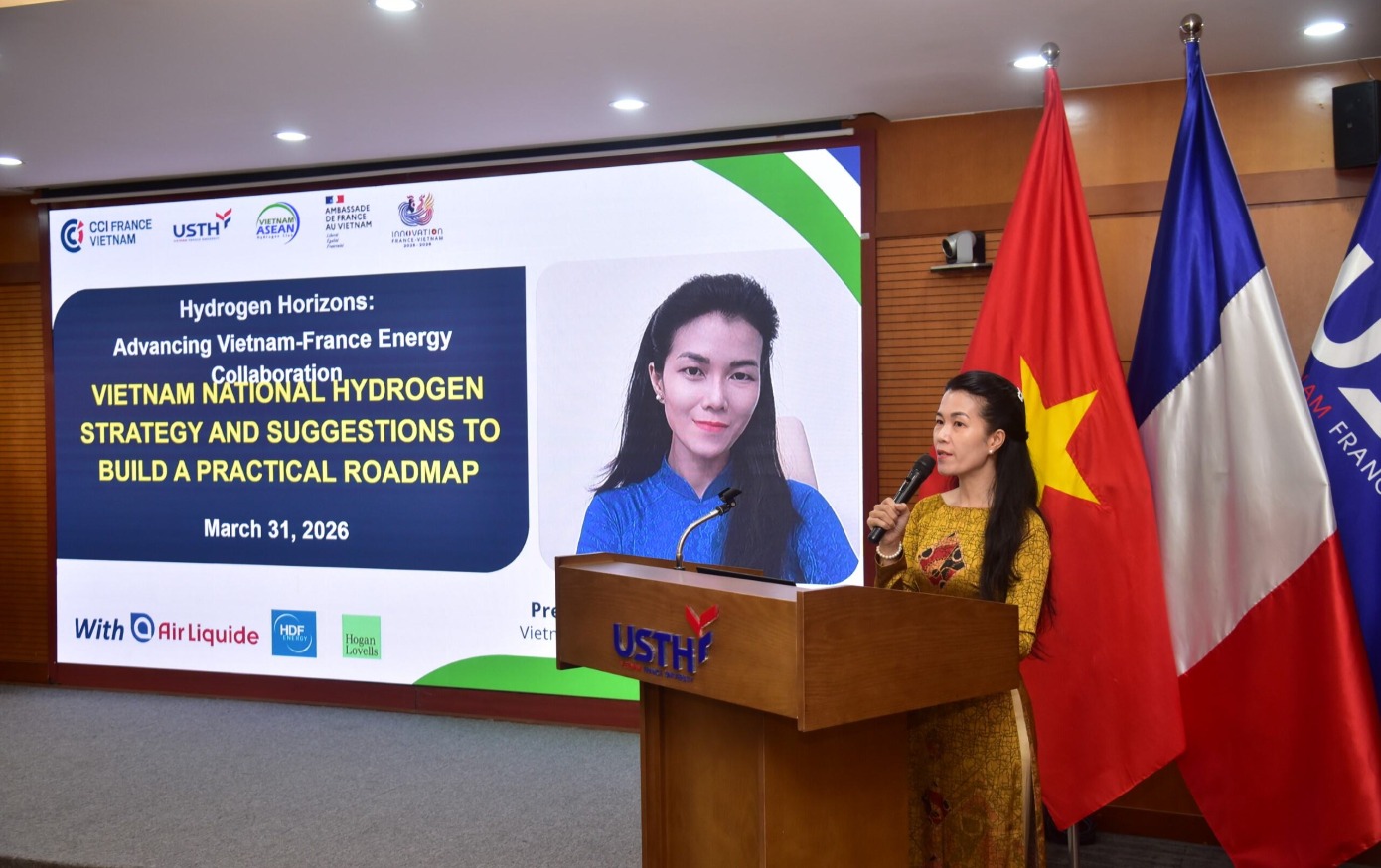
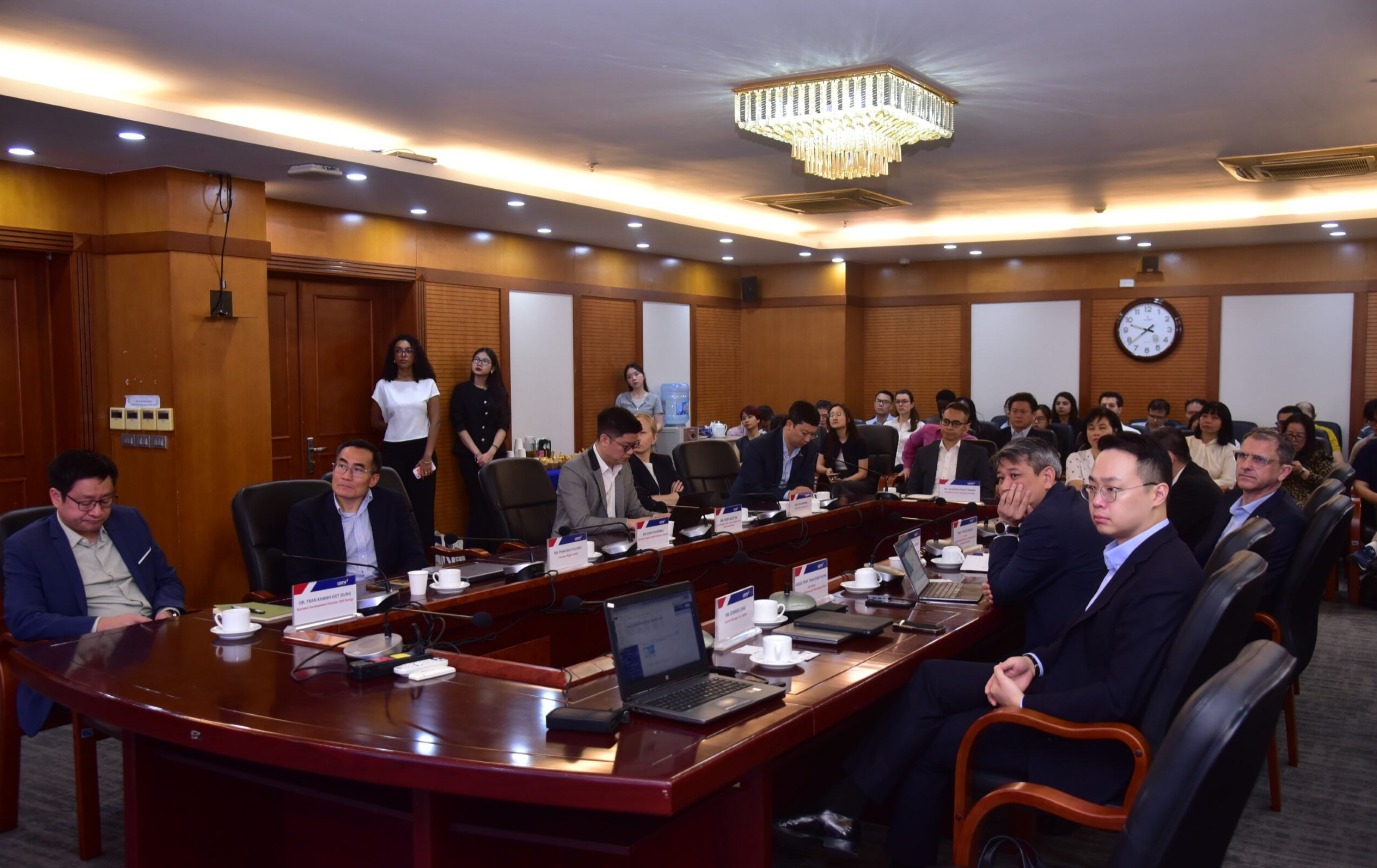
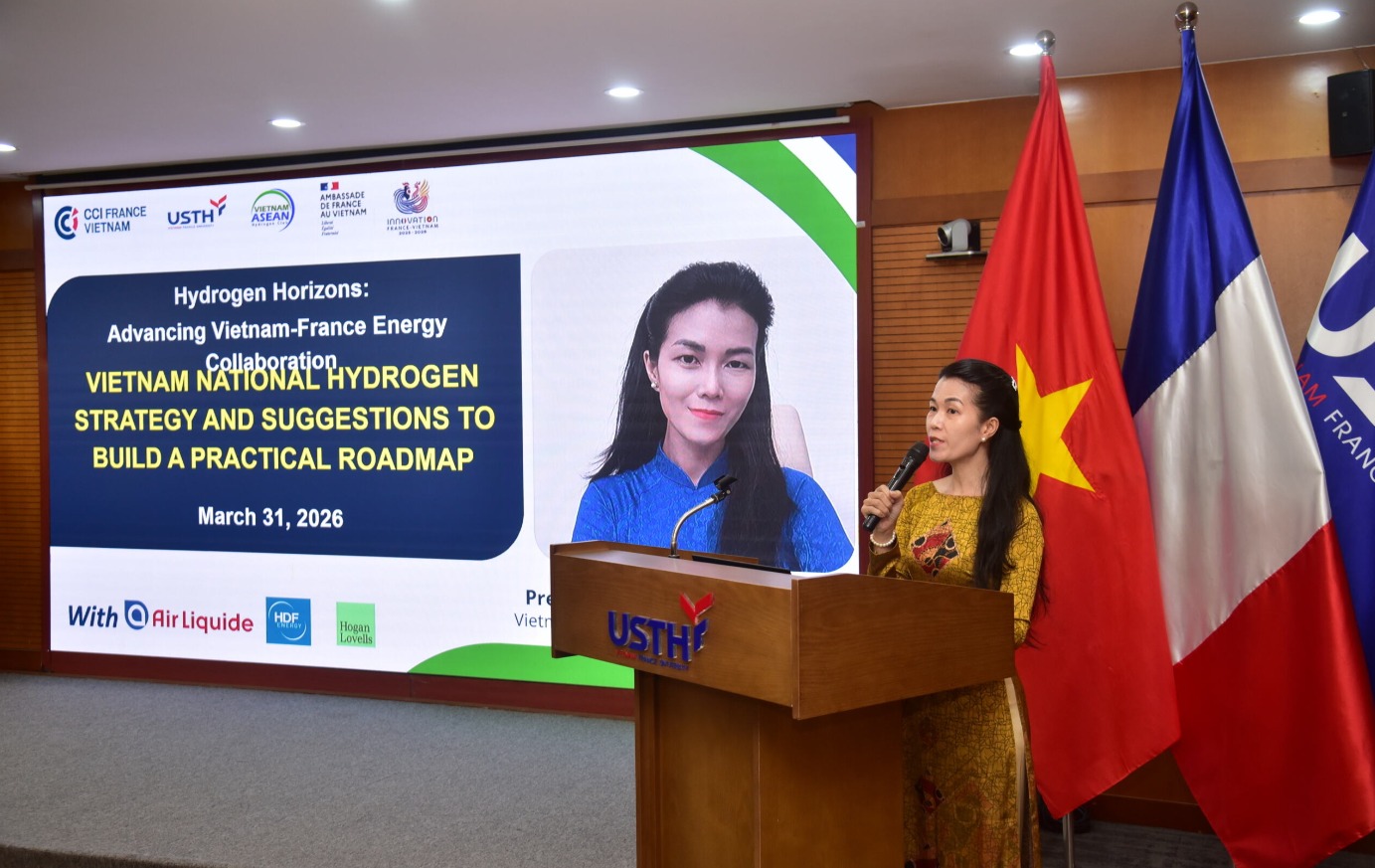
HANOI – Within the framework of the international workshop "Hydrogen Horizons - Advancing Vietnam-France Energy Collaboration" held at the University of Science and Technology of Hanoi (USTH) on March 31, 2026, Dr. Cao Thuy Oanh – representing the Vietnam ASEAN Hydrogen Club (VAHC) – delivered a significant presentation on "Vietnam National Hydrogen Strategy and Some Suggestions to Build the Roadmap" .
Dr. Oanh emphasized from the outset: VAHC is not a think tank – we are a project enabler.
The Hydrogen Moment – Global Potential vs. Regional Reality
Dr. Oanh opened with a comprehensive overview: Global hydrogen demand reaches 100 million tons/year, yet current low-emission hydrogen supply accounts for less than 1%. Investment jumped from $4.3 billion to $8 billion in the 2024-2025 period, but only 6% of announced projects reach Final Investment Decision (FID).
In ASEAN, hydrogen demand reaches 4 million tons/year in ammonia, refining, and chemicals. Vietnam is positioned as the potential central hub to capture the upcoming regional FID wave.
"The hydrogen opportunity is real – but execution is rare," Dr. Oanh stated.
Vietnam's National Hydrogen Strategy – The Top-Down View
Dr. Oanh recapped the core targets of Decision 165/QD-TTg (February 7, 2024) – Vietnam's Hydrogen Energy Development Strategy to 2030 with a vision to 2050:
-
By 2030: Achieve hydrogen production of 100,000 – 500,000 tons/year; adopt advanced technologies for green hydrogen and carbon capture (CCS/CCUS); pilot hydrogen use in power generation, transportation, and heavy industry.
-
By 2050: Achieve hydrogen production of 10 – 20 million tons/year; master green hydrogen and CCUS technologies; build a complete hydrogen ecosystem (production – storage – transport – use); target exports.
Guiding principles:
-
Develop hydrogen along the entire value chain.
-
Reasonable roadmap aligned with energy transition and global technology trends.
-
Encourage hydrogen use in high-emission sectors.
-
Strengthen international cooperation (COP, JETP, AZEC).

Vietnam Reality – Strategy is Clear, Execution Pathway is Not
Dr. Oanh candidly pointed out: The strategy is clear – but the execution pathway is still unclear.
Based on a survey of 930 enterprises, cooperatives, and traders across 14 provinces/cities (representing 41.1% of all provinces nationwide):
-
58.5% of enterprises consider hydrogen important or very important in the next 10-20 years.
-
However, 44.5% have no plan to apply hydrogen; 19.3% are still considering; only 36.1% have a plan.
-
Currently, only 20% of enterprises use hydrogen (primarily in food processing and mechanical sectors).
-
Main barriers: High investment costs, high green hydrogen prices, lack of storage and distribution infrastructure, and unproven technologies.
"Hydrogen is strategic – but not yet investable. Strategy is moving faster than reality," Dr. Oanh remarked.
International Lessons for Vietnam
Dr. Oanh analyzed three successful global models:
1. Europe – Policy-Driven Market Creation:
-
EU 2030 targets: 10 Mt domestic, 10 Mt imported, 40 GW electrolyser capacity.
-
Policy tools: RED III (mandates & quotas), EU Hydrogen Bank (subsidy mechanism), European Hydrogen Backbone.
-
Lessons for Vietnam: Policy must create demand (offtake), not just set production targets; initial financial support is required; keep regulations simple.
2. China – Scale & Cost Leadership:
-
Target: Becoming the global hydrogen equipment manufacturing hub.
-
Actions: Building the world's largest electrolyser manufacturing capacity; deploying massive local hydrogen clusters.
-
Lessons for Vietnam: Scale drives cost reduction; the "industrial policy + local demonstration zones" model is highly applicable to Vietnam's coastal economic zones.
3. Japan – Technology, Safety & Business Models:
-
Vision: Comprehensive hydrogen society + import strategy.
-
Lessons for Vietnam: Critical questions from day one: Who is the offtaker? What is the hydrogen price? What is the risk-sharing mechanism? Demand certainty enables long-term investment.
"Successful hydrogen markets combine demand (EU), scale (China), and trust (Japan/US). Hydrogen is a system decision – not a single technology choice," Dr. Oanh summarized.
Suggested Roadmap for Vietnam
Drawing from international lessons and domestic reality, Dr. Oanh proposed a three-phase roadmap:
Phase 1: 2025–2030 – Kick-off Phase "No-Regret Pilots"
-
Finalize the legal framework, basic technical and safety standards; strengthen public awareness.
-
Deploy 5–10 bankable pilot projects in: steel, fertilizers, food processing, and refining (where ~20% of enterprises already use hydrogen).
-
Develop 2–3 pilot port-based hydrogen/ammonia hubs.
Core principle: "No project – No market." Prioritize projects with clear offtakers, long-term contracts, and risk-sharing mechanisms.
Phase 2: 2030–2040 – Scale-up Phase (Clusters & Supply Chains)
-
Expand port-based hydrogen hubs; develop pipelines, storage systems, and refueling infrastructure.
-
Develop domestic supply chains for hydrogen equipment: electrolyser components, storage tanks, compression systems, and Balance of Plant (BoP).
Phase 3: 2040–2050 – Optimization Phase (Diversification & Export)
-
Diversify hydrogen pathways (green, blue, biomass, and natural/white hydrogen).
-
Expand applications in agriculture and residential sectors.
-
Target exports of hydrogen, ammonia, e-fuels, and hydrogen-related technical services across ASEAN.
Additional Strategic Recommendations
1. White (Natural) Hydrogen:
-
An emerging global trend with theoretical extraction costs estimated at <1 USD/kg.
-
Recommendations: Integrate natural hydrogen surveys into national geological mapping programs; deploy small-scale pilots; draft an early legal framework similar to oil & gas extraction.
2. Standards, Safety & Public Acceptance:
-
"No safety – No social license – No project."
-
National standards must be established from the very beginning.
3. Emerging Applications (not short-term priorities but important for long-term adoption):
-
Agriculture: Reducing plant oxidative stress, moving toward carbon-neutral farming.
-
Daily life: Hydrogen inhalation, hydrogen cooking, hydrogen coffee roasting, ENE-FARM fuel cell models.
4. Investment & Financing Mechanisms:
-
PPP model for shared infrastructure (ports, pipelines, storage); private investment for electrolyser plants and H₂/NH₃ production.
-
Integrate with carbon markets to improve project NPV/IRR.
-
International financing sources: JCM (Japan), climate funds, EU, IEA, IRENA support programs.
5. Hydrogen Refueling Station Economics:
-
Canada example: Minimum hydrogen price of 4.3-4.9 CAD/kg required to achieve IRR ~8%.
-
Implication for Vietnam: Early-stage price support and incentives are required; otherwise, projects will not be bankable.
Conclusion – VAHC's Commitment
Dr. Oanh concluded her presentation with VAHC's commitment:
"VAHC is committed to partnering with the Government in developing national strategies and technical standards; connecting Vietnamese enterprises with international partners in technology, finance, and markets; promoting pilot projects based on key principles: bankability, safety, data-driven approach, and international best practices."
Dr. Oanh's final message: From policy-driven to project-driven – No project, No market. Vietnam needs to act today to seize the hydrogen opportunity regionally and globally.
Reported by: VAHC Secretariat
Contact VAHC: contact@vahc.com.vn