

Vietnam Hydrogen Legal and Regulatory Forum 2026: From Strategy to Action – Building the Legal Foundation for a New Energy Era
Annie Nguyễn
May 29, 2026 – Saigon Innovation Hub (SIHUB), Ho Chi Minh City
Opening: Net Zero aAmbition and the Legal Challenge
On May 29, 2026, the ASEAN Vietnam Hydrogen Club (VAHC) successfully organized the Vietnam Hydrogen Legal and Regulatory Forum 2026 at the Saigon Innovation Hub (SIHUB) in Ho Chi Minh City. The event brought together leading domestic and international experts, representatives from regulatory agencies, enterprises, research institutes, and development organizations to discuss one of the most pressing issues in Vietnam's energy transition: the legal framework for hydrogen.
Against the backdrop of Vietnam having issued Decision No. 165/QĐ-TTg (National Hydrogen Energy Development Strategy to 2030, vision to 2050) with ambitious targets – 100,000–500,000 tonnes of H₂/year by 2030 and 10–20 million tonnes by 2050 – experts noted that the strategy remains at the vision level. What is truly needed now is a dedicated legal framework, a suitable set of technical standards (TCVN), and a concrete implementation roadmap with clear responsibilities, deadlines, and accountable persons.
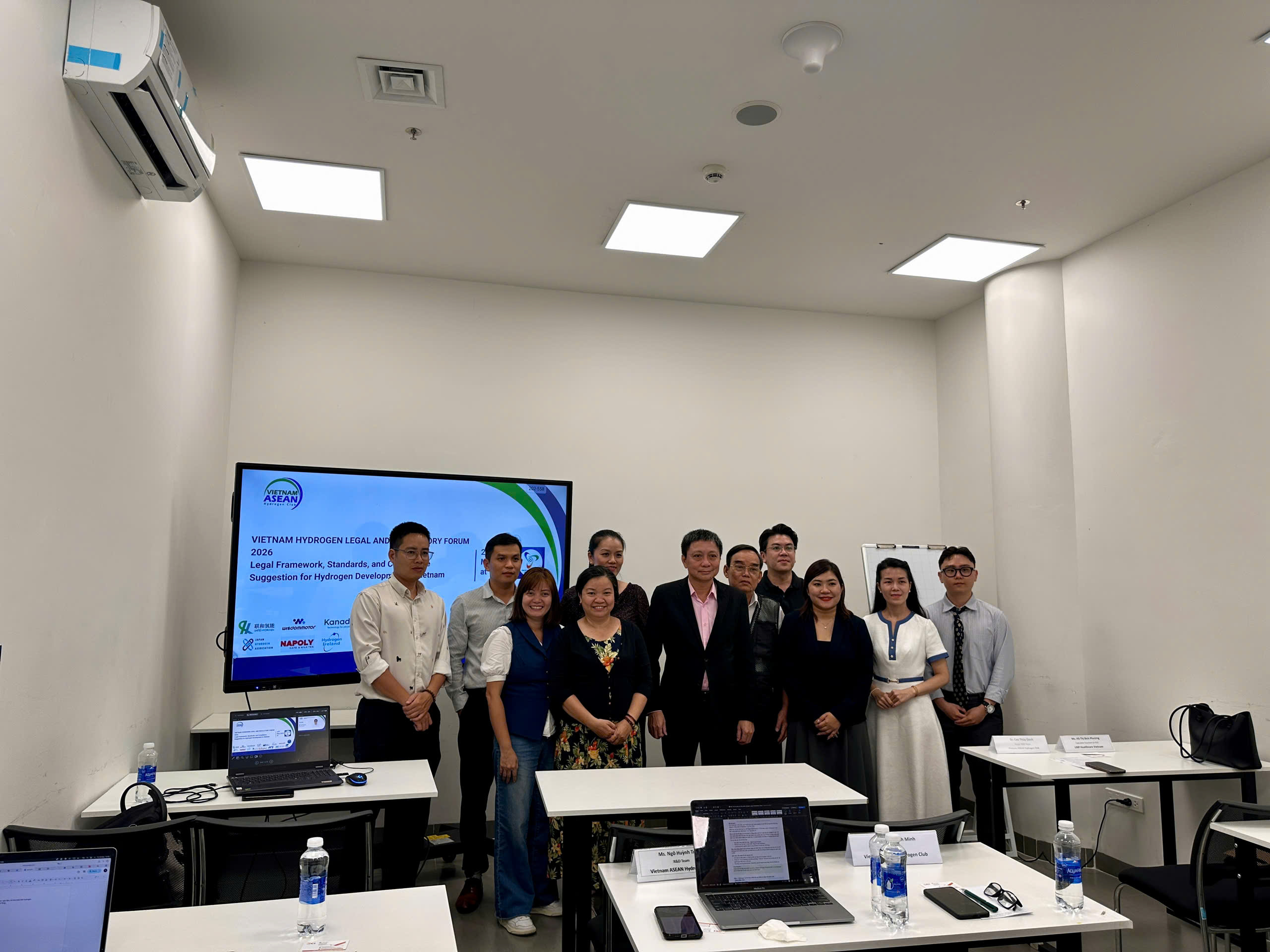
Session 1: Opening Remarks by Mr. Lê Ngọc Ánh Minh, Chairman of VAHC
The forum opened with a welcome speech by Mr. Lê Ngọc Ánh Minh, Chairman of the ASEAN Vietnam Hydrogen Club (VAHC). He emphasized:
"We are living in a time when climate change is no longer a forecast but a reality. The pressure to reduce emissions and achieve the Net Zero target by 2050 is reshaping the entire global energy economy. In this context, hydrogen emerges as a strategic pillar, an indispensable energy carrier for decarbonizing heavy industry, transport, and power generation."
He also pointed out that although Vietnam has Decision 165, what is critically lacking is a dedicated, coherent and enforceable legal framework. Hydrogen currently falls into a legal gap among existing laws: sometimes treated as an industrial gas, sometimes as a hazardous chemical, and sometimes as a "new fuel" without a clear legal status. Vietnam has no framework decree, no set of TCVN standards based on ISO/TC 197, no low‑emission hydrogen certification mechanism, and no concrete pilot roadmap.
Mr. Lê Ngọc Ánh Minh called on the forum to focus on concrete actions: identifying what needs to be done in 2026 and 2027 to fill the legal gaps, develop the core TCVN standards, propose a sandbox mechanism, and select the first pilot projects that can be deployed in Vietnam.
Session 2: International Experience – Lessons from Japan, South Korea and Europe
2.1. UNIHYS: A Customized Approach – From Technology to Law
A representative from UNIHYS presented South Korea's hydrogen development model – the country possessing the world's first dedicated hydrogen law (Hydrogen Economy Promotion and Hydrogen Safety Management Act, effective in 2021 and fully effective from October 2025). A distinctive feature of South Korea is that technology came first, law followed: major companies such as Hyundai, SK, POSCO, Hanwha, and Hyosung had accumulated over 15 years of technology, launching pilot refueling stations in 2006 and hydrogen buses in 2018 – all before any dedicated hydrogen law. The pilot results became the scientific basis for drafting the law.
Strategic comparison between the two countries:
-
South Korea: Technology created the law. Enterprises had over 15 years of technology accumulation before the law. Pilots preceded the law, and data provided the legal foundation.
-
Vietnam: The law can bring in technology. Technology will be transferred through international cooperation. The legal framework should be built first, then attract technology and capital from pioneering countries.
UNIHYS affirmed its readiness to accompany Vietnam in transferring electrolysis and hydrogen storage technologies, supporting the development of technical regulations based on KGS (Korea Gas Safety Code) experience, piloting medium‑scale hydrogen demonstration projects in Vietnam, and training human resources in hydrogen operation and safety.
2.2. Japan: Legal Framework for Hydrogen Therapy
Ms. Phuong Hoang (representative of UNPHC) presented the legal status of the hydrogen therapy industry in Japan – a pioneer in applying hydrogen to healthcare. In Japan, bagged hydrogen water is classified as food (under the Food Sanitation Act, Food Labeling Act, and Pharmaceutical and Medical Device (PMD) Act), not as medicine. Health claims are only permitted when supported by scientific evidence (Food Function Claim). The IZUMIO product from SHEFCO Kanuma Factory has been distributed globally due to strict compliance with production safety (GMP, ISO), transparency of H₂ concentration, and careful communication.
In Vietnam, the hydrogen health market is in its early stages, demand is growing rapidly, but there is no clear legal definition, no technical standards, and a risk of exaggerated advertising (e.g., "cure‑all"). Lessons from Japan: technology development must go hand in hand with standards, innovation must be paired with safety control, and commercialization must be based on scientific evidence.
Session 3: Legal Classification of Hydrogen under Vietnamese Law
Dr. Cao Thúy Oanh (Head of Research & Development Group, VAHC) presented an in‑depth analysis of the legal classification of hydrogen under three layers:
-
Hydrogen as an industrial gas: Hydrogen should be managed as a flammable, high‑pressure industrial gas, similar to LPG and LNG. Mandatory requirements for risk assessment, safety distances, refueling station design, storage vessels, and pipelines according to TCVN based on ISO/TC 197.
-
Hydrogen as a chemical: Under the Globally Harmonized System (GHS), hydrogen is a flammable hazardous chemical, requiring MSDS, hazard classification, labeling, declaration, warehouse management, and transport controls under the Law on Chemicals.
-
Hydrogen as an energy carrier: This is the layer most lacking clarity. Hydrogen currently falls into a legal gap between the Petroleum Law, the Electricity Law, and the Chemical Law. A dedicated legal regime for hydrogen energy is needed, defining the position of H₂ in the electricity market, carbon market, and gas market.
Dr. Cao Thúy Oanh also emphasized the importance of ISO/TC 197 – the international technical committee on hydrogen technologies, with more than 25 full member countries and over 15 observer countries. Vietnam has no equivalent TCVN set and has not yet joined ISO/TC 197 as an observer. She recommended: urgently establish an inter‑ministerial task force, develop a TCVN "H₂‑core set" based on ISO/TC 197, and join ISO/TC 197 to proactively localize international standards.
Session 4: Real Data from 930 Vietnamese Enterprises
One of the key highlights of the forum was the release of the results of a survey of 930 enterprises across 14 provinces/cities conducted by Dr. Cao Thúy Oanh and the VAHC team. The results showed:
-
58.5% of enterprises consider hydrogen important or very important for the next 10–20 years.
-
However, 68% have no significant activities related to hydrogen.
-
Only about 20% have ever used H₂, and less than 10% have entered the pilot stage.
-
The three largest barriers identified: (1) high costs – lack of infrastructure – immature technology; (2) lack of legal framework, standards, and support mechanisms; (3) limited market and social awareness.
The conclusion: Enterprises are ready in terms of awareness, but not yet ready in terms of action. They are waiting for a clear legal framework, feasible pilot projects, and supportive financial mechanisms.
Session 5: Proposed Three‑Phase Hydrogen Roadmap 2025–2050
Based on international experience and real enterprise data, VAHC proposed a national hydrogen roadmap with three specific phases:
Phase 1 (2025–2030): Targeted launch
-
Complete the minimum legal framework: framework decree on hydrogen energy + TCVN "H₂‑core set" based on ISO/TC 197.
-
Deploy 5–10 bankable pilot projects including: diesel engine H₂ injection retrofits (in Vũng Áng, Hà Tĩnh); hydrogen for industries currently using grey H₂ (oil refining, fertilizers, steel, food processing); and 1–2 H₂ refueling stations for fixed‑route buses or trucks.
-
Establish 2–3 "hydrogen hubs" linked to industrial‑port clusters such as Cái Mép – Thị Vải, Dung Quất, Nghi Sơn, Hải Phòng.
-
Achieve 100,000 – 500,000 tonnes of H₂/year as targeted by Strategy 165.
Phase 2 (2030–2040): Selective scaling
-
Design time‑limited, conditional price support programs (5–7 years, degressing).
-
Develop domestic hydrogen equipment manufacturing capacity (LILAMA, HB‑GREEN, Ikonomy…).
-
Expand from 2–3 to 5–7 hydrogen hubs.
-
Build 200–500 km of H₂/NH₃ distribution pipelines in industrial‑port belts.
-
20–50 H₂ refueling stations for buses, trucks, and logistics fleets.
-
Green and blue H₂ reach 20–30% of industrial H₂ demand.
-
5–10% of urban buses and heavy trucks convert to H₂ (FCEVs and H₂‑ICEs).
Phase 3 (2040–2050): System optimization and regional integration
-
Achieve 10–20 million tonnes of H₂/year for domestic use and exports.
-
Power system structure: 40–50% of capacity from flexible H₂/NH₃ + renewables, complete phase‑out of coal power.
-
H₂ contributes 15–20% of final energy demand.
-
Diversify production pathways: green, blue, biomass, and natural (white) hydrogen as a long‑term strategic bet.
-
Vietnam becomes a regional H₂/NH₃ hub, exporting technology and services.
Session 6: Financial Mechanisms and Project Bank
The forum agreed that: without price support – projects are not bankable; without projects – there is no market. Financial tools need to be designed from the very beginning, including:
-
Contracts for Difference (CfD) for electricity and H₂.
-
Competitive auctions for large‑scale hydrogen projects.
-
Tax incentives, green credit, credit guarantees for pioneer enterprises.
-
National H₂ Project Bank – a portfolio of projects for 2025–2040 with full information on location, technology, CAPEX, OPEX, legal status, and potential off‑takers.
The hydrogen cluster / valley model linked to industrial parks and ports was proposed as the most effective way to optimize costs: produce H₂ on‑site, use it on‑site, utilize waste heat and surplus electricity, and reduce transport costs.
Session 7: Emerging Applications – H₂‑ICE, Agriculture, Health, Natural Hydrogen
In addition to traditional energy applications, the forum also discussed areas with potential for immediate piloting in Vietnam:
-
Hydrogen internal combustion engine (H₂‑ICE): Trials in Vũng Áng in 2025 showed fuel savings of 5–15%, combustion efficiency increase of 3–10%, and significant reductions in CO, CO₂, and HC. This is a practical bridge between today's fleet and a zero‑emission future.
-
Hydrogen in agriculture: H₂‑enriched water increases crop yields. About 30% of surveyed enterprises are in food processing – ideal for pilot projects.
-
Hydrogen therapy: A legal framework is needed to clearly classify wellness products versus medical devices, requiring clinical evidence and strict advertising controls.
-
Natural (white) hydrogen: The global trend is to explore natural H₂ extraction with theoretical costs below 1 USD/kg. Vietnam should integrate this into geological and oil‑gas surveys from 2025–2030, pilot 2–3 small projects in 2030–2040, and develop an extraction legal framework after 2040 if feasible.
Conclusion: Hydrogen as a Test of Vietnam's Policy Coordination Capacity
Closing the forum, Dr. Cao Thúy Oanh summarized:
Hydrogen is both an opportunity to achieve Net Zero and a test of Vietnam's policy coordination capacity. If Vietnam clearly defines the legal classification, aligns with ISO/TC 197 and international standards, and learns how to move from strategy to concrete projects as Japan, South Korea and Europe have done, then Vietnam can simultaneously achieve Net Zero 2050, upgrade industrial capacity, and avoid the trap of non‑bankable projects.
Vietnam's hydrogen roadmap should combine three elements: a long‑term vision in the manner of Japan, a policy framework in the manner of Europe, and a practical, region‑based implementation approach as in North America and the Nordics.
The forum ended with a call to action from VAHC: establish an inter‑ministerial hydrogen task force; develop the framework decree and TCVN "H₂‑core set" in 2026–2027; deploy 5–10 pilot projects immediately in the 2025–2030 period; and make Vietnam an important link in the regional hydrogen value chain.
Final message: Hydrogen does not wait – and neither can Vietnam.
This summary is based on the presentations and discussions at the Vietnam Hydrogen Legal and Regulatory Forum 2026, organized by the ASEAN Vietnam Hydrogen Club (VAHC) on May 29, 2026, at the Saigon Innovation Hub, Ho Chi Minh City.