

UNIHYS presents "Customized Hydrogen Approach for South Korea and Vietnam" at Vietnam Hydrogen Legal and Regulatory Forum 2026
Annie Nguyễn
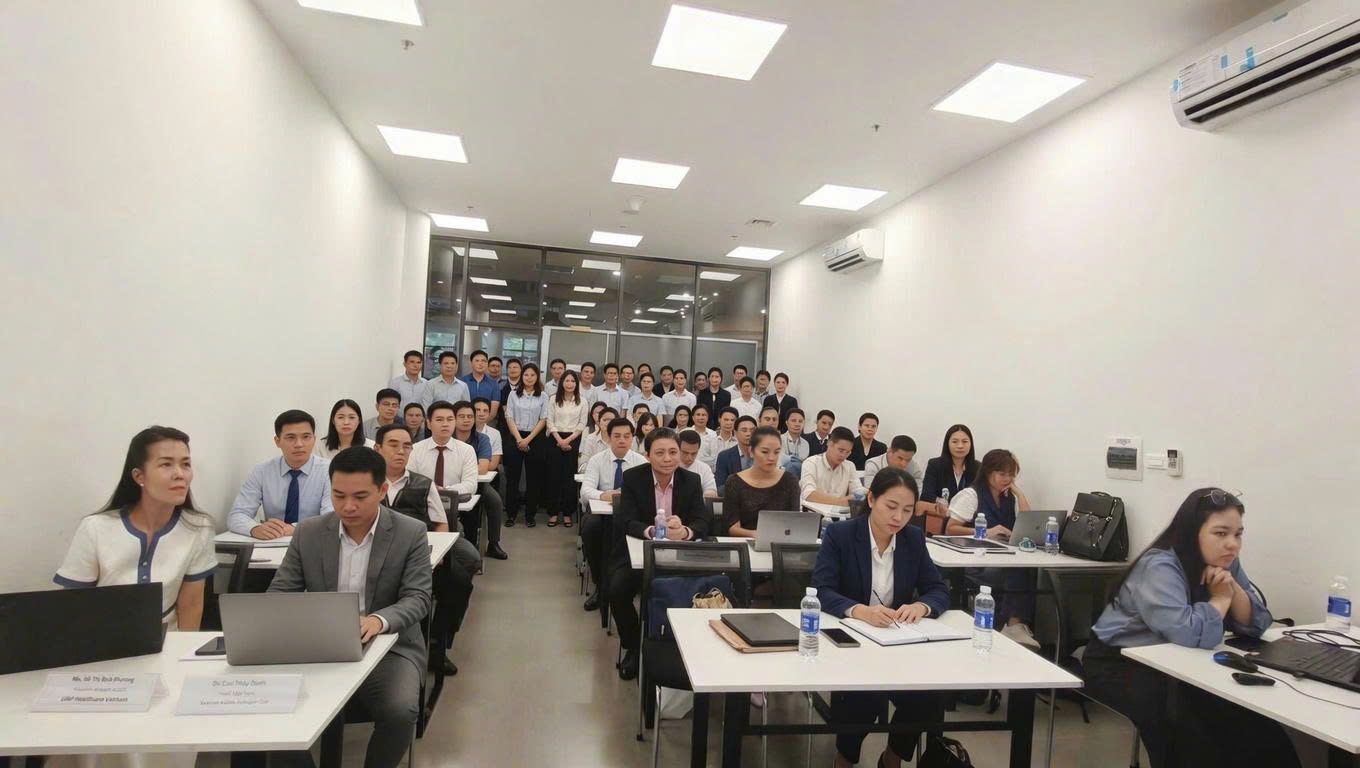
May 29, 2026 – Saigon Innovation Hub (SIHUB), Ho Chi Minh City
As part of the Vietnam Hydrogen Legal and Regulatory Forum 2026 organized by the ASEAN Vietnam Hydrogen Club (VAHC) , Mr. Lê Ngọc Ánh Minh – Chairman of VAHC – delivered an important opening speech, followed by in-depth presentations from international experts. One of the most notable presentations came from UNIHYS, titled: "Customized Hydrogen Approach: South Korea & Vietnam – from Technology to Law" by Dr. Kim Hee Jung.
The presentation provided a comprehensive picture of Korea's hydrogen development journey – the country with the world's first dedicated hydrogen law – while offering valuable strategic insights for Vietnam in building its legal framework for this emerging energy sector.
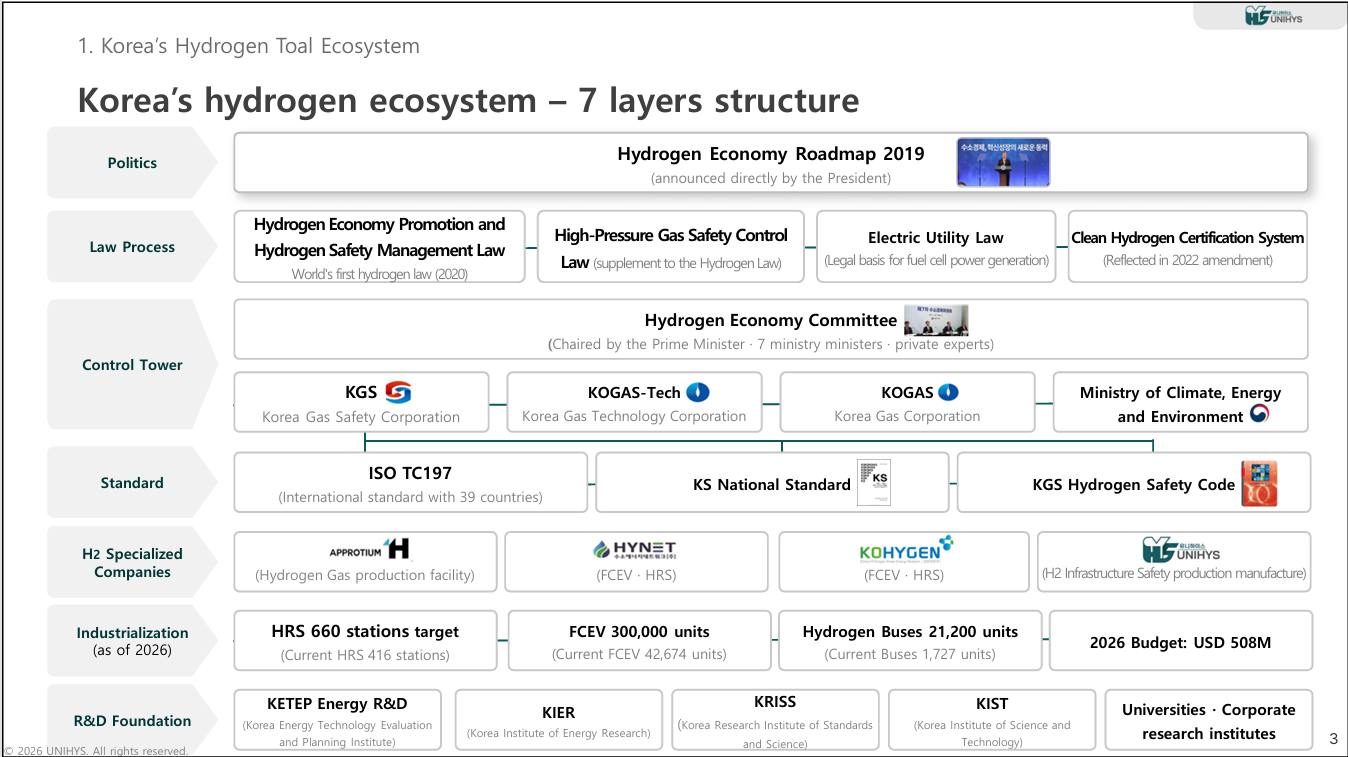
1. Korea's Hydrogen Ecosystem – A 7-Layer Structure
UNIHYS introduced Korea's hydrogen ecosystem with 7 layers, including:
-
Technology
-
Pilot / Demonstration
-
Legal – Regulation
-
Market – Industrialization
-
Standards
-
Safety
-
International Cooperation
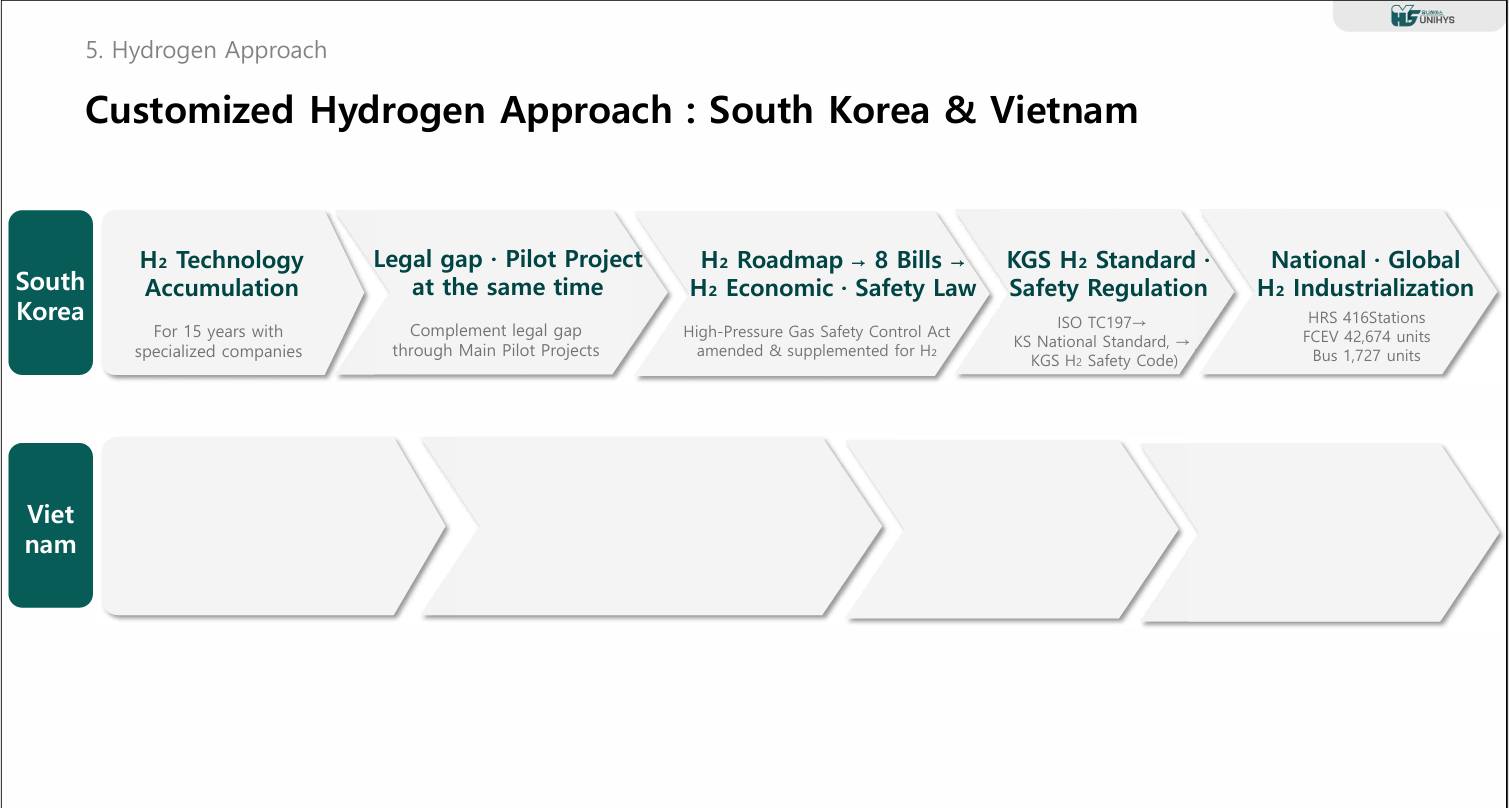
The key characteristic of Korea's approach is that technology came first, followed by law. Specialized companies with over 15 years of accumulated technology (Hyundai, SK, POSCO, Hanwha, Hyosung) existed early on, enabling pilot projects to be launched even without dedicated legislation.
2. Pilot Development Process – The Foundation for Law
First Hydrogen Refueling Station Pilot (2006):
-
R&D program launched in September 2003
-
First HRS built at the Korea Institute of Energy Research (KIER) on a 20m x 15m site
-
Production capacity: 20 Nm³/hour – enough to refuel 5 passenger vehicles/day
-
Completed and fully operational from August 2006
First Hydrogen Bus Pilot (2018):
-
October 22, 2018: Ulsan City Bus Route No. 124 (56 km round trip) introduced 1 hydrogen bus
-
Result: 1 hydrogen bus purifies fine dust equivalent to 40 mid-sized diesel vehicles
-
Later expanded nationwide
These real-world pilot data became the scientific basis for Korea's National Assembly to draft and pass the hydrogen law.
3. Hydrogen Law Development – A Historic Milestone
Key timeline:
-
January 2019: President of Korea announced the "Hydrogen Economy Roadmap" , defining the "hydrogen economy" as an economic-industrial structure where hydrogen becomes a major energy source, fundamentally changing national, social, and daily life.
-
January 2020: 8 hydrogen bills (6 on economy, 2 on safety) submitted to the National Assembly. All 8 were passed unanimously on January 9, 2020.
-
February 2021: Law partially took effect.
-
October 1, 2025: The Hydrogen Economy Promotion and Hydrogen Safety Management Act (abbreviated: Hydrogen Act) fully entered into force.
Core content of Korea's Hydrogen Act:
-
Purpose (Article 1): Establish a foundation to promote the hydrogen economy, systematically foster the hydrogen industry, and ensure public safety.
-
Definition of "Hydrogen Economy" (Article 2): An economic-industrial structure where hydrogen production and utilization drive fundamental changes across the nation, society, and people's daily lives, becoming a new engine of economic growth.
-
Definition of "Hydrogen Industry": Includes production, storage, transport, charging, sale of hydrogen, as well as manufacturing equipment such as fuel cells and hydrogen gas turbines.
-
"Clean Hydrogen" concept (added in 2026): Includes carbon-free hydrogen (zero emissions during production) and low-carbon hydrogen.
Competent authority: Ministry of Climate, Energy and Environment (effective October 1, 2025).
4. Standardization Process Based on ISO TC 197 and KGS
Korea has built its Korea Gas Safety Code (KGS) system for hydrogen based on ISO TC 197 (Hydrogen Technologies) , adapted to domestic conditions.
Notable KGS codes include:
-
KGS AC417: Code for manufacturing non-metal liner composite cylinders for compressed hydrogen transport
-
KGS FP217: Performance certification standard for hydrogen tube trailer filling hose
-
KGS FU671: Code for the use of hydrogen gas
The standardization process develops in parallel with pilots and law, creating a synchronized system from technology to safety.
5. Customized Approach for Vietnam – Lessons from Korea
The most important highlight of the presentation was the strategic comparison between the two countries:
| Criteria | South Korea | Vietnam |
|---|---|---|
| Strategy | Technology created the law | The law can bring in the technology |
| Characteristics | Specialized companies with 15+ years of technology accumulation already existed before legislation. This made it possible to launch pilot projects even without laws. Those pilot results became the direct foundation that led to the law. | Technology will be brought in through global cooperation. Data and experience will accumulate during implementation. The foundation for safety regulation will be established throughout this process. |
UNIHYS's message to Vietnam:
"Vietnam can follow the reverse path: Instead of waiting for fully indigenous technology, proactively build or run parallel the legal framework first, then attract technology and capital from pioneering countries such as Korea, Japan, and Europe. Real operational data will then serve as the basis for refining safety regulations."
This strategic suggestion is highly relevant to Vietnam's current context, where Decision No. 165/QĐ-TTg on the Hydrogen Energy Development Strategy has been issued, but a dedicated legal framework is still in its early stages.
6. Conclusion and Vietnam–Korea Cooperation Outlook
The presentation concluded with the message of "Harmonization" – harmonizing technology, law, and standards across countries. UNIHYS affirmed its readiness to accompany Vietnam in:
-
Transferring electrolysis and hydrogen storage technologies
-
Supporting the development of technical regulations based on KGS experience
-
Piloting medium-scale hydrogen demonstration projects in Vietnam
-
Training human resources in hydrogen operation and safety
The forum ended with a note of thanks from VAHC and UNIHYS: "Thank you, Xin cảm ơn" – opening a new chapter in clean energy cooperation between Vietnam and Korea, advancing toward the Net Zero goal by 2050.
Find the video clip of presentation by Dr. Kim
Part 1: https://www.youtube.com/watch?v=QOBzTfJzUnA&t=19s
Part 2: https://www.youtube.com/watch?v=9LjA7_x1LTs