
UNIDO's Hydrogen Support Mechanisms and Recommendations for Vietnam
Date: August 2, 2026
By Annie Nguyễn
1. Overview of UNIDO's Global Hydrogen Programme
The United Nations Industrial Development Organization (UNIDO) launched its Global Programme for Hydrogen in Industry (GPHI) in 2021, with support from the Governments of Austria, Germany, and Italy. The programme's goal is to support a just hydrogen transition in developing countries, with a focus on social and environmental considerations.
UNIDO is currently implementing hydrogen projects in more than 13 countries, including Algeria, Brazil, China, Egypt, Ecuador, Malaysia, Morocco, Namibia, Nigeria, Pakistan, Philippines, South Africa, and Tunisia.
1.1. Key Programmes and Initiatives
GEF-8 Global Clean Hydrogen Programme
This is UNIDO's flagship programme, with $15.8 million** in GEF funding and **$213.5 million in co-financing. The programme targets 9 countries: Algeria, Ecuador, Egypt, Malaysia, Namibia, Nigeria, Pakistan, Philippines, and South Africa . Its focus areas include:
-
Enhancing national institutional capacities
-
Creating enabling policy frameworks
-
Improving technological readiness
-
Designing financial mechanisms and risk mitigation strategies
-
Fostering collective learning and knowledge sharing on clean hydrogen production and application
A2D Facility (Accelerate-to-Demonstrate)
This is a funding facility managed by UNIDO, supported by the UK Government's Ayrton Fund. It provides grants from $1-5 million for large-scale demonstration projects in clean energy and industrial decarbonization, including green hydrogen and CCUS solutions.
International Hydrogen Trade Forum (IHTF)
UNIDO coordinates this forum to promote harmonization of standards, certification systems, and cross-border trade frameworks for hydrogen.
International Hydrogen Innovation and Partnership Competition (IHIPC)
UNIDO co-organizes this annual competition with the International Hydrogen Energy Center (IHEC) in China to identify and develop startup and innovation projects in the hydrogen sector.
2. Evidence of UNIDO Cooperation with ASEAN Countries
2.1. Malaysia: Official UNIDO Country Project
Malaysia is one of the 9 participating countries in UNIDO's GEF-8 Global Clean Hydrogen Programme.
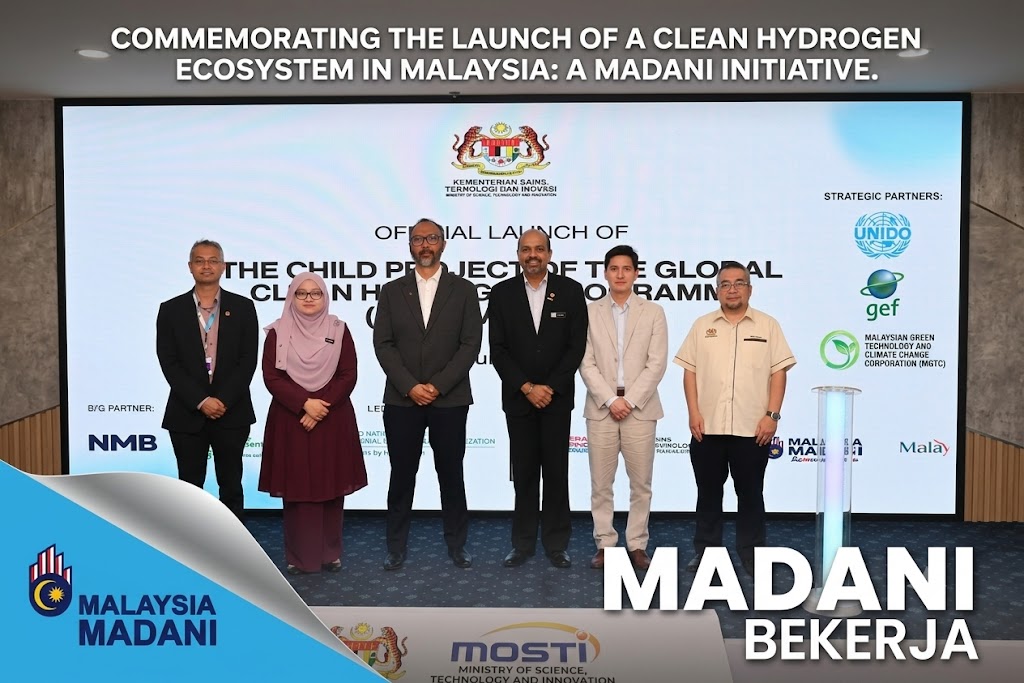
Project Launch: On July 10, 2026, Malaysia officially launched its country project under the Global Clean Hydrogen Programme (GCHP Malaysia).
Implementing Partners:
-
Lead Agency: NanoMalaysia Berhad (NMB), a company limited by guarantee under the Ministry of Science, Technology and Innovation (MOSTI).
-
Strategic Partner: Ministry of Natural Resources and Environmental Sustainability (NRES), serving as Malaysia's GEF Operational Focal Point.
Project Activities:
-
Strengthening the national clean hydrogen ecosystem through policy and standards development
-
Capacity building
-
Industry collaboration
-
Knowledge sharing
-
Aligning with Malaysia's Hydrogen Economy and Technology Roadmap (HETR) and National Energy Transition Roadmap (NETR)
Malaysia's Hydrogen Targets:
-
100 MW installed electrolyser capacity by 2025
-
500 MW by 2030
-
50,000 tons of clean hydrogen production annually by 2030 (primarily for export)
-
Contribution of over $1.5 billion to GDP by 2030
Key Projects:
-
Sarawak Hydrogen Hub: Expected to begin operations by 2027, leveraging hydro capacity to supply markets such as South Korea and Japan.
-
Samalaju Hydrogen Plant: SEDC Energy, H2X Global, and Thales New Energy.
-
H2Biscus: Samsung Engineering, Lotte Chemical, Korea National Oil Corporation, and SEDC Energy.
-
Mobile Hydrogen Refuelling Station: NanoMalaysia, MOSTI, Petronas, and Toyota.

2.2. Philippines: Official UNIDO Country Project
The Philippines is also a participating country in UNIDO's GEF-8 Global Clean Hydrogen Programme.
Project Dates: March 2024 - December 2029.
Budget: $1,050,000.
Project Objectives:
-
Enhancing national institutional capacities
-
Enabling policy frameworks
-
Improving technological readiness at industrial level
-
Developing financial mechanisms for successful clean hydrogen uptake
Context: The Philippines faces challenges from a rapidly growing population and energy demand. It has one of the highest concentrations of geothermal power in Asia, plus wind and hydropower potential, but remains heavily dependent on imported fossil fuels . Clean/green hydrogen presents an opportunity to improve national energy security and local industrial development.

2.3. Indonesia: National Projects and UNIDO Engagement
While Indonesia is not one of the 9 countries in the GEF-8 Global Clean Hydrogen Programme, it has significant hydrogen development activities and engagement with UNIDO.
UNIDO Engagement:
-
The A2D Facility held a global workshop in Indonesia in 2025, focusing on clean hydrogen and industrial decarbonization.
-
Indonesia is included in UNIDO's broader hydrogen cooperation discussions.
Indonesia's Hydrogen Projects:
-
Pertamina Green Hydrogen Projects:
-
Solar PV-Hydrogen Project at Refinery Unit III, Palembang: Using a 2.25 MWp solar farm to produce green hydrogen, replacing grey hydrogen for polypropylene production.
-
Hydrogen Refuelling Station (HRS) at Senayan: Operational since February 2024.
-
Green Hydrogen Plant (GHP) at PLTP Kamojang: Operational since February 2024.
-
21 GHP facilities across Indonesia: Operational since November 2023.
-
GHP for Pupuk Kujang: Planned for 2026.
-
-
Pertamina and Hyundai Motor Project: Conceptual study through Q1 2025, with EPC completion in 2026 and target COD in 2027.
-
National Hydrogen and Ammonia Roadmap: The government estimates green hydrogen generation will be introduced in 2031, gradually increasing to approximately 52 GW by 2060 (10% of the power mix).
-
International Cooperation:
-
Signed MoC with Japan on energy cooperation for realistic energy transitions.
-
Japan announced intentions to mobilize resources under AZEC cooperation.
-
German-Indonesian Chamber of Industry and Commerce (EKONID) launched the Hydrogen Business Desk (HBD) in 2022.
-
2.4. Brunei: UNIDO-Relevant Hydrogen Activity
While not a direct UNIDO programme participant, Brunei has significant hydrogen activity:
-
AHEAD Project: With funding from Japan's NEDO, Brunei successfully completed trials of the world's first international shipment of Methylcyclohexane (MCH) and stable hydrogen extraction in 2020 .
-
Brunei has also concluded MOUs with Japan and Singapore on hydrogen supply chain cooperation.
2.5. Singapore: National Hydrogen Strategy
-
Launched its National Hydrogen Strategy in October 2022.
-
Concluded cooperation arrangements with Japan, Australia, New Zealand, and Chile.
-
Corporate-level MOUs to explore hydrogen supply chains using different hydrogen carriers.
3. Recommendations for Vietnam
Based on UNIDO's mechanisms and ASEAN country experiences, VAHC proposes the following recommendations:
| Recommendation | Specific Actions | Potential Partners |
|---|---|---|
| 1. Join the GEF-8 Global Clean Hydrogen Programme | Propose to UNIDO and GEF for Vietnam to become the 10th participating country. Develop project proposals for green hydrogen in hard-to-abate sectors (steel, cement, chemicals) and green ammonia for fertilizer production. | UNIDO, GEF, MOIT, MONRE |
| 2. Submit proposals through the A2D Facility | Prepare large-scale demonstration projects (MW-scale) for renewable hydrogen electrolysis. Submit proposals based on UNIDO's call cycles (deadlines are often short; be prepared). | UNIDO, UK Government (Ayrton Fund), Vietnamese hydrogen enterprises |
| 3. Participate in the IHTF | Send representatives to IHTF meetings to update on international standards and certification. Propose Vietnam as a pilot country for hydrogen trade standards. | UNIDO, MOIT, industry associations (VAHC) |
| 4. Apply UNIDO's Sustainable Hydrogen Project Guidelines | Use UNIDO's guidelines to develop an assessment framework for hydrogen projects in Vietnam. Attract international investment by ensuring compliance with equitable and sustainable standards. | UNIDO, MOIT, international investors |
| 5. Leverage UNIDO's policy support | Request UNIDO assistance in finalizing the National Hydrogen Strategy and related policies. Use UNIDO's Policy Toolkit to design support mechanisms for hydrogen projects. | UNIDO, MOIT, MPI |
| 6. Participate in the IHIPC competition | Encourage Vietnamese startups, research institutes, and universities to participate in the annual competition. Leverage opportunities to connect with global investors and enterprises. | IHEC, UNIDO, VAHC |
| 7. Coordinate with UNIDO within the JETP framework | Propose UNIDO technical assistance for developing decarbonization roadmaps for heavy industries (steel, cement). Develop green hydrogen projects to receive JETP support ($15.5 billion committed by international partners). | UNIDO, JETP Secretariat, MOIT |
| 8. Cooperate with IHEC in China | Leverage cooperation opportunities with IHEC through UNIDO to access advanced hydrogen technologies. Participate in training and technical exchange programs organized by IHEC. | UNIDO, IHEC, VAHC, Vietnamese research institutes |
4. Conclusion
UNIDO, through the GEF-8 Global Clean Hydrogen Programme, A2D Facility, and GPHI, is playing a critical role in promoting hydrogen development in developing countries. Malaysia, the Philippines, and Indonesia have already engaged with UNIDO's mechanisms:
-
Malaysia officially launched its GCHP country project in July 2026, led by NanoMalaysia Berhad under MOSTI.
-
The Philippines has a $1.05 million country project under GCHP running from 2024-2029.
-
Indonesia has hosted A2D Facility workshops and is actively developing Pertamina-led green hydrogen projects.
Vietnam has a long-standing cooperation relationship with UNIDO (since 1985, approximately 170 projects) and has already proposed priority areas including green hydrogen and CCUS. To maximize UNIDO's support mechanisms, Vietnam should:
-
Proactively develop and submit specific project proposals to join the GEF-8 Global Clean Hydrogen Programme
-
Strengthen coordination with UNIDO within the JETP framework to realize international financial commitments
-
Actively participate in international forums coordinated by UNIDO (IHTF) to update standards and build Vietnam's position in global hydrogen trade
-
Leverage UNIDO's technical and policy support to complete the legal framework and attract foreign investment
With its established strategic partnership and mutual commitment, Vietnam has a significant opportunity to become a pioneering country in Southeast Asia for developing a sustainable and equitable hydrogen industry with UNIDO's support.