

The Role of Hydrogen in Vietnam's Oil Refining and Upstream Oil & Gas Industry
July 9, 2026 | VAHC Secretariat
Beyond the fertilizer, chemical, and mining sectors, hydrogen plays an indispensable role in oil refining – the second-largest industrial hydrogen consumer in Vietnam, after fertilizer production. This article analyzes current and future hydrogen demand in the oil and gas sector, along with the potential for transitioning to clean hydrogen.
1. The Role of Hydrogen in Oil Refining
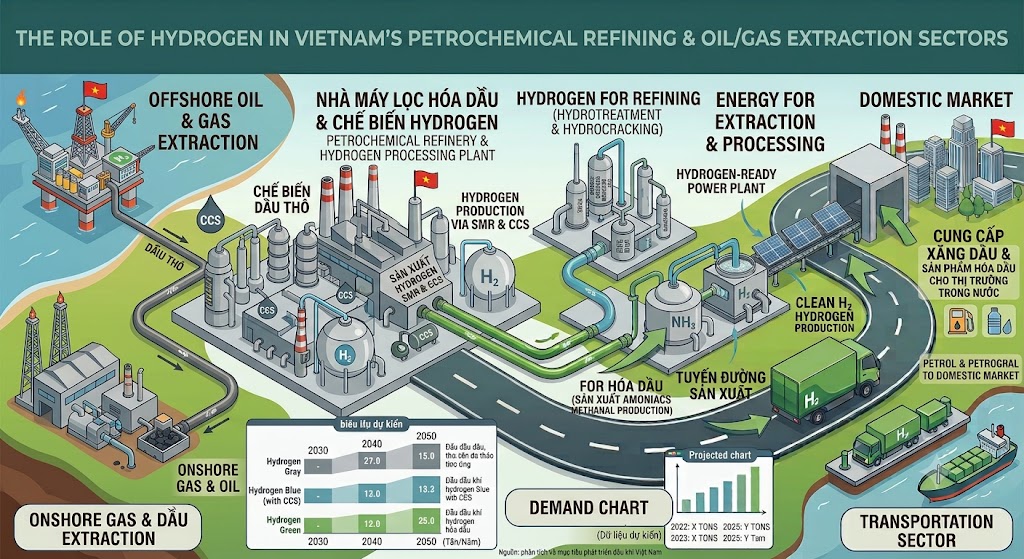
Hydrogen is a critical feedstock in product upgrading and fuel treatment processes. Key applications include:
-
Hydrotreating: Removing sulfur, nitrogen, and oxygen impurities from petroleum products to produce cleaner fuels that meet increasingly stringent emission standards.
-
Hydrocracking: Breaking heavy hydrocarbon molecules into lighter products like gasoline and diesel, while adding hydrogen to stabilize the products.
-
Chemical production: Hydrogen is a feedstock for various petrochemical processes, including methanol and intermediate compound production.
-
Impurity removal: Deactivating metal oxides and saturating unsaturated compounds.
The global refining industry is moving toward ultra-low sulfur products, driving higher hydrogen demand. In modern refineries, hydrogen consumption is concentrated in hydrotreating and hydrocracking units.
2. Current Hydrogen Demand in Vietnam
According to data from the Ministry of Industry and Trade and PetroVietnam (PVN), current hydrogen demand in oil refining is concentrated at the country's two major refineries:
| Refinery | H₂ Consumption (tons/year) | Notes |
|---|---|---|
| Dung Quất | ~39,000 | Undergoing expansion |
| Nghi Sơn | ~139,000 | Commissioned in 2018 |
| Total | ~178,000 |
Data from multiple sources confirm these figures. Ministry of Industry and Trade reports show Dung Quất consumes approximately 39,000 tons H₂/year and Nghi Sơn consumes 139,000 tons/year. This hydrogen is currently primarily gray hydrogen produced from natural gas or refinery by-products.
Dung Quất Refinery Upgrade Project:
Dung Quất is undergoing expansion and upgrade with total investment of approximately $1.3 billion USD, expected to be completed in Q1/2028. The project includes a new Hydrogen Manufacturing Unit with design capacity of 22,676 m³/h (approximately 17,000-18,000 tons/year). The technology is licensed by KT Tech (part of Maire Tecnimont), using steam methane reforming (SMR) and integrating carbon capture technology, aiming for lower-carbon hydrogen production.
3. Hydrogen Demand Forecast for Oil Refining to 2050
Market Size:
According to research reports, total hydrogen demand in Vietnam is forecast to reach approximately 4,000 KTA (kilotons per annum) by 2050 . Oil refining will continue to be a key driver of this growth.
An ERIA (Economic Research Institute for ASEAN and East Asia) study forecasts hydrogen demand in Southeast Asia's refining sector:
-
"Frozen" Scenario (no policy change): Increases from 1,168 KTPA (2020) to 2,926 KTPA by 2050, with compound annual growth rates of 5.2% (2020-2030) and 2.1% (2030-2050) .
-
Growth is driven by rising refining product demand (~3%/year) and new refinery expansion projects in Indonesia, Thailand, Singapore, Malaysia, Vietnam, and Brunei .
-
Notably: Vietnam has the highest fuel demand growth rate in the region (12.2%/year during 2015-2020) , and is forecast to maintain strong growth in the coming decades.
-
Energy Transition Scenario (APS - Announced Pledges Scenario): Hydrogen demand could peak and decline after 2030 due to transport electrification and reduced oil demand, but will simultaneously shift toward clean (green/blue) hydrogen as a replacement.
4. Opportunities for Transition to Clean Hydrogen
Current Hydrogen Production in Oil Refining:
Hydrogen is currently produced primarily via steam methane reforming (SMR) of natural gas – classified as gray hydrogen, with significant CO₂ emissions. Refineries like Dung Quất and Nghi Sơn produce hydrogen for internal use and also consume some from external sources.
Transition Pathways:
-
Blue hydrogen: The Dung Quất upgrade project is integrating CO₂ capture technology into the new hydrogen production unit, aiming for blue hydrogen production. This is an appropriate transitional step, leveraging existing infrastructure and reducing emissions.
-
Green hydrogen: In the long term, refineries can transition to hydrogen produced from water electrolysis using renewable electricity. This requires the development of green power sources and reduced production costs.
-
PVN's role: PetroVietnam (PVN) has developed a scientific research program on hydrogen production, storage, transport, and utilization in Vietnam for the 2021-2025 period, indicating a strategic interest in clean hydrogen development.
5. Current and Forecast Hydrogen Demand Summary
| Sector | Current H₂ (KTA) | H₂ 2030 (forecast) | H₂ 2050 (forecast) |
|---|---|---|---|
| Oil Refining | ~178 | 200-250 | 190-260 |
| Fertilizer | ~316 | 350-400 | 400-450 |
| Other sectors (chemicals, steel, mining, transport...) | ~6 | 50-100 | 3,300-3,500 |
| Total | ~500 | ~600-750 | ~3,900-4,200 |
Sources: Compiled from .
Key observation: While hydrogen demand in oil refining and fertilizer is not forecast to surge dramatically, these are stable and significant-scale markets, providing a solid foundation for developing clean hydrogen production in the early stages. The Dung Quất blue hydrogen project is a prime example of this transition pathway.
6. Implications for the National Clean Hydrogen Strategy
-
Oil refining as a stable clean hydrogen market: With current demand of ~178,000 tons H₂/year, the oil and gas sector can serve as a "bridge" for clean hydrogen production, similar to Germany's strategy with green hydrogen in oil refineries.
-
Dung Quất project paves the way for blue hydrogen: The integration of CO₂ capture in the new Dung Quất hydrogen unit demonstrates the feasibility of blue hydrogen as a transitional solution.
-
Opportunity to replace gray with green hydrogen: Leveraging Vietnam's abundant renewable energy resources, the country can move toward green hydrogen production to gradually replace gray hydrogen in refineries, reducing emissions across the entire oil and gas value chain.
-
Integration recommendation: Include oil refining and upstream oil & gas among the priority hydrogen-consuming sectors in the National Hydrogen Strategy implementation roadmap, with a transition pathway from gray → blue (2030-2040) → green (2040-2050).