

The Role of Ammonia in Food Production and Demand for Monosodium Glutamate (MSG) Manufacturing in Vietnam
July 9, 2026 | VAHC Secretariat
Beyond the mineral extraction industry, ammonia (NH₃) is an essential input in the food production sector, particularly in the manufacture of monosodium glutamate (MSG). This article analyzes the role of ammonia in MSG production and estimates the ammonia demand for this industry in Vietnam.
1. The Role of Ammonia in MSG Production
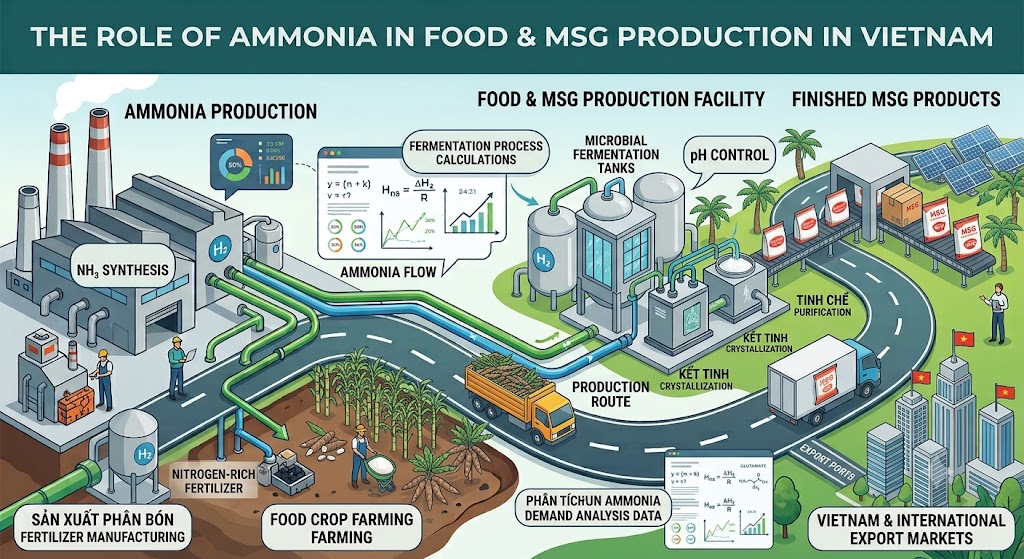
Ammonia serves as a nitrogen source in the fermentation process for glutamic acid production. Modern MSG production technology utilizes microbial fermentation, in which bacteria such as Corynebacterium glutamicum or Micrococcus glutamicus are cultured in an ammonia-rich medium to synthesize glutamic acid.
Basic MSG Production Process:
-
Fermentation: Bacteria are cultured in a medium containing sugar (from cassava starch, molasses) and ammonia as a nitrogen source.
-
Neutralization and Extraction: Glutamic acid is neutralized with sodium hydroxide to form sodium glutamate (MSG).
-
Purification: Crystallization and separation of MSG from the solution.
According to patents and technical literature, 1 mole of MSG produced consumes 1 mole of ammonia (1:1 molar ratio). However, the actual fermentation efficiency only reaches about 30-50% for input materials, meaning a significant amount of ammonia is not converted into the final product but remains in the fermentation broth.
2. Ammonia Emissions in MSG Production
A key characteristic of MSG production is the loss and emission of ammonia into the environment. Quantitative studies show:
-
The highest NH₃ emission occurs during fermentation, reaching up to 880 mg/(L·min).
-
NH₃ emissions have a linear relationship with ammoniacal nitrogen concentration in wastewater.
This means the actual ammonia demand for MSG production is significantly higher than the chemically bound ammonia in the final product, due to losses during fermentation and wastewater treatment.
3. Scale of MSG Production in Vietnam
Vietnam is one of the world's leading MSG producers, with approximately 90,000 tons of annual capacity. Major producers include:
| Producer | Capacity (tons/year) | Notes |
|---|---|---|
| Vedan Vietnam | Tens of thousands | Largest MSG producer in Southeast Asia |
| Daesang (MiWon) | 35,000 | MSG capacity in Vietnam |
| Ajinomoto | Undisclosed | Present in Vietnamese market |
Total MSG capacity in Vietnam is estimated at approximately 90,000-100,000 tons/year, with products consumed both domestically and exported.
4. Estimated Ammonia Demand for MSG Production
Based on consumption ratios and actual production, estimates can be made:
Method 1: Molar Ratio (Theoretical)
-
1 ton MSG ≈ 5.92 kmol MSG → consumes ≈ 5.92 kmol NH₃ ≈ 100.6 kg NH₃/ton MSG
-
At 90,000 tons MSG/year → theoretical NH₃ demand: ~9,050 tons NH₃/year
Method 2: Actual Plant Design (Including Losses)
-
MSG plant designs for 38,000-70,000 tons/year show NH₃ demand of approximately 10,000-20,000 tons/year.
-
At 90,000 tons/year → actual NH₃ demand: ~15,000-25,000 tons NH₃/year (including losses)
Summary Estimate:
| Method | NH₃ (tons/ton MSG) | Estimated NH₃ (tons/year) |
|---|---|---|
| Theoretical (1:1 molar) | 0.101 | 9,050 |
| Actual (with losses) | 0.17-0.28 | 15,000-25,000 |
Conclusion: Ammonia demand for MSG production in Vietnam is estimated at approximately 15,000-25,000 tons NH₃/year, equivalent to a clean hydrogen demand of approximately 2,650-4,400 tons H₂/year (at a ratio of 1 ton H₂ ≈ 5.67 tons NH₃).
5. Total Ammonia Demand for Key Industries in Vietnam
| Industry | Estimated NH₃ (tons/year) | Converted H₂ (tons/year) |
|---|---|---|
| Coal mining explosives | 75,000-88,000 | 13,200-15,500 |
| Stone mining explosives | ~3,400 | ~600 |
| MSG production | 15,000-25,000 | 2,650-4,400 |
| Total | ~93,000-116,000 | ~16,500-20,500 |
6. Implications for the National Clean Hydrogen Strategy
Significant Scale: Ammonia demand for MSG production adds approximately 15-20% to the current total demand for mineral extraction, raising the total to 93,000-116,000 tons NH₃/year.
Stable Market: MSG production is a stable industry with continuous food consumption demand, suitable to serve as a "bridge" for clean hydrogen in the early stages.
Emission Reduction Opportunity: Ammonia used in MSG production currently comes primarily from natural gas or imports. Switching to green ammonia would significantly reduce carbon emissions for the food industry.
Integration Recommendation: Include the food production (MSG) and fertilizer sectors among the priority ammonia-consuming industries in Vietnam's National Hydrogen Strategy implementation roadmap.