
The Role of Ammonia in Fertilizer Production and Demand for the Fertilizer Industry in Vietnam
July 9, 2026 | VAHC Secretariat
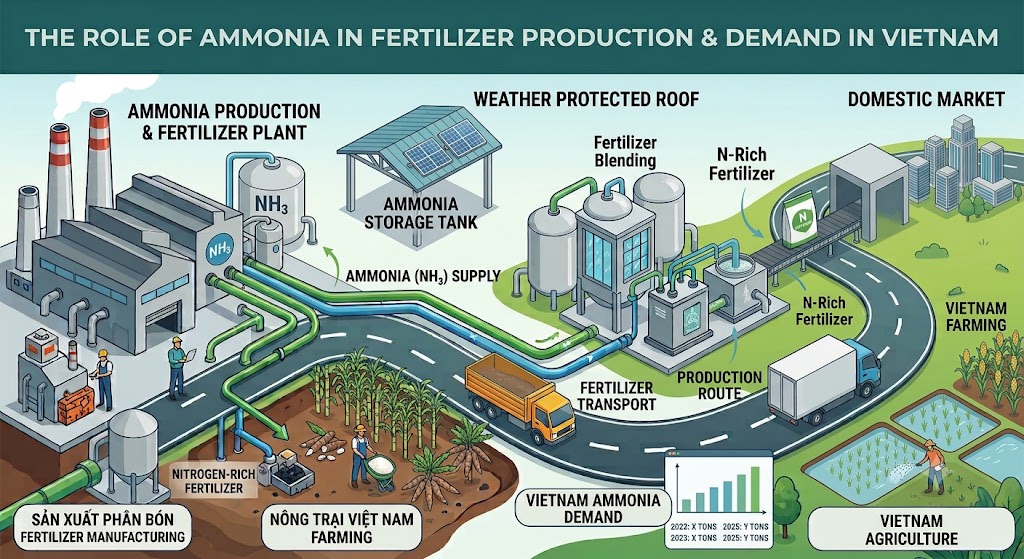
Beyond mineral extraction and food production, ammonia (NH₃) is an indispensable input in fertilizer production – the largest ammonia-consuming sector in Vietnam. This article analyzes the role of ammonia in fertilizer production and estimates the ammonia demand for this industry, thereby assessing the potential for transitioning to green ammonia within the national hydrogen strategy.
1. The Role of Ammonia in Fertilizer Production
Ammonia is the primary input for producing nitrogen-based fertilizers, particularly urea (CO(NH₂)₂), ammonium nitrate (NH₄NO₃), DAP (diammonium phosphate), and NPK .
Basic fertilizer production processes:
-
Urea: Ammonia reacts with CO₂ under high pressure and temperature to form urea: 2NH₃ + CO₂ → CO(NH₂)₂ + H₂O.
-
Ammonium nitrate: Ammonia is neutralized with nitric acid to form NH₄NO₃, used directly as fertilizer or as raw material for explosives.
-
DAP: Ammonia reacts with phosphoric acid to form (NH₄)₂HPO₄.
Natural gas is the primary input for ammonia production . Vietnam currently has 4 large urea plants with a total capacity of approximately 2.6 million tons/year .
2. Scale of Fertilizer Production and Ammonia Demand in Vietnam
2.1. Urea Production
| Plant | Capacity (million tons urea/year) |
|---|---|
| Phu My Urea | ~0.8 |
| Ca Mau Urea | ~0.8 |
| Ha Bac Urea | ~0.5 |
| Ninh Binh Urea | ~0.5 |
| Total | ~2.6 |
In the first 9 months of 2025, Phu My Urea produced over 682,000 tons of urea . Domestic urea demand is approximately 1.8 million tons/year, with the remainder exported .
2.2. Ammonia Demand for Fertilizer Production
Total ammonia demand for Vietnam's fertilizer industry is estimated as follows:
| Fertilizer | Production (million tons/year) | NH₃ consumption (million tons/year) |
|---|---|---|
| Urea | 2.6 | 1.3 – 1.5 |
| DAP/NPK | 0.3 – 0.5 | 0.2 – 0.3 |
| Ammonium nitrate (fertilizer) | 0.2 – 0.3 | 0.1 – 0.2 |
| Total | 3.1 – 3.4 | 1.6 – 2.0 |
Additionally, Vietnam uses approximately 9 – 10.5 million tons of inorganic fertilizers annually, with nitrogen fertilizers accounting for the largest share . Total ammonia demand for the fertilizer industry is estimated at 2.0 – 2.6 million tons NH₃/year .
3. Imported and Domestically Produced Ammonia Demand
In 2022, Vietnam's ammonia market reached $891 million USD, with consumption of approximately 1.5 million tons . In 2024, Vietnam imported approximately 111,358 tons of anhydrous ammonia worth $73.6 million USD, primarily from Indonesia and China .
To secure domestic supply, Vinacomin is investing in a 90,000 tons/year ammonia plant in Hung Yen to meet demand for the Thai Binh ammonium nitrate plant .
4. Total Ammonia Demand and Green Ammonia Transition Potential
| Sector | Estimated NH₃ (million tons/year) | H₂ equivalent (million tons/year) |
|---|---|---|
| Fertilizer | 2.0 – 2.6 | 0.35 – 0.46 |
| Chemical industry | 0.3 – 0.4 | 0.05 – 0.07 |
| Mining (explosives) | 0.08 – 0.09 | 0.014 – 0.016 |
| Total | ~2.4 – 3.1 | ~0.42 – 0.55 |
Green ammonia demand forecast:
| Timeline | Green ammonia share | Green ammonia volume (million tons/year) | Electrolysis capacity (GW) |
|---|---|---|---|
| 2025 | ~5% | ~0.15 | 0.18 |
| 2035 | 20-25% | ~0.8 | ~1.0 |
| 2045 | 50-60% | 2.5 – 3.0 | 3.0 – 3.5 |
Producing 1 ton of green ammonia requires approximately 9.5 MWh of renewable electricity . By 2045, if 50-60% of ammonia demand shifts to green ammonia, Vietnam would need approximately 3.0 – 3.5 GW of electrolysis capacity .
5. Implications for the National Clean Hydrogen Strategy
-
Massive scale: The fertilizer industry accounts for 80-85% of Vietnam's total ammonia demand, with consumption of 2.0 – 2.6 million tons NH₃/year. This represents a potential clean hydrogen market of approximately 0.35 – 0.46 million tons H₂/year.
-
Stable and growing market: Fertilizer demand continues to grow steadily with the agricultural sector . Vietnam's ammonia market is projected to grow at a CAGR of approximately 9.2% during 2025-2035, reaching $6.99 billion USD by 2035 .
-
Import substitution opportunity: Vietnam currently depends partially on ammonia imports . Transitioning to domestic green ammonia would reduce import dependence, enhance energy security, and lower emissions.
-
Integration recommendation: Prioritize the fertilizer industry as the top ammonia-consuming sector in Vietnam's National Hydrogen Strategy implementation roadmap, with a transition timeline:
-
2030: 5-10% green ammonia in fertilizer production
-
2040: 30-40% green ammonia
-
2050: 50-60% green ammonia
-
-
Integration with Power Development Plan VIII: Utilize surplus renewable electricity from solar and wind potential regions (Central, Central Highlands, Southern regions) for green hydrogen production, serving existing fertilizer plants (Phu My, Ca Mau, Ha Bac, Ninh Binh) and new projects.
6. Conclusion
Ammonia demand for fertilizer production in Vietnam is currently 2.0 – 2.6 million tons NH₃/year, accounting for over 80% of total national ammonia demand. This is the largest and most stable market, warranting the top priority in the National Hydrogen Strategy implementation roadmap. Transitioning to green ammonia for the fertilizer sector would create the most significant demand driver for the clean hydrogen supply chain, contributing to Vietnam's Net Zero 2050 target and reducing dependence on imported raw materials.