

The Korea-Vietnam WtE-PV-SOEC Microgrid Research Project: A Technological Leap or a Long-Term Economic Challenge?
November 1, 2026
Annie Nguyen, VAHC Secretariat
Project Authoer: Dr. Bui Viet Tuan Anh from the Korean Institute of Material and Machinery (KIMM)
We invite interested university partners and project owners to contact us at: contact@vahc.com.vn. VAHC is currently establishing a Vietnamese research team and project owner group to collaborate with a leading Korean energy institute to secure funding for this project.
As Vietnam strives to realize its Net Zero emissions targets and seeks clean energy solutions, an ambitious demonstration project titled "WtE-PV-SOEC Korea-Vietnam Microgrid (2027–2030)" has been proposed by a research team at the Korea Institute of Machinery and Materials (KIMM) alongside Vietnamese partners. This proposal is not merely a technical project but a strategic test of the feasibility of Solid Oxide Electrolysis Cell (SOEC) technology within Vietnam's energy landscape.
1. Project Architecture: Maximizing Existing Resources
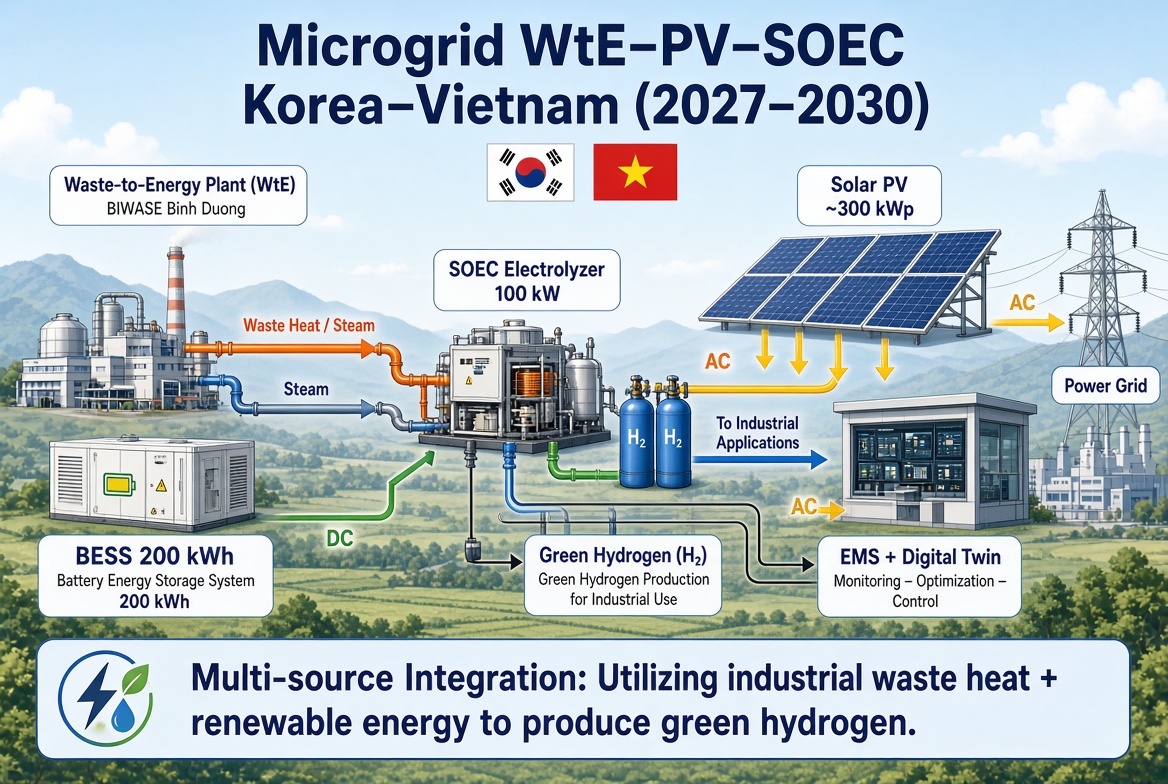
The most innovative aspect of the project is its integration of multiple energy sources within a small-scale microgrid ($4.9 million, 36 months). Instead of building entirely new infrastructure, the project utilizes an existing waste-to-energy (WtE) incineration plant (assumed at the Nam Binh Duong Solid Waste Treatment Complex - Biwase or another province with equivalent scale).
The system configuration includes:
100 kW SOEC Electrolyzer: Utilizes steam extracted from the WtE turbine and grid electricity.
~300 kWp Solar PV: Supplements daytime power.
200 kWh Battery Storage (BESS): Smooths loads and supports operations.
EMS and Digital Twin: Manages and optimizes operations.
Notably, the project does not claim SOEC is the cheapest solution today. At the 100 kW scale, PEM and ALK technologies still have lower capital costs. However, SOEC was chosen as it is the only pathway to utilize industrial waste steam, aiming for the highest efficiency and lowest emissions.
2. Economic Analysis: LCOH and the Competitiveness Equation
According to the research team's calculations, at a base scenario scaled to 1 MW (10 modules), the estimated Levelized Cost of Hydrogen (LCOH) is approximately **$9.8/kg**. This figure is currently significantly higher than PEM ($8.8/kg) and ALK ($7.4/kg).
The primary reason is the capital expenditure (CAPEX) of SOEC and the shorter lifespan of the stack. However, the project sets a clear pathway for SOEC to compete:
CAPEX needs to drop to ≤ $2,000/kW.
Stack lifespan needs to reach ≥ 26,000 hours with a replacement cost of ≤ $700/kW.
The project also demonstrates an SOEC advantage: due to its ability to reduce load with almost no efficiency loss, the system can concentrate production during off-peak hours (cheap electricity) to optimize operating costs. This is particularly suitable for Vietnam's new three-tier electricity tariff structure.
3. Challenges and Risks to Overcome
Despite its potential, the project faces several barriers:
Lack of legal framework for hydrogen safety: Vietnam currently lacks specific standards for small-scale hydrogen storage and operation, requiring the project to work closely with fire prevention authorities.
Offtake challenge: Finding hydrogen buyers (such as industrial zones in Binh Duong) is a crucial factor for financial viability.
Technical risks: Biwase's (the incineration plant owner) participation is not yet confirmed, and the waste quality (low calorific value) could affect the steam supply to the SOEC.
Stack degradation rate: If the stack degrades faster than expected (1%/kh instead of 0.5%/kh), the LCOH could surge to $11.7/kg.
4. Strategic Significance for Vietnam
This project is not only a technical trial but also a stepping stone to build domestic technological capacity. Through collaboration with universities (such as VNU-IS, HCMUT, HUTECH) and Korean enterprises, Vietnam can:
Train a specialized engineering workforce in hydrogen.
Build a real-world operational database for SOEC, PV, and BESS technologies.
Propose appropriate incentive policies (tax, land) for hydrogen energy.
Conclusion: The WtE-PV-SOEC Microgrid project is a correct and necessary direction for Vietnam to enter the hydrogen era. However, the project's success will depend on close coordination among stakeholders and the ability to realize technology cost reduction targets in the future.