

Techno-Economic Analysis of a PV–Hydrogen System: A Case Study in Vietnam
July 9, 2026 | Annie Nguyễn
Research Overview
A comprehensive study recently published in the journal Clean Energy (Volume 10, Issue 3, June 2026) has conducted a techno-economic assessment of photovoltaic (PV) systems combined with green hydrogen production at nine representative locations across Vietnam. The research, conducted by Van Tri Bui, My Hanh Pham, and Phuong Truong Le, developed a complete simulation framework on the MATLAB/Simulink platform, integrating solar radiation data, PV generation models, and electrolyzer performance to quantify energy yield and the Levelized Cost of Hydrogen (LCOH). This study is considered an important contribution to Vietnam's green hydrogen development strategy, especially as the country aims for net-zero emissions by 2050.
1. Background and Research Motivation
In the context of accelerating depletion of fossil fuel resources due to overexploitation, the need for viable sustainable energy alternatives has become urgent. Although battery electric vehicles (BEVs) have been widely promoted, this technology still faces limitations including long charging durations, underdeveloped charging infrastructure (especially in rural and remote areas), and environmental risks from lithium-ion battery disposal. In this context, green hydrogen produced from renewable energy sources like solar or wind has emerged as a promising alternative with advantages in refueling speed (minutes, comparable to internal combustion vehicles) and zero CO₂ emissions, with water vapor as the only byproduct.
2. Methodology and Modeling
2.1. System Description
The PV-hydrogen system consists of four main components: the PV system converting solar radiation to DC electricity, the PEM electrolyzer using electricity to split water into hydrogen and oxygen, the gas separation unit for hydrogen purification, and the hydrogen storage tank. Water is continuously supplied to the electrolyzer, excess heat is removed via cooling system, oxygen is released as a byproduct, and hydrogen is stored for later use.
2.2. PV Electricity Production Calculation
PV electricity production is calculated by the equation:
Epv = PR × Ppeak × G/GSTC
Where Epv is total electricity production (kWh), PR is the plant's performance ratio (0.75-0.85 for utility-scale projects in Vietnam), Ppeak is the nominal power (kW), G is total solar radiation (kWh/m²), and GSTC is the standard test condition radiation (1 kW/m²).
2.3. Hydrogen Production Calculation
Hydrogen is produced via water electrolysis following the reaction:
2H₂O → 2H₂ + O₂
The electrolysis system efficiency is expressed as the ratio between the chemical energy content of produced hydrogen and the electrical energy input, using either Higher Heating Value (HHV) or Lower Heating Value (LHV). Hydrogen production (kg) is calculated as:
mH₂ = (Epv × ηel × ηconv) / HHVH₂
With HHVH₂ = 39.4 kWh/kg, ηel is electrolyzer efficiency (70%), and ηconv is power conversion efficiency.
2.4. Economic Assessment
The Levelized Cost of Hydrogen (LCOH) is determined based on Net Present Value (NPV) and total hydrogen production:
LCOH = NPV / Total hydrogen production
The NPV formula excludes revenue to ensure assessment independence from market price fluctuations. The study uses key economic input parameters: project lifetime 20 years, PV investment cost 0.69 USD/W, electrolyzer investment cost 1,287 USD/kW (with reduction scenarios to 1000, 600, 300 USD/kW), annual O&M costs at 20% of PV cost, and preferential loan interest rate of 6% per annum from the State Bank of Vietnam.
2.5. Solar Radiation Data
The study uses solar radiation data from the PVGIS database for 9 representative provinces across Vietnam: Tay Ninh, Dong Nai, Binh Thuan, Da Nang, Quang Binh, Dak Lak, Lam Dong, Hanoi, and Cao Bang. Climate characteristics show clear regional differences: the South has two seasons (rainy and dry) with stable high radiation (132-204 kWh/m²/month); the Central region has an extended rainy and storm season; the North has four seasons with cloudy winters and low radiation (lowest at Quang Binh, 57.83 kWh/m²).
3. Simulation Results and Discussion
3.1. Hydrogen Yield by Region
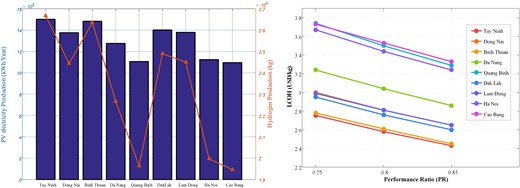
Simulation results show that green hydrogen production strongly depends on radiation conditions. For a 1 MW PV system, annual hydrogen yield is highest in Tay Ninh (26,672.5 kg), Binh Thuan (26,352.6 kg), and Dong Nai (24,438.3 kg). These provinces benefit from tropical monsoon climates with stable year-round solar radiation, creating favorable conditions for large-scale hydrogen production.
Meanwhile, Central region sites like Da Nang (22,660.9 kg) and Quang Binh (19,644.6 kg) are significantly affected by extended rainy and storm seasons, causing substantial seasonal output fluctuations. The North with Hanoi and Cao Bang has the lowest output (approximately 19,466.5 kg/year in Cao Bang) due to humid subtropical climates with cold, cloudy winters reducing solar radiation. The Central Highlands (Dak Lak, Lam Dong) maintain stable output thanks to relatively high radiation and stable temperatures.
3.2. Levelized Cost of Hydrogen (LCOH)
LCOH analysis reveals clear regional differences. At PR = 0.85, Tay Ninh and Binh Thuan achieve the lowest costs (2.81 - 2.85 USD/kg), followed by Dak Lak (3.01 USD/kg) and Lam Dong (3.06 USD/kg). The Central region shows costs from 3.31 USD/kg (Da Nang) to 3.82 USD/kg (Quang Binh), while the North has the highest costs, from 3.76 USD/kg (Hanoi) to 3.88 USD/kg (Cao Bang).
Notably, the study reveals a very strong inverse linear correlation (R² ≈ 0.99) between PR and LCOH. Specifically, every 0.1 increase in PR (corresponding to a 13.3% performance improvement) reduces hydrogen costs by approximately 11.8% (from 3.72 USD/kg to 3.28 USD/kg). This confirms that investment in high-efficiency PV technology, quality inverters, and optimized maintenance strategies yields clear economic benefits.
3.3. Sensitivity Analysis with Electrolyzer Costs
When considering four electrolyzer cost scenarios (1287, 1000, 600, and 300 USD/kW), results show that cost reduction positively impacts LCOH. For example in Tay Ninh, LCOH decreases from 3.19 USD/kg (at 1287 USD/kW) to 2.87 USD/kg (at 300 USD/kW). This improvement demonstrates significant cost reduction potential in the future as electrolyzer technology advances and scales up.
3.4. Sensitivity Analysis with Solar Radiation
Sensitivity analysis with a ±5% uncertainty assumption in radiation data (corresponding to typical PVGIS-SARAH errors in Southeast Asia) shows LCOH variations of approximately ±4% to ±6%, depending on specific site characteristics. This indicates relatively good model stability.
4. Comparison with International Studies
The study compared results with international publications and found that Vietnam's LCOH (2.81 - 3.88 USD/kg) falls within the global competitive range. Specifically, these results are similar to Kim et al.'s findings (3.8 USD/kg in Myanmar, 3.9 USD/kg in Thailand), significantly lower than Oman (5.63 USD/kg) and Morocco (3.59-4.34 USD/kg), but higher than 2050 forecasts (1.59 - 2.16 USD/kg). This confirms Vietnam's competitive advantage from abundant solar resources and low PV costs (0.69 USD/W).
5. Policy Implications and Recommendations
Based on the study results, the authors propose three main policy pillars to realize Vietnam's green hydrogen potential:
5.1. Price and Investment Support Mechanisms
-
Establish feed-in tariffs or contract-for-difference schemes for renewable electricity used in hydrogen production, ensuring stable and affordable supply.
-
Implement tax incentives, green credit programs, and financial support packages to reduce initial capital expenditure for electrolyzer and hydrogen storage systems.
-
Consider competitive bidding or targeted investment support mechanisms for green hydrogen projects in high-potential areas (Tay Ninh, Binh Thuan, Dak Lak, Lam Dong).
5.2. Demand-Side Policies
-
Introduce mandatory quotas or blending mandates requiring hard-to-abate industrial sectors (steel, cement, chemicals) and heavy transport to gradually substitute fossil fuels with green hydrogen.
-
Develop a national certification system and carbon-intensity-based standard for green hydrogen, meeting domestic and export requirements.
-
Promote public-private partnerships to create long-term purchase orders and reduce market risks for investors.
5.3. Legal and Infrastructure Development
-
Integrate green hydrogen development into Vietnam's Power Development Plan VIII, treating electrolysis as flexible load to absorb excess renewable electricity and enhance grid stability.
-
Prioritize R&D, technology transfer, and localization of electrolyzer and hydrogen storage manufacturing.
-
Invest in transport, storage, and export port infrastructure to ensure full value-chain connectivity, especially in key regions like Binh Thuan - where solar potential converges with strategic international seaport proximity.
6. Conclusion
The study has successfully established a techno-economic assessment model for PV-hydrogen systems in Vietnam, with important quantitative results on green hydrogen yield and costs across regions. Key findings include:
(1) The Southern and Central Highlands provinces demonstrate superior potential for green hydrogen production with globally competitive LCOH (2.81 - 3.07 USD/kg), with Tay Ninh and Binh Thuan as priority investment destinations.
(2) The strong linear correlation between PR and LCOH confirms the value of improving PV system efficiency, significantly reducing hydrogen production costs (approximately 11-12%) and improving overall economic performance.
(3) The combination of abundant solar resources, low PV costs, and potential electrolyzer cost reductions gives Vietnam a competitive advantage in the regional Southeast Asian green hydrogen value chain.
The proposed policy recommendations aim to establish a foundation for the sustainable development of the green hydrogen ecosystem, contributing significantly to the net-zero emissions commitment by 2050 and positioning Vietnam as a regional green hydrogen hub.