


Technical and Economic Efficiency of Hydrogen Injection Equipment in Internal Combustion Engines: A Comprehensive Review from International Studies
Date: August 15, 2026, by VAHC Secretariat, Annie Nguyen
I. Technology Overview and Global Context
Hydrogen injection technology in internal combustion engines (H2-ICE) has made significant advances in recent years, particularly in heavy-duty trucks and industrial applications. Key technical challenges are being addressed, and the economic viability is becoming clearer. The Direct Injection (DI) method is emerging as the technology standard, outperforming Port Fuel Injection (PFI) in efficiency and abnormal combustion control.
Recent studies from various countries, including real-world testing on large-displacement engines in China and Japan, are providing crucial experimental data for injection system optimization. Global interest in H2-ICE is driven by two main factors: its ability to leverage existing internal combustion engine infrastructure and supply chains, and its potential for carbon neutrality when using green hydrogen.
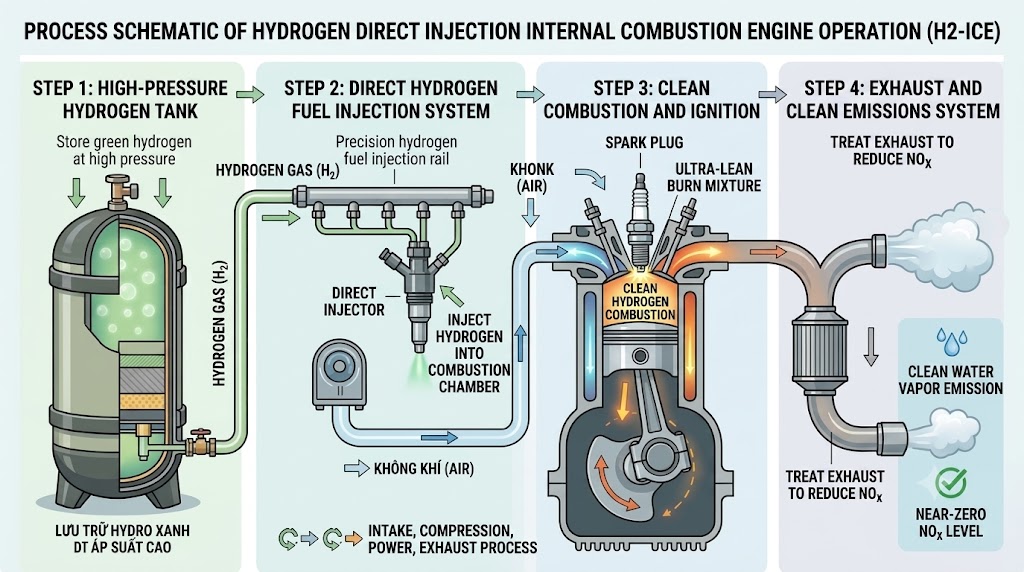
II. Detailed Technical Data
1. Effects of Injection Pressure and Timing
Optimal Injection Pressure:
The relationship between injection pressure and engine performance is non-linear and highly dependent on operating conditions. While increasing injection pressure from 50 bar to 150 bar can shorten injection duration by about two-thirds, experimental studies on a six-cylinder engine show that increasing injection pressure from 5 bar to 25 bar under medium and high loads can reduce both power output and fuel economy, despite significantly lowering NOx emissions.
Research on direct-injection engines indicates that an injection pressure of 25-27.5 bar yields the highest and earliest peak in-cylinder pressure under fixed timing. At 15 bar, ignition delay increases to 14.7° crank angle (CA), while at 25 bar, NOx peaks at 537 ppm . Brake Thermal Efficiency (BTE) exhibits a U-shaped relationship with pressure, with minimum efficiency near 25 bar when timing is held constant.
Tests on a 1.054 L engine in Japan comparing high-pressure injection (10 MPa) and low-pressure injection (3 MPa, LPDI) show that LPDI can achieve high Indicated Thermal Efficiency (ITE), up to 47.8%, while maintaining near-zero NOx emissions under ultra-lean combustion conditions (λ ≈ 3.3) . Low-pressure injection also improves injector sealing and durability, especially when combined with late injection strategies.
Late Injection Timing:
Late injection strategies create stratified mixtures, improving thermal efficiency. On the 1.054L engine, ITE increased as injection timing was retarded from 90° CA BTDC to 60° CA BTDC . The study also indicates that with LPDI, when injection timing is retarded beyond 70° CA BTDC, in-cylinder pressure approaches injection pressure, making fuel injection difficult.
Another study on a 2.8L engine shows that simultaneous optimization of excess air ratio (λ), start of injection (SOI), and injection pressure (PH2) can solve the performance-emissions trade-off . Optimization algorithms such as genetic algorithms and particle swarm optimization are being applied to find optimal operating ranges for H2-ICE.
2. Multi-Pulse Injection Strategies and Spray Dynamics
Split Injection:
Splitting hydrogen into two injections is a key strategy for improving mixing and combustion control. On a 15.0L large-displacement engine, adjusting the secondary injection ratio from 10% to 40% directly affects performance and emissions . Research indicates that secondary injection strategies can promote combustion and improve thermal efficiency compared to single injection, although NOx may increase.
ITE can reach up to 44.72% with optimized split injection strategies . Achieving maximum ITE of 44.05% requires integrated adjustment of piston bowl geometry, injection parameters, and injection pressure.
Spray Dynamics:
When injected into high-pressure, high-temperature environments, hydrogen jets exhibit significantly greater penetration and volume growth compared to other gaseous fuels. Specifically, at t = 30 μs, hydrogen jet axial penetration and volumetric expansion are 16% and 117% higher, respectively, than methane under the same conditions . Hydrogen penetrates faster and develops stronger vortex structures, promoting better fuel-air mixing.
Research also shows that injection pressure primarily affects turbulence generation during injection, influencing mixture formation and combustion . Injector configuration also significantly impacts spray dynamics, with designs like OOI (outward-opening injector) and NSI (needle single orifice) providing different spray characteristics.
3. NOx Emissions and Solutions
NOx Challenge:
High combustion temperatures in hydrogen engines lead to NOx emissions that can exceed those of conventional gasoline engines. Research on a 14.6L engine highlights the need for systematic solutions.
Primary Solution - Ultra-Lean Combustion:
This is the most effective strategy for NOx control. Operating in ultra-lean mode with λ ≈ 3 can reduce NOx to near-zero levels (0-5 ppm) . Research on a 2.8L engine confirms near-zero NOx at λ = 3.
Supplementary Solutions:
-
EGR (Exhaust Gas Recirculation): Effective in reducing NOx but may cost a few efficiency points.
-
Water Injection: Demonstrated significant potential for NOx reduction.
-
Split Injection and Multi-Parameter Optimization: Combining adjustments of λ, SOI, and injection pressure to balance performance and emissions.
III. Economic Data Analysis
1. System Costs (CAPEX)
The core competitive advantage of H2-ICE comes from leveraging existing technology and supply chains. H2-ICE requires targeted modifications to conventional diesel engines – including fuel injection, ignition, turbocharging – but retains the core engine architecture . This allows continued use of existing supply chains, service infrastructure, and technician skill sets . H2-ICE also avoids dependence on imported critical minerals, enhancing energy security.
A comparative study for heavy-duty trucks in Finland indicates that for larger trucks, H2-ICE emerges as the most economical option despite lower efficiency, primarily due to lower vehicle purchase costs . UC Davis research also highlights lower production costs and potentially greater reliability of H2-ICE compared to FCEV.
2. Operating Costs and Total Cost of Ownership (TCO)
Current and Future TCO:
In the Indian market, with current hydrogen prices around Rs 750/kg, the TCO for a 35-tonne truck over an 8-year lifecycle is Rs 102.52/km, significantly higher than diesel (Rs 45.09/km). However, at a projected hydrogen cost of Rs 200/kg, TCO declines to Rs 45.65/km, approaching parity with diesel .
A TCO analysis for heavy-duty trucks in Finland shows that H2-ICE is economically attractive at hydrogen prices below €4/kg for urban applications and below €8-10/kg for extra-urban and long-haul applications . Projections indicate that by 2035, H2-ICE hybrid trucks (HEV) could achieve or even surpass diesel TCO (5-8% reduction).
For Class 8 long-haul trucks, H2-ICE HEVs show particular sensitivity to energy efficiency and fuel cost, and offer a more pragmatically accessible transitional solution due to lower capital costs and established manufacturing infrastructure.
Fuel Purity Factor:
H2-ICE can use lower-purity hydrogen compared to FCEV, offering cost advantages and supply flexibility.
3. Emissions and Compliance Costs
H2-ICE offers Well-to-Wheel CO₂ emissions benefits when using green hydrogen, meeting increasingly stringent emissions regulations. However, H2-ICE is not a zero-emission vehicle (ZEV) in operation due to NOx emissions, whereas FCEV is a ZEV.
HPDI (High Pressure Direct Injection) technology shows potential for compliance with future emissions regulations, although NOx remains an issue due to diffusion combustion characteristics.
IV. Conclusion and Outlook
Hydrogen injection technology, particularly direct injection, has achieved impressive performance parameters, with Indicated Thermal Efficiency reaching 47.8% and the ability to operate in ultra-lean mode to control NOx to near-zero levels . Economically, H2-ICE offers significantly lower system costs than FCEV and the ability to leverage existing infrastructure and supply chains, making it an attractive transitional solution, especially for heavy-duty trucks, industrial machinery, and other heavy-load applications.
However, challenges remain in controlling NOx under high-load conditions and dependence on high-pressure injection technology. Global research is focused on addressing these issues through multi-parameter optimization (λ, SOI, injection pressure) and developing advanced injection strategies such as split injection and water injection . The current development trend is shifting from technology demonstration to commercial value demonstration, with pilot projects and initial commercialization underway in countries like China, Japan, and European nations.
Directory of HOD Manufacturers & Technologies
| Company / Manufacturer | Country | Technology / Key Products | Claimed Performance | Additional Info |
|---|---|---|---|---|
| dynaCERT Inc. | Canada | HydraGEN™ System: Generates H2 & O2 from distilled water via electrolysis, injected into diesel engine intake. | Fuel savings ~8-20%; NOx reduction up to 88.7%; CO₂ reduction up to 9.6%; PM reduction up to 55.3%. | Commonly used in heavy trucks, mining equipment. Hardware cost ~$8,000 - $10,000 USD. |
| Greentek Australia | Australia | H2 Injection System: Produces 99.9% pure hydrogen, injected into intake manifold via proprietary ECU. | Vietnam field tests: 15-30% diesel savings; 25-35% CO₂ reduction; 18-45% smoke reduction. | Plans for manufacturing facility in Vietnam. Increases engine power and cleans combustion chamber. |
| HYDI Hydrogen | Australia | HYDI Device: Generates hydrogen from distilled water and vehicle electricity, no storage, Bluetooth connectivity. | Scania truck testing: Up to 15% fuel savings; Reduction in CO₂, NOx, and PM. | No engine modifications required; OEM warranty friendly. |
| HHO Plus | Portugal | HHO Gas Generators: Generates Hydrogen/Oxygen mix, typically sold as DIY systems. | Claims of improved combustion efficiency and fuel savings. | Mixed market reputation; reports of quality and customer support issues. |
| PUREST FUELS LLC | United States | HHO Solutions: On-demand hydrogen injection with real-time monitoring capabilities. | Supports improved combustion, fuel consumption reduction, and lowered emissions. | Supports ESG reporting; no major engine modifications required. |
| eHydrogen Solutions | United States | Hydrogen-on-Demand: Utilizes electrolysis of distilled water for hydrogen production and combustion injection. | Claims fuel consumption and emissions reduction. | Technology adaptable to various ICE and stationary applications. |
| Alpha H2 | United States (Testing in Mexico) |
Water-to-Hydrogen Converter: Blends generated hydrogen with traditional fuel. | Field tests indicate 20% fuel reduction, 13% CO₂, and 16% hydrocarbon reduction. | Currently in real-world pilot testing phase. |
Note: The performance specifications in the table above are figures published by the manufacturers and may vary depending on operating conditions, engine type, and maintenance status.
References
-
ScienceDirect. (2025). Single-factor analysis and multi-objective optimization of hydrogen injection strategies and stoichiometric control for a PFI hydrogen ICE. https://www.sciencedirect.com/science/article/abs/pii/S0959652625024837
-
ScienceDirect. (2026). Cost drivers and decarbonization trade-offs of transitioning refuse trucks to hydrogen - A total cost of ownership comparison of diesel, hydrogen ICE, and hydrogen fuel cell trucks. https://www.sciencedirect.com/science/article/abs/pii/S036031992602776X
-
Matilda. (2024). A Review of Hydrogen Storage System (HSS) and Hydrogen Internal Combustion Engine (H2-ICE) for the Potential H2-ICE Vehicle. https://matilda.science/work/a9406ef8-91f8-4924-81ff-eec71d7c7b40
-
ScienceDirect. (2026). Coupling effects of excess air ratio and injection timing on performance and NOx emissions of a direct-injection hydrogen engine. https://www.sciencedirect.com/science/article/abs/pii/S0360319926003113
-
ScienceDirect. (2026). Comparative evaluation of hydrogen-based powertrains in medium- and heavy-duty trucks as transitional solutions for electrification. https://www.sciencedirect.com/science/article/abs/pii/S0360319926020185
-
ScienceDirect. (2026). Performance analysis of a large-displacement hydrogen direct injection engine designed for zero-carbon heavy-duty truck. https://www.sciencedirect.com/science/article/abs/pii/S0959652626004671
-
Sage Journals. (2025). Hydrogen internal combustion engines: Bridging the gap to zero-emission transportation. https://journals.sagepub.com/doi/abs/10.1177/0958305x251375934
-
SAE International. (2024). Erik Doosje - Profile. https://profiles.sae.org/erik_doosje/
-
ScienceDirect. (2025). Experimental and numerical investigation of a low-pressure direct-injection hydrogen engine focusing on high thermal efficiency with near-zero emissions. https://www.sciencedirect.com/science/article/pii/S0360319925054217
-
Renewable Watch. (2026). Green Mobility: Assessing the commercial viability of hydrogen in transportation. https://renewablewatch.in/2026/06/07/green-mobility-assessing-the-commercial-viability-of-hydrogen-in-transportation/
-
Towards Automotive. (2025). H2-ICE Market Emerging Trends, Opportunities and Competitive Benchmarking. https://www.towardsautomotive.com/report-toc.php?slug=h2-ice-market-sizing
-
ScienceDirect. (2025). Spray-to-combustion interaction in hydrogen direct injection engines: Effects of injector structure and injection pressure. https://www.sciencedirect.com/science/article/abs/pii/S0360544225031561
-
DOAJ. (2025). Experimental study on the effects of injection pressure and injection timing on combustion and emissions in a direct-injection hydrogen engine. https://doaj.org/article/c764cfcff4cc403da563e2b937221e69
-
UC Davis. (2024). A Comparative Review of Hydrogen Engines and Fuel Cells for Trucks. https://itspubs.ucdavis.edu/publication_detail.php?id=4492
-
Semantic Scholar. (2024). A Review of Hydrogen Storage System (HSS) and Hydrogen Internal Combustion Engine (H2-ICE) for the Potential H2-ICE Vehicle. https://www.semanticscholar.org/paper/A-Review-of-Hydrogen-Storage-System-(HSS)-and-for-Biswas-Naik/0050f21a6142379f3d39f44e61fd733c38554586