
Review of Sustainable Finance Products at Selected International Finance Centers and Implications for VIFC-HCMC – Perspectives from FiinGroup and VAHC's Assessment on Hydrogen
August 08, 2026
Annie Nguyễn, VAHC Secretariat
1. Global Sustainable Finance Market Context
At the Vietnam Green Finance Conference 2026 by VIFC-HCM, Nam A Bank and FiinGroup, supported by GGGI, Mr. Le Xuan Dong, CFA, Managing Director, Head of Market Research & Advisory Services at FiinGroup, delivered a presentation on the structure of the green finance market and lessons from international financial centers (IFCs).
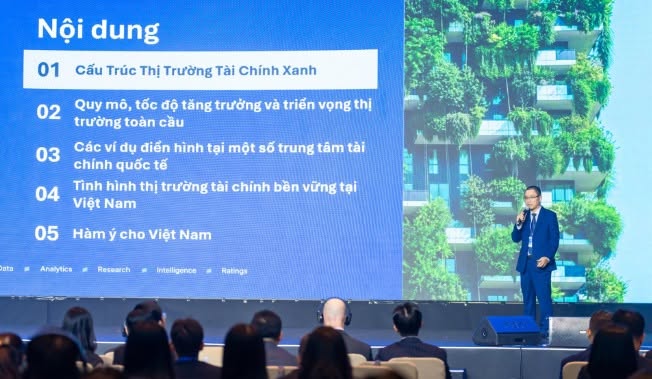
Mr. Le Xuan Dong presented at the Conference
According to Mr. Dong, the global sustainable finance market is entering a more diversified and disciplined phase. In 2025, total sustainable debt issuance reached approximately $1,800 billion, alongside continued growth in equity capital markets and climate-focused funds. Key trends include maturing debt markets, broader sector allocation, transition finance, and tighter integrity standards. The opportunity is widening, but credible standards and transparent evidence increasingly determine access to capital.
2. Lessons from International Financial Centers
Mr. Dong analyzed three IFC models:
GIFT City (India): Stands out with a unified regulatory model, where a single authority (IFSCA) regulates all financial sectors. A notable feature is the 5% sustainable lending target for financial institutions, with explanation and correction mechanisms for shortfalls. GIFT City recognizes international standards such as LMA (loans), ICMA, CBI, ASEAN, and EU (bonds). Implications for VIFC: A unified green finance framework, domestic market connectivity, and performance measurement based on actual capital channeled into the real economy.
Singapore: Excels as a regional "orchestrator," combining public and private capital with professional fund managers. Grant schemes for issuance and external review costs, along with the Financing Asia's Transition Partnership (FAST-P) initiative aiming to mobilize up to $5 billion through blended finance. Implications for VIFC: Build a blended finance platform, engage professional fund managers, and support first-time issuers through capped grants.
Hong Kong: A strong cross-border market access gateway, with connectivity infrastructure (Bond Connect), interoperable taxonomy, and multi-currency government bond programs. Implications for VIFC: Develop market connectivity infrastructure, issue sovereign green bonds through VIFC to establish a benchmark yield curve, and develop a dedicated transition finance framework for high-emitting sectors.
3. Current State of Sustainable Finance in Vietnam
Mr. Dong noted that Vietnam's sustainable finance market remains bank-led. Green credit reached approximately 780,000 billion VND (about $32-33 billion) by end-2025, up 14.62% year-on-year and accounting for about 4.19% of total outstanding loans. However, Vietnam's sustainable (GSS+) bond market remains small compared to regional peers, indicating significant room for VIFC-HCMC to develop the sustainable capital market.
4. Implications and Roadmap for VIFC-HCMC
Based on these lessons, Mr. Dong proposed a three-year roadmap:
-
Year 1: Build credibility and market foundations. Issue a green finance rulebook, accredit verifiers and SPO providers, establish a green project registry, and execute 3-5 pilot transactions with anchor issuers such as banks and SOEs.
-
Year 2: Scale pipeline and mobilize capital. Set up a project preparation facility, operate a blended finance platform, broaden the issuer base, and launch a transition finance framework for hard-to-abate sectors.
-
Year 3: Deepen liquidity and regional positioning. Build a green yield curve, strengthen secondary market liquidity, expand into equity and climate funds, and connect with international investors.
5. VAHC Assessment: Implications for Green Hydrogen in Vietnam
Although Mr. Dong did not directly mention hydrogen, the IFC lessons offer important insights:
First, a transition finance framework is a top priority for hydrogen. Green hydrogen projects often do not meet traditional green criteria (such as operating renewable energy) due to high costs and unproven economics. A transition framework, with clear decarbonization pathways and KPIs, is a suitable tool for financing hydrogen projects in their early stages. Hong Kong's experience in expanding its taxonomy (Phase 2A) to include transition activities is a relevant model.
Second, a Project Preparation Facility is essential to materialize hydrogen projects. Green hydrogen projects in Vietnam often face pre-investment difficulties due to a lack of feasibility studies, financial modeling, and standardized contracts. This facility will help hydrogen developers package projects to international standards.
Third, blended finance and risk mitigation mechanisms are particularly important. Green hydrogen production costs remain higher than fossil-fuel alternatives. Guarantees, concessional financing, and FX risk-sharing (from models like Singapore's FAST-P and GIFT City) will help reduce capital costs and attract private and international investment.
Fourth, transparency and MRV standards are key. Measurement, Reporting, and Verification (MRV) systems are crucial to demonstrate emission reduction effectiveness of green hydrogen projects. Establishing these standards will help hydrogen projects access green capital and international carbon credits.
Finally, the priority products and platforms proposed by FiinGroup – including blended finance platforms, project preparation facilities, and transition finance frameworks – can be used to design financial products for green hydrogen. FiinGroup, as a strategic partner of S&P Global and a pioneer in external verification in Vietnam, can play a key role in building this ecosystem. VAHC will continue to seek for collaboration with institutes like FiinGroup and international partners to promote the development of financial instruments for Vietnam's green hydrogen sector.