

Research on Hydrogen Technology and Economics at HUTECH – Contributing to the Development of Ho Chi Minh City's Hydrogen Economy
October 1, 2026 by Annie Nguyen, VAHC Secretariat
Speaker: Assoc. Prof. Dr. Huynh Phu, Director of the Institute of Environment and Circular Economy in the South, Lecturer at HUTECH School of Engineering at the Vietnam Hydrogen Economy Workshop by VAHC and HUTECH School of Engineering on September 30, 2026
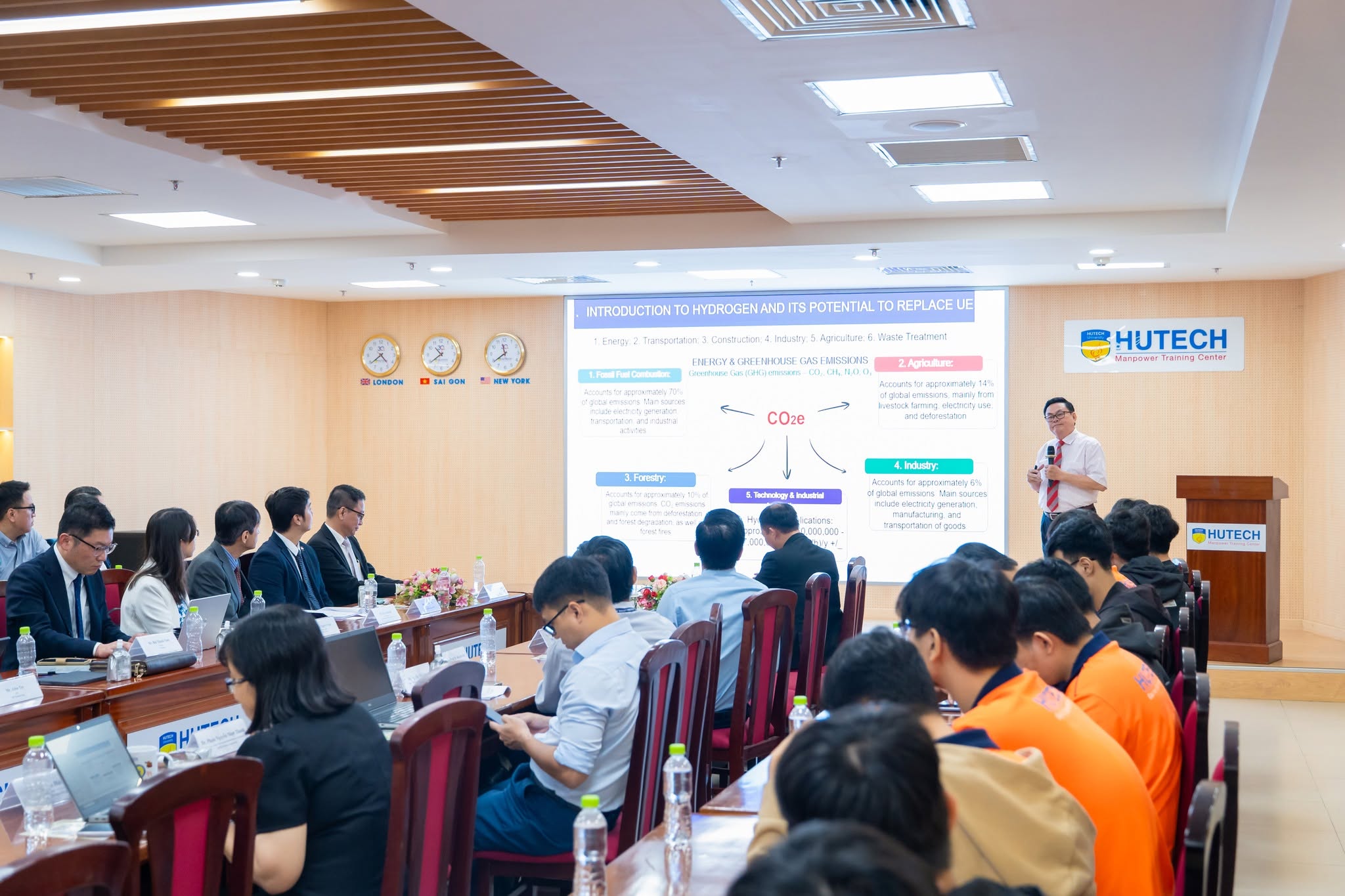
Assoc. Prof. Dr. Huynh Phu opened his presentation by placing hydrogen in the context of global emissions. He presented a greenhouse gas emissions diagram: energy and greenhouse gas emissions account for approximately 70% of global emissions, with main sources including electricity generation, transportation and industrial activities. Agriculture and forestry account for approximately 14% of global emissions, mainly from livestock farming, electricity use and deforestation. Forestry accounts for approximately 10% of global emissions, with CO₂ emissions mainly from deforestation and forest degradation, as well as forest fires. Industry accounts for approximately 6% of global emissions, with main sources including electricity generation, manufacturing and transportation of goods. Waste treatment also contributes significantly to greenhouse gas emissions.
History of Hydrogen Use
Dr. Phu presented the history of hydrogen use over more than 200 years. Since the 1800s, hydrogen has been used in the energy sector and as a fuel for internal combustion engines. Hydrogen was used to lift hot-air balloons in the 18th and 19th centuries. It helped carry humans to the Moon in the 1960s. In the 20th century, hydrogen played an important role in oil refining and ammonia production. Today, hydrogen is mainly used in three major industries: oil refining, chemicals (ammonia and methanol) and steel production.
Expansion into Other Sectors
Dr. Phu analysed the expansion of hydrogen into other sectors, including transportation, buildings and power systems. Electricity generated from hydrogen fuel cells can be used for: transportation – power cars, buses, trucks, ships and even aircraft; power systems – serve as a flexible power source within the electricity system; buildings – provide heat for buildings to reduce emissions, particularly when low-carbon hydrogen is used as the fuel input.
Unique Characteristics of Hydrogen
Dr. Phu emphasised hydrogen's unique characteristics – including its high energy content per unit of mass, light weight, reactivity and ability to be produced and stored on an industrial scale – making it highly applicable across a wide range of markets and industries. Hydrogen offers new options for reducing emissions across different sectors. It can be used without emitting greenhouse gases at the point of use. From the production side, hydrogen can be produced from clean energy sources such as renewable energy, biomass and nuclear power, using a variety of production methods to supply existing hydrogen applications. Although hydrogen is currently produced primarily from fossil fuels, resulting in significant annual emissions, countries such as the United States, the United Kingdom, Canada and Australia are investing heavily in blue hydrogen using CCUS technology. In the long term, green hydrogen is expected to attract greater investment and could contribute to deeper reductions in greenhouse gas emissions.
Applied Research on Hydrogen Production
Dr. Phu analysed three main technologies. Green Hydrogen: Using renewable energy sources (solar and wind power) to electrolyse water into H₂ and O₂ without CO₂ emissions. Current research focuses on improving electrolyser efficiency and reducing costs. Globally, green hydrogen produced from water electrolysis accounted for only 0.03% of total hydrogen production in 2020. However, improvements in electrolysis technologies and low renewable energy costs could make green hydrogen cost-competitive by 2030. The production and use of green hydrogen is still a new field in Vietnam, but this transitional energy topic is increasingly attracting interest. Blue Hydrogen: Produced from fossil fuels combined with carbon capture and storage (CCUS) technology. Hydrogen Storage Technology: Dr. Phu introduced two main methods. Solid-state hydrogen storage uses materials such as magnesium (Mg) metal to absorb hydrogen under the influence of heat, forming a metal hydride compound (MgH₂) at a temperature of approximately 250–350°C, which helps increase safety and minimise the risk of fire and explosion compared to conventional compressed gas. Compressed or liquid hydrogen storage cools hydrogen gas to an extremely low temperature of approximately -253°C to convert it into a liquid state or compresses it in specialised containers to achieve higher energy density during transportation.
Assessment of Green Hydrogen Production Potential in Vietnam
Dr. Phu assessed green hydrogen production potential in Vietnam. Alongside solutions for developing renewable energy, using energy economically and efficiently, and developing low-carbon power sources, green hydrogen and hydrogen derivatives are receiving global attention and are expected to be a solution with an increasingly important position in the energy transition roadmap to reduce emissions of polluting gases and CO₂ from industrial manufacturing sectors. On cost-competitiveness, globally, green hydrogen produced from water electrolysis accounted for only 0.03% of total hydrogen production in 2020. However, improvements in electrolysis technologies and low renewable energy costs could make green hydrogen cost-competitive by 2030. The production and use of green hydrogen is still a new field in Vietnam, but this transitional energy topic is increasingly attracting interest.
Proposed Solutions for Ho Chi Minh City's Transportation and Industrial Systems
Dr. Phu presented proposed solutions for transportation and industrial systems in Ho Chi Minh City, including images of highways, urban railways, mixed traffic and renewable energy. He emphasised the need to integrate hydrogen into the city's transportation and industrial planning.
The Role of Universities in Human Resource Training
Assoc. Prof. Dr. Huynh Phu emphasised three main roles of universities. Leading training and standardising curricula: Developing competency frameworks and in-depth curricula on renewable energy and hydrogen ranging from technical foundations to digital technology. Implementing the 'four-party' cooperation model: Closely linking universities, businesses, government and financial institutions to align practical demands with training. Expanding the international collaboration network: Leading and participating in training alliances (networks led by HUTECH University or European-standard programmes at Viet Duc University) to enhance learning outcomes for engineers.
Current Human Resource Gap
Dr. Phu pointed out the current human resource gap: Vietnam has no dedicated university or college programmes specifically for hydrogen. Existing human resources are "pieced together" from mechanical, electrical-electronics, chemical and environmental fields, leading to a shortage of specialised skills in electrolysis technologies (PEM, Alkaline), hydrogen storage and transportation, fire, explosion and leakage safety, hydrogen applications in industry, ESG and green finance for hydrogen projects. Universities lack internationally qualified lecturers, curricula and simulation laboratories – a major bottleneck if Vietnam wants to capture the wave of gigawatt-scale investment.
Hydrogen Value Chain and Workforce Positions to Prepare
Dr. Phu presented "The Journey of a Hydrogen Molecule": from production → storage – transportation → application → governance – finance. Each link requires its own team: electrolysis engineers, cryogenic experts, pipeline engineers, hydrogen-ammonia logistics specialists, fuel cell engineers, LCA – carbon market experts, and ESG specialists. This is not just an engineering problem – it is a complete multidisciplinary ecosystem.
Four-Step Roadmap
Dr. Phu proposed a four-step roadmap. Step 1: Standardise the National Hydrogen Competency Framework with 5 groups: foundational knowledge, hydrogen technologies, industrial operations, ESG-hydrogen economics, projects & safety (HAZOP, hydrogen dispersion modelling). Based on the EU Hydrogen Skills Strategy, Japan's METI and Korea Hydrogen Safety. Step 2: Develop short-term training programmes/university programmes with a 100–150-hour programme at HCMUNRE, IUH, HCMUTE and the University of Technology. Establish the National Hydrogen Training Centre (H2 Training Centre). Small-scale electrolysis-fuel cell laboratory. Pilot-scale technology testing centre. Step 3: Establish an international cooperation network with Germany (electrolysis), South Korea (safety), Singapore (micro-credentials), Russia (LH₂), the EU (CEN-ISO standards), and NEUMAN & ESSER – VAHC's strategic partner. Step 4: Prepare the workforce; Build the 2026–2035 workforce pipeline: 2026–2027: 800–1,000 engineers/technicians; 2028–2030: 2,500 hydrogen workers; 2030–2035: 5,000–8,000 workers for gigawatt-scale projects.
Role of Stakeholders
Dr. Phu emphasised the role of stakeholders: Universities lead training – standardise curricula. Businesses provide practical skill requirements. Finance (typically TPBank) provides funding for training and infrastructure. Government approves occupational standards, licenses training centres and provides tax incentives. TPBank supports green credit for training programmes, creating a new connection between banking and education.
Detailed Training Programme
Dr. Phu presented the detailed training programme. Foundational Knowledge Block (Year 1–2): General Mathematics – Physics – Chemistry (analytical thinking, thermodynamics and fundamental chemical reactions); Fundamentals of Thermal Engineering and Heat Transfer (principles of energy conversion); Basic Electrical Engineering and Electronics (understanding electrical circuits, power grids and power electronic devices). Core Technical Knowledge Block (Year 3): Principles of Energy Conversion and Storage (clean energy, energy storage technologies such as batteries, supercapacitors); Hydrogen Production Technologies (electrolysis methods PEM, Alkaline, SOEC; hydrogen production from renewable energy following the Power-to-X trend); Hydrogen Storage, Transportation and Safety; Compression and liquefaction technologies, hydrogen storage materials (high-pressure storage tanks, hydride-absorbing materials); Safety standards and risk assessment. Advanced Knowledge and Practical Applications (Year 4): Fuel Cell Technology (operating principles, structure and applications of fuel cells); Energy Economics and Policy (legal framework and national hydrogen development strategy to achieve Net Zero emissions); Energy System Modelling and Optimisation (use of specialised software); Graduation Project/Corporate Internship.