

POWER-TO-X IN VIETNAM: FROM ELECTRICITY TO GLOBAL VALUE
Energy Evolution - A Milestone for Vietnam's Power-to-X Ecosystem
August 22, 2026 - Truong Dang Nghia, Country Head of Phoenix Contact Vietnam
On August 20, 2026, the "Energy Evolution" event took place at the Eastin Grand Hotel in Ho Chi Minh City, organized by Phoenix Contact Group in collaboration with the Vietnam ASEAN Hydrogen Club (VAHC) . The event brought together leading experts in energy and automation, focusing on the role of hydrogen and Power-to-X technology in the global energy transition strategy . This was not merely a technology event but potentially a milestone marking the beginning of a broader dialogue on how Vietnam will participate in the regional and global Hydrogen and Power-to-X econ
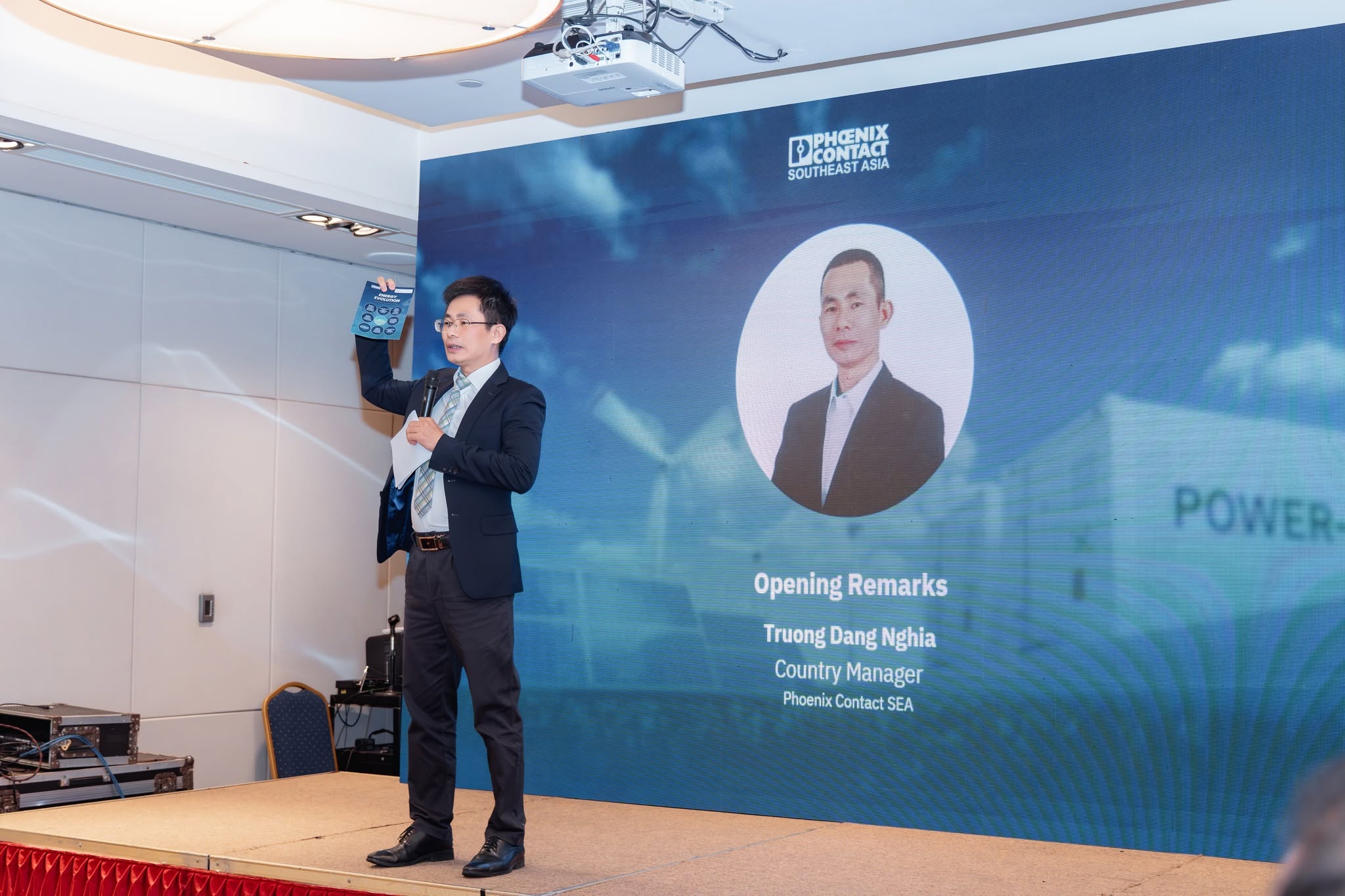
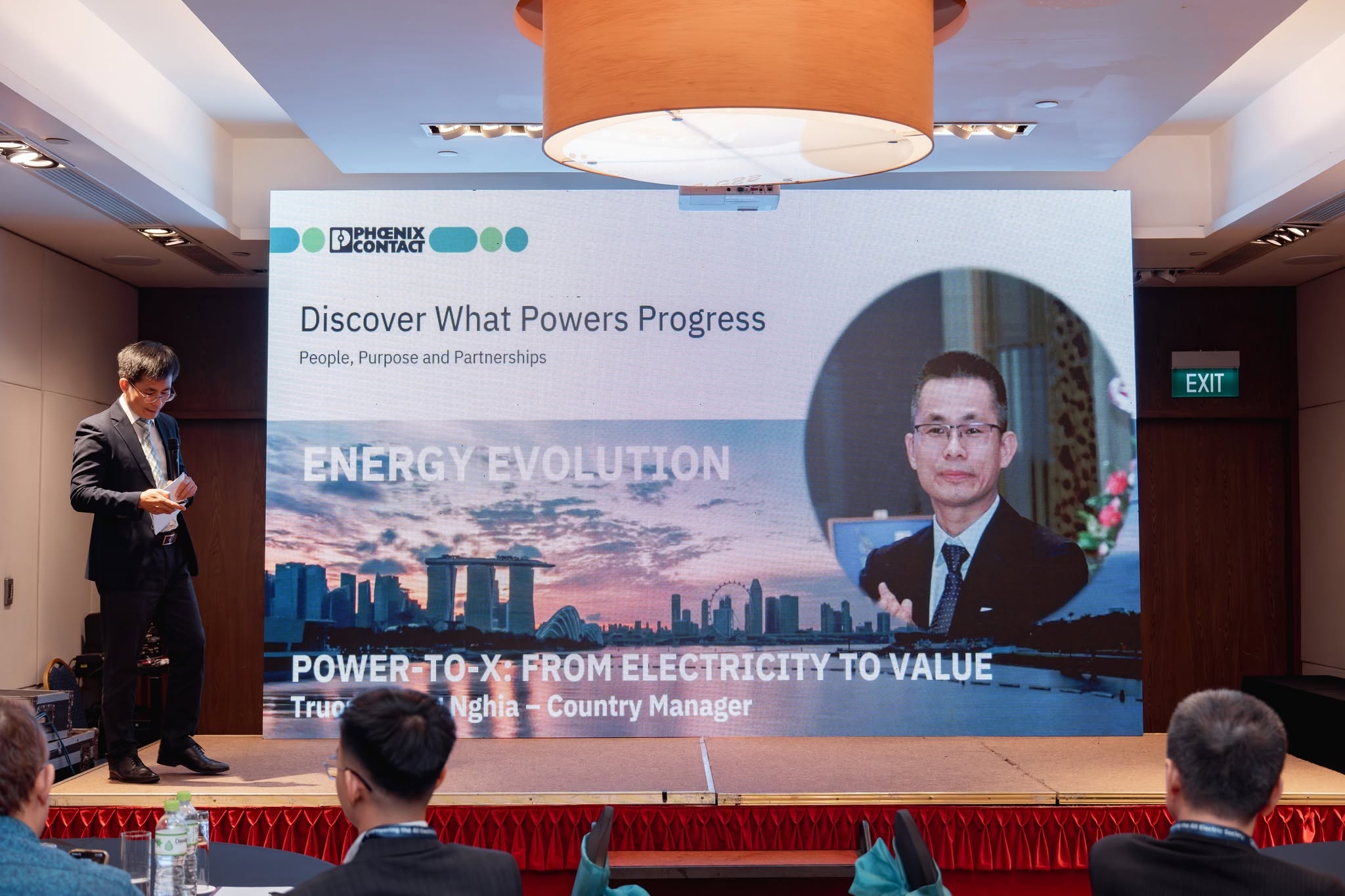
Mr. Truong Dang Nghia delivered an opening speech at the Seminar
From "Renewable Energy" to "New Industrial Value"
As renewable energy increasingly becomes the foundation of future energy systems, the strategic question is no longer just how much green electricity can be produced, but how to convert that electricity into energy, raw materials, and industrial value at scale. Power-to-X offers a new approach to this challenge.
For decades, electricity has been primarily viewed as an energy source for production and consumption. However, the energy transition is fundamentally changing electricity's role. As solar and wind power expand significantly, energy systems face a new challenge: renewable electricity generation depends on weather and timing, while energy demand is continuous. At the same time, not all sectors of the economy can be directly electrified with equal efficiency and feasibility.
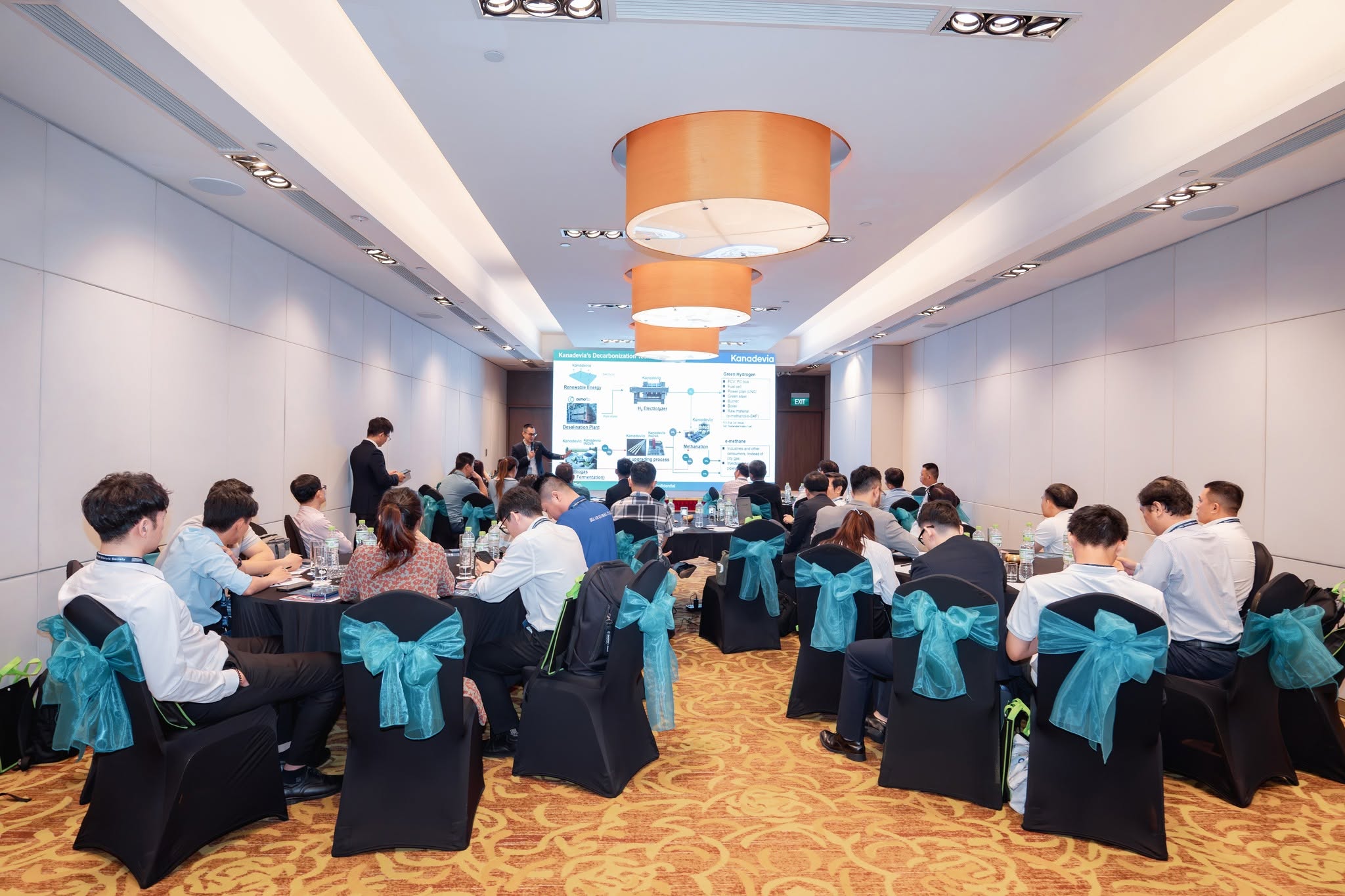
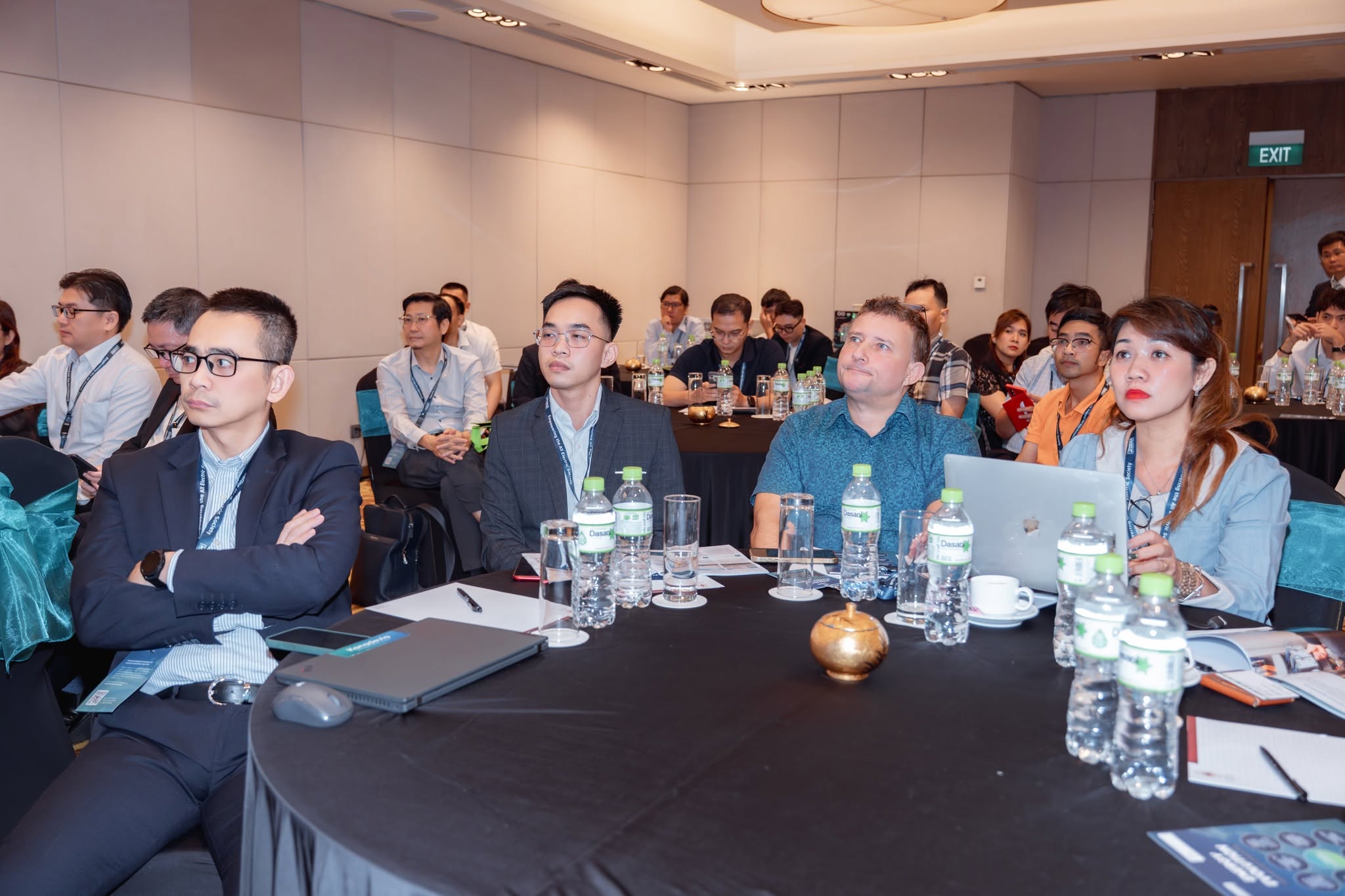
Audience at the Seminar
This context highlights the role of Power-to-X (PtX or P2X).
At its core, Power-to-X encompasses technologies that use electricity, particularly from renewable sources, to produce another form of energy, fuel, chemical, or raw material, collectively referred to as "X". It is important to emphasize that Power-to-X is not merely an electricity storage technology. At a systemic level, PtX is a model connecting the power sector with industry, transport, and chemicals, enabling the conversion of electricity into forms of energy or matter that can be stored, transported, and used where direct electrification is limited.
If direct electrification is an efficient pathway for many applications, Power-to-X creates a complementary path for hard-to-electrify sectors, particularly heavy industry, chemicals, maritime, and aviation. In other words, PtX helps convert "electrons" into "molecules," thereby expanding the reach of renewable energy into the broader economy
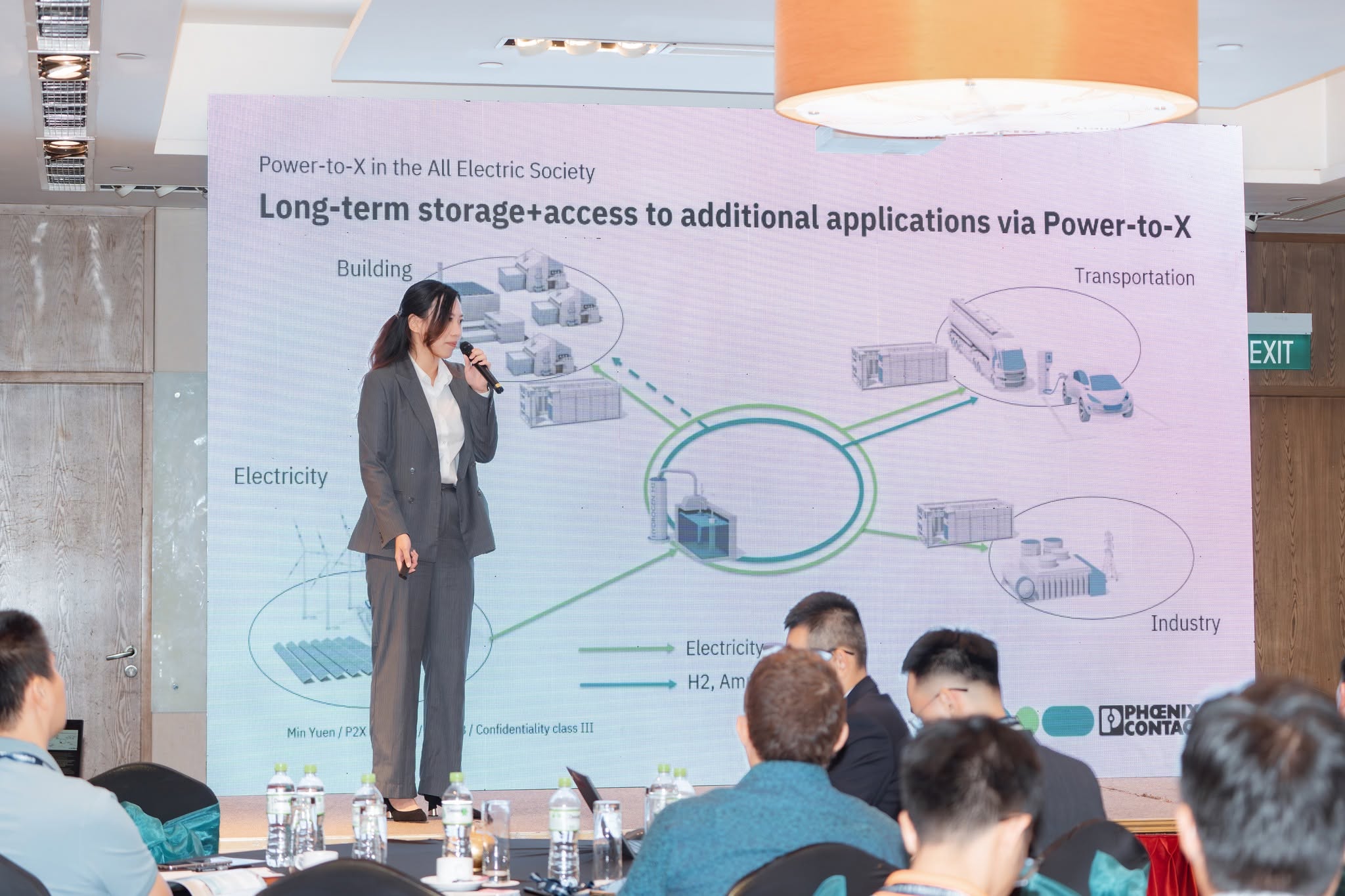
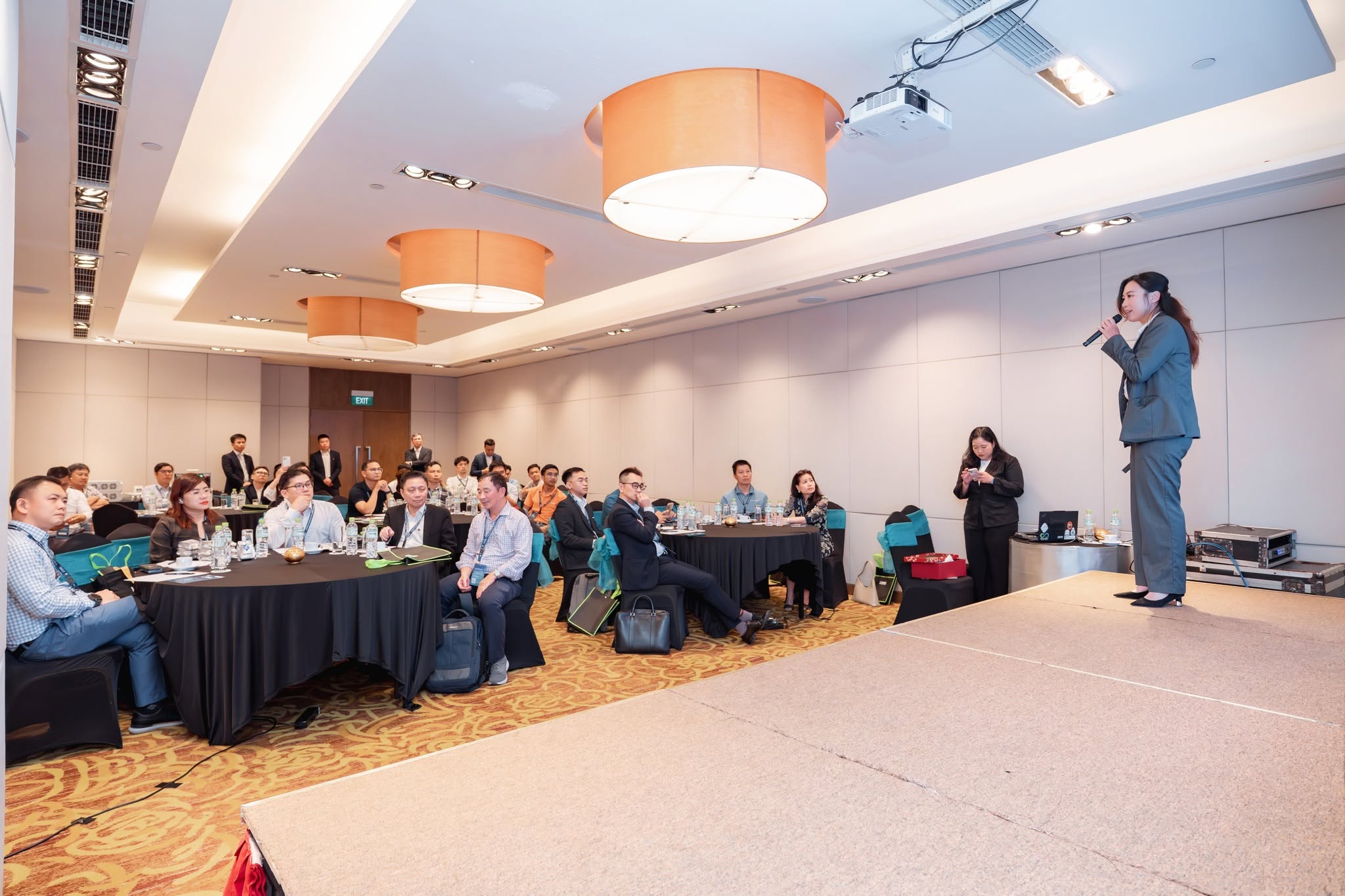
Presentation by Ms. Ong Min Yuen, senior expert on hydrogen and Power-to-X of Phoenix Contact
Hydrogen – The Central Link in the Power-to-X Ecosystem
Within the Power-to-X ecosystem, green hydrogen is considered one of the most important foundations. Through water electrolysis using renewable electricity, water is split into hydrogen and oxygen. Hydrogen can then be used directly or further converted into higher-value products.
This is where Power-to-X demonstrates its flexibility.
Hydrogen can become a feedstock for the chemical industry, fuel for certain vehicles, a reducing agent in industrial processes, or an input for producing ammonia, methanol, and synthetic fuels. In the future, hydrogen will therefore not only be seen as a new fuel but could become a crucial "energy carrier" and industrial feedstock for the low-carbon economy.
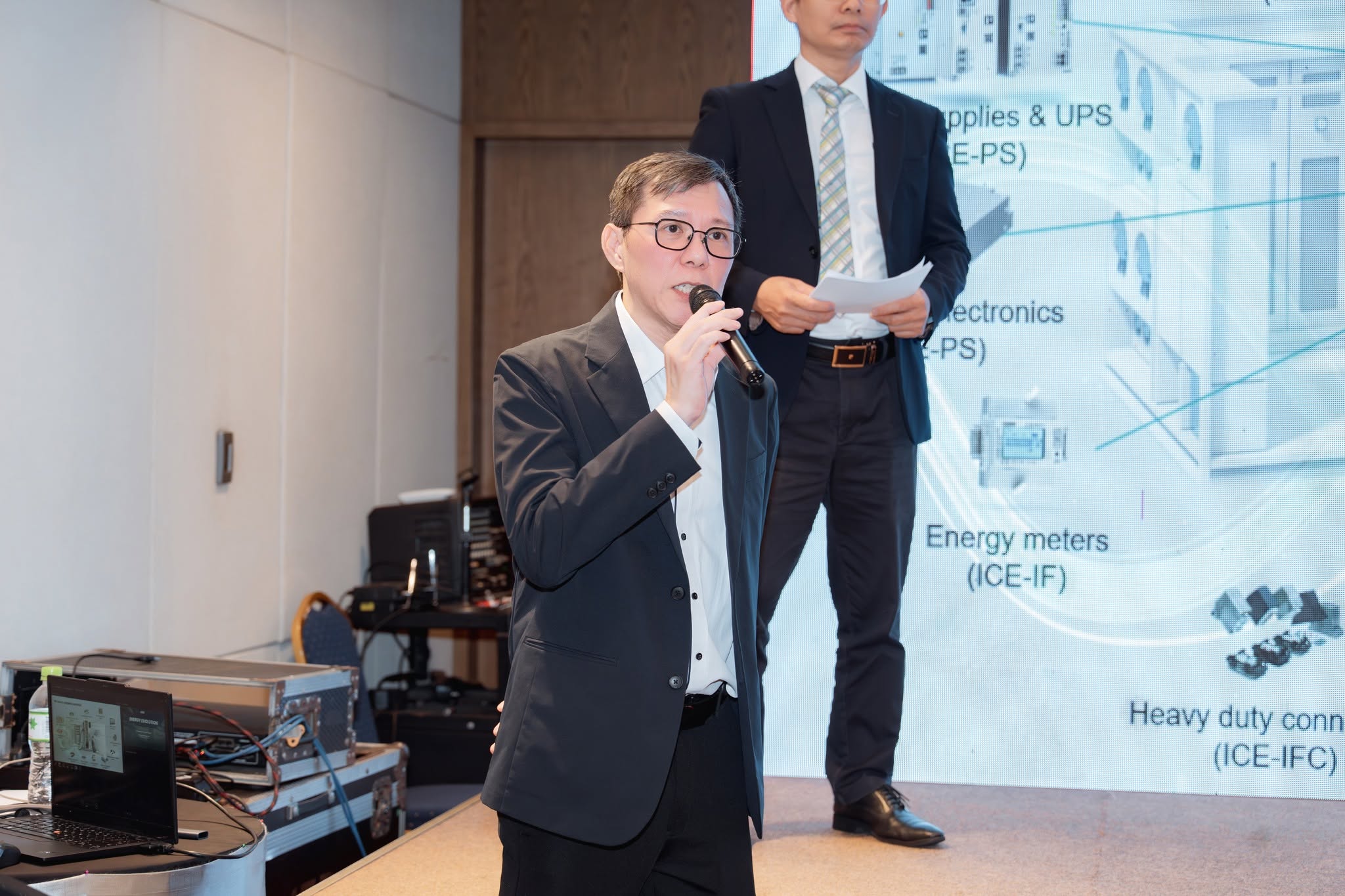
Simon Low, an expert from Phoenix Contact, presents on Power-to-X: "Hydrogen Electrification & Energy Transition."
From Hydrogen to Ammonia, Methanol, and Synthetic Fuels
One of Power-to-X's greatest values lies in its ability to convert hydrogen into molecules better suited for storage, transport, and use.
Green hydrogen can be combined with nitrogen to produce ammonia. Ammonia is already a critical fertilizer and chemical feedstock and is being researched as an energy carrier and fuel for specific applications, particularly in maritime transport.
Another pathway involves combining hydrogen with carbon dioxide from suitable sources to produce synthetic methanol. Methanol can serve both as a chemical feedstock and as a fuel or precursor for other products.
Similarly, hydrogen can participate in producing synthetic fuels, often called e-fuels or Power-to-Liquid. This is particularly noteworthy for sectors where replacing liquid fuels with direct electricity faces significant limitations.
Thus, Power-to-X creates a new value chain: renewable electricity → hydrogen → green molecules → fuels, chemicals, and industrial feedstocks.
That is why PtX is increasingly viewed not just as an energy solution but as a platform for industrial transformation.
Why is Power-to-X Strategically Significant?
Power-to-X's value lies first in its ability to connect energy systems that were previously relatively separate. As the share of renewable energy rises, the power system needs to efficiently absorb and utilize variable electricity. Instead of only balancing the power grid through electricity storage, a portion of energy can be converted into hydrogen or other molecules for use in industry and transport. This creates a form of sector coupling, where electricity, gas, chemicals, and transport are connected into a more unified energy system.
More importantly, PtX allows renewable energy to enter sectors where direct electrification is not yet optimal. This is the strategic significance of Power-to-X: extending decarbonization from the power system to the entire economy.
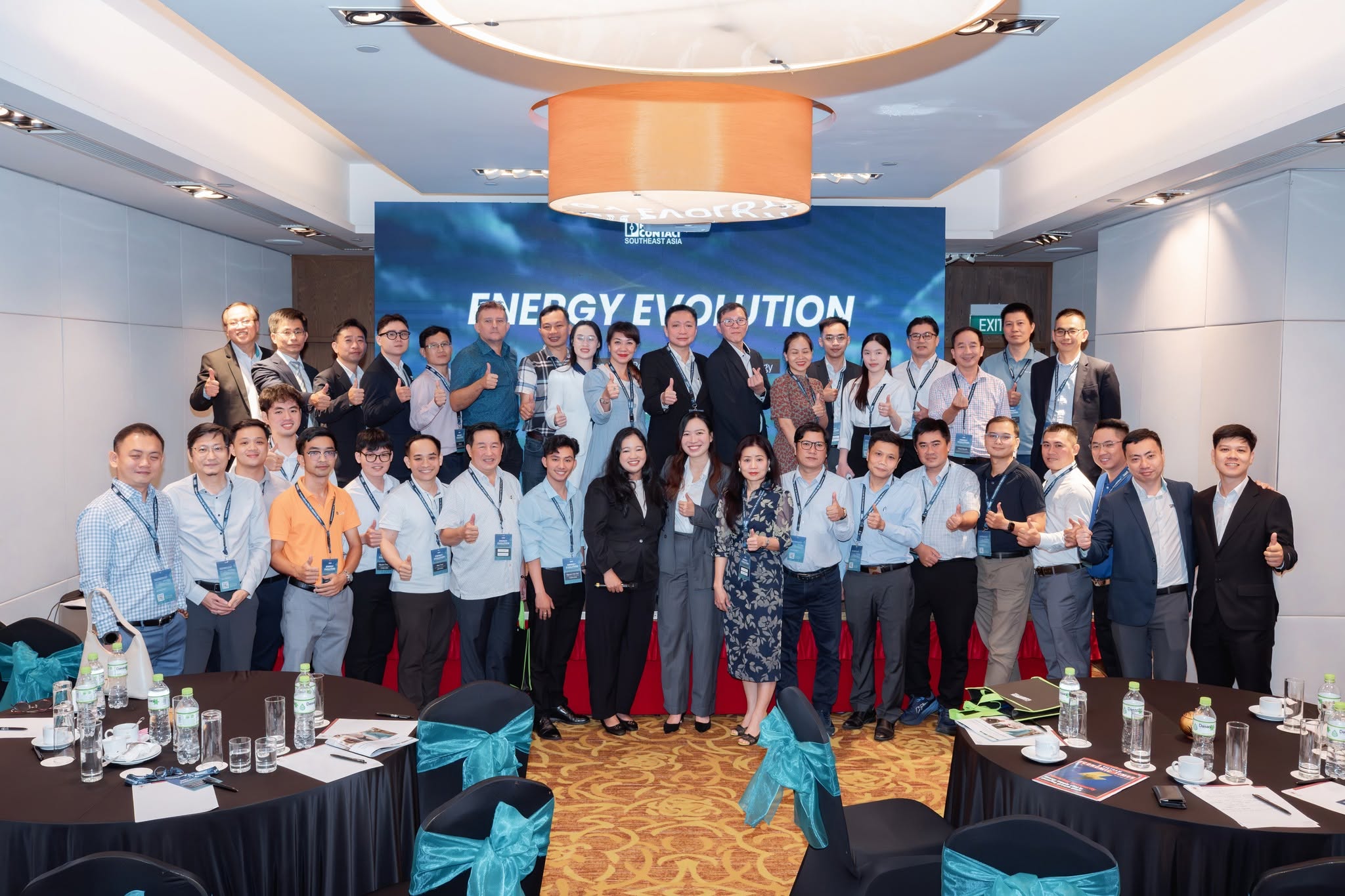
The Energy Evolution event, with participation from experts, businesses, and partners including the Vietnam ASEAN Hydrogen Club, Obayashi Corporation, Kanadevia Corporation, KPT Chemical, Gentari Renewables (Petronas), Mitsubishi Heavy Industries, John Cockerill, etc opened a forum to examine opportunities, challenges, and initial steps for Power-to-X in Vietnam .
Hydrogen: A Great Opportunity, But Not an Easy Game
Hydrogen is expected to play a crucial role in reducing emissions in hard-to-electrify sectors – particularly heavy industry, chemicals, long-distance transport, and new fuel supply chains. But international markets offer a clear lesson: Hydrogen is not a game where technology and electricity alone guarantee success.
According to the IEA, global hydrogen demand exceeded 100 million tonnes in 2025, but almost all of it remains concentrated in traditional industrial and refining applications. Low-emission hydrogen grew by about 20% but still accounts for just under 1% of total production. Meanwhile, new low-emission hydrogen purchase agreements in 2025 reached approximately 1.7 million tonnes per year, with only about 20% being firmly binding commitments. This shows the market is shifting from an "announcement" phase to an "execution" phase. Announced projects do not necessarily mean invested projects. Designed capacity does not necessarily mean commercial output. And abundant renewable electricity does not necessarily mean a competitive hydrogen model.
The major bottlenecks remain: cost, demand, infrastructure, policy, finance, standards, certification, and safety.
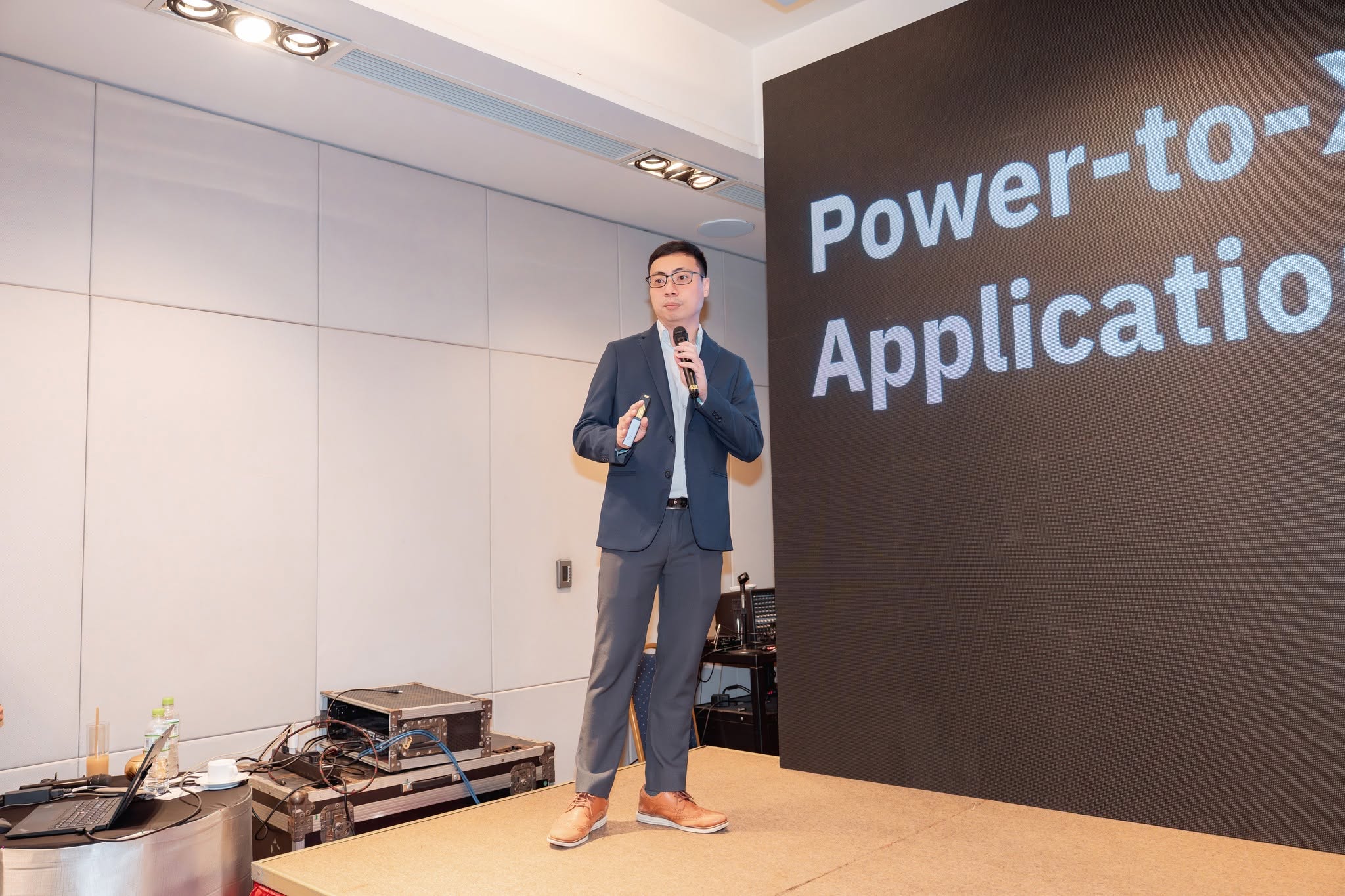
Mr. Fan Shen Yin presents "Smart Operations with Next-Generation Automation."
Therefore, the first lesson for Vietnam is: "Don't start with the question 'How much Hydrogen can Vietnam produce?' but with 'Who will use Hydrogen, for what purpose, at what price, and what economic value will it create?'" That is the difference between a technology project and a commercializable industry.
Vietnam's Hydrogen Strategy Provides a Foundation for PtX
That is precisely the space that Power-to-X opens up.
Power-to-X is not just about Hydrogen. It is a mindset of converting electricity – especially from renewable sources – into Hydrogen and higher-value forms of energy, fuels, chemicals, or feedstocks, thereby connecting the power sector with industry, transport, chemicals, logistics, and hard-to-electrify sectors. For Vietnam, this represents a significant opportunity – not just for energy transition, but for shifting the industrial model and deepening participation in global value chains.
Vietnam Has the Vision – The Next Question Is Implementation
Vietnam stands before a new opportunity. With its long coastline, substantial offshore wind potential, favorable solar energy in many regions, and growing energy demand, Vietnam has a foundation for large-scale renewable energy development. Notably, the revised PDP VIII emphasizes renewable energy and identifies the significant potential of offshore wind power. The plan also envisions offshore wind power development combined with other renewable sources to produce hydrogen and ammonia for domestic use and export. This is a direction with significance beyond the power sector.
If implemented correctly, Vietnam can gradually transition from a renewable electricity production model to an energy and industrial product production model based on renewable energy. That is a very important shift.
Power-to-X in Vietnam does not start from zero. On February 7, 2024, the Prime Minister issued Decision 165/QD-TTg approving Vietnam's Hydrogen Energy Development Strategy to 2030, with a vision to 2050. The strategy aims to build a Hydrogen ecosystem based on renewable energy, including production, storage, transport, distribution, domestic use, and export, with synchronized and modern infrastructure. Vietnam targets renewable energy-based and carbon-captured Hydrogen production capacity of approximately 100,000-500,000 tonnes/year by 2030, and 10-20 million tonnes/year by 2050.
Notably, the strategy is not just about production. Vietnam also aims to develop the market for Hydrogen use in power generation, transport, steel, cement, chemicals, refining, and other industries, while researching storage, transport, distribution, and export infrastructure.
The strategic vision is set. The key question for the next phase is: How to turn that vision into projects with economic viability, real customers, ability to mobilize capital, and scalability?
1. Start with the Right Choices
Power-to-X is a vast space. Vietnam cannot – and does not need to – do everything at once. Resources in capital, technology, infrastructure, human resources, and governance capacity are all limited. Therefore, the right strategy is not "do as much as possible", but: "choose right – do right – prove value – then scale."
Sectors with existing or soon-to-emerge hydrogen demand should be prioritized, such as: refining, fertilizers, chemicals, steel, maritime fuels, methanol, ammonia, industrial hydrogen. This aligns with international lessons. The IEA notes that traditional applications – particularly refining and chemicals – are leading in low-emission hydrogen uptake; projects with clear demand are more likely to reach investment.
"Identify demand first, develop projects later. Demand must be identified before deciding project scale."
Don't start with "How many MW can we build?", but with: who will buy this product, what contract terms, what price, what duration, what carbon value, and is the project competitive?
2. Don't Chase Scale – Focus on Efficiency
International markets reveal a sobering reality. Nearly 45% of low-emission hydrogen output from announced global projects is export-oriented, but export-oriented projects have significantly lower rates of reaching investment. The IEA points to large scale, lack of firm offtake customers, and capital and export infrastructure challenges as key reasons. This is particularly relevant for an emerging economy like Vietnam. A larger project is not necessarily a better project. A smaller project with competitive power, real customers, long-term offtake contracts, available infrastructure, clear standards and certification, transparent financial models, and scalability – can create much greater value.
"Scale matters, but economic efficiency must come first."
3. Do It Right and Synchronously from the Start
Power-to-X is not a device – it is an integrated system. The value chain can be visualized as: "Renewable energy → Power management → Electrolysis →
Hydrogen processing → Storage → Transport → Conversion → Ammonia / Methanol / Fuels → Industrial applications → Offtake → Certification → Global markets."
If one link is weak, the entire model can be affected. Therefore, synchrony is needed from the start: technology, engineering, automation, infrastructure, safety, cybersecurity, finance, certification, and markets. Safety, in particular, cannot be treated as an add-on layer at the end of a project. With Hydrogen, fire, pressure, leakage, hazardous area, and increasing connectivity risks require functional safety, explosion protection, and industrial cybersecurity to be considered simultaneously from the design phase.
"Systems thinking, not single-equipment thinking."
4. No Single Enterprise Can Build a Hydrogen Economy Alone
At Energy Evolution, Mr. Le Ngoc Anh Minh – Executive Chairman of Pacific Group and Chairman of VAHC – shared a key perspective: "opportunities for Hydrogen development and business in Vietnam are potential, but accompanied by many challenges; therefore, coordinated collaboration is needed between the Government and regulatory agencies, domestic and international enterprises, universities and research institutes, scientists, and a transparent financial system."
The Hydrogen economy cannot be built by a single enterprise. It requires an ecosystem:
| Stakeholder | Role |
|---|---|
| Government | Policy, standards, and market mechanisms |
| Energy companies | Power development and infrastructure |
| Technology providers | Supplying technology |
| EPC contractors & integrators | Design and integrated deployment |
| Industrial companies | Creating demand |
| Financial institutions | Providing capital |
| Universities & research institutes | Knowledge and talent creation |
| International partners | Technology, experience, and markets |
| Offtakers | Creating commercial output |
"No ecosystem, no industry."
5. Lessons from International Corporations: Don't Just Build a Plant, Build a Value Chain
Leading countries and corporations look beyond just Hydrogen production – they look at the entire chain: "Electricity → Hydrogen → Derivatives → Infrastructure → Logistics → Offtake → Certification → Markets."
This is particularly important for Vietnam. Vietnam doesn't need to lead in all stages. What needs to be identified is: "Where can Vietnam become a competitive link in the global Power-to-X value chain?" This could be power supply, Hydrogen/ammonia/methanol production, low-carbon steel, chemicals, equipment, engineering and system integration – or a combination of multiple links. This is the thinking of an industrial strategy, rather than just a standalone energy project strategy.
6. Go Global – From Day One
Don't wait until the project is completed to think about international markets. From day one, think in global terms: international standards, international technology, international certification, international finance, international partners, international offtakers, and international markets.
Vietnam's Hydrogen Strategy also aims to leverage renewable energy advantages and geographical location to encourage green Hydrogen production for export; in the long term, towards forming a clean energy industrial ecosystem and becoming a regional clean energy and green Hydrogen export hub.
But Go Global doesn't necessarily mean exporting pure Hydrogen. The more important question is: should we export molecules or should we export value? Instead of just exporting Hydrogen, Vietnam could target higher-value products such as Green Ammonia, Green Methanol, Low-carbon Steel, Green Chemicals, and
Sustainable Fuels. This is also the direction emphasized by the IEA for emerging economies: instead of over-relying on Hydrogen exports, develop domestic markets and prioritize higher-value products.
"Built in Vietnam. Go Global."
7. Technology is a Necessary Condition – Integration is the Decisive Factor
A high-efficiency electrolyser is a necessary condition. But for a Power-to-X system to operate efficiently at industrial scale, integration is needed: electrification, automation, power conversion, control, networking, functional safety, explosion protection, cybersecurity, energy management, and digitalization . Phoenix Contact, with over 100 years of German expertise in electrification, industrial automation, connectivity, control, and digitalization, approaches Power-to-X through this integrated lens, providing solutions for electrolyser control and monitoring, modular power supplies, automation, networking, safety, security, and data management across the entire Hydrogen and Power-to-X chain.
This points to an important trend: future value lies not in individual devices but in the ability to integrate entire systems. For Vietnam, this also represents an opportunity to gradually develop domestic capabilities in engineering, automation, system integration, digitalization, safety, cybersecurity, operations, and maintenance – capabilities that can create longer-term value than simply importing equipment.
8. From Hydrogen Project to Power-to-X Industry
A Hydrogen plant does not make an industry. An industry truly forms when around it emerge: technology suppliers, engineering firms, system integrators, equipment manufacturers, service providers, training centers, certification bodies, financial institutions, research institutes, and industrial customers. Only then does Power-to-X truly transition from a standalone project to an ecosystem, and ultimately to an industry.
If done well, Power-to-X can create not just clean energy, but also new technologies, high-quality jobs, new production capacity, new supply chains, and new industrial products.
9. Energy Evolution – From Dialogue to Action
Energy Evolution's significance extends beyond a single event. It is where stakeholders began asking bigger questions: Where does Vietnam want to stand in the Hydrogen value chain? Which sectors should we start with? Where is the real demand market? How can we reduce costs, ensure safety and reliability, attract capital, and connect Vietnamese enterprises with international technology and markets?
And most importantly: how to turn Power-to-X potential into real economic value for Vietnam?
The connections made between enterprises, specialized organizations, and international partners at Energy Evolution show that the Power-to-X journey must be built through collaboration, not isolated efforts.
10. Phoenix Contact: From Technology Equipment Supplier to Ecosystem Partner
For Phoenix Contact, Power-to-X is not just a new product market. It is part of the vision for the All Electric Society – where renewable energy is electrified, connected, controlled, and used more efficiently across sectors . Power-to-X serves as a bridge to convert electricity into forms of energy or materials that can be stored, transported, and used in hard-to-electrify sectors .
The role of a technology partner in Power-to-X is not just supplying products, but providing end-to-end support from planning, engineering, integration, automation, safety, security, and operation to scale-up. Phoenix Contact develops Power-to-X solutions from electrolysis, automation, and power supply to fuel cells, hydrogen infrastructure, functional safety, and industrial security . In Vietnam, this direction can be understood more broadly: not just supplying equipment for a Hydrogen project, but contributing with partners to build technology capability and the Power-to-X ecosystem in Vietnam.
Three Principles for Enterprises in Vietnam
First: Start in the right direction – not necessarily large scale. Start with applications that have real demand, demonstrable economic efficiency, and suitable infrastructure. A right project is worth more than a large project without a market.
Second: Execute correctly – do it right and synchronously. From power source to technology, from safety to cybersecurity, from finance to offtake, every link must be designed as a system. Don't let one weak link undermine the value of the entire project.
Third: Think global – from day one. International standards, international technology, international partners, international capital, international customers, and international markets.
Built in Vietnam. Go Global.
POWER-TO-X: FROM ELECTRICITY TO VALUE.
Power-to-X should be viewed not just as an energy conversion technology, but as a platform connecting energy, industry, technology, and markets: "Implementing Power-to-X means building an ecosystem capable of converting electricity into value – creating products, creating industry, creating markets, and creating new competitive capabilities for Vietnam. This is the process of constructing a new energy value chain for the nation, contributing to diversifying energy sources and services, building sustainable energy infrastructure; while gradually greening Vietnam's industry and elevating Vietnam's energy commercialization capabilities to regional and global levels," said Mr. Truong Dang Nghia – Country Manager of Phoenix Contact Vietnam.
This is precisely the mindset shift Vietnam needs in its new phase. Vietnam doesn't necessarily need to become the world's largest Hydrogen producer. But Vietnam can certainly aim to become a valuable link in ASEAN's and the world's Power-to-X chain.
We can start with suitable sectors. Start with projects capable of demonstrating efficiency. Start by connecting Vietnamese enterprises with international corporations. Start by building standards, human resources, and integration capabilities.
But most importantly: we must start.
From Vietnam to the World
Power-to-X is not a race to see who builds the largest Hydrogen plant. It is a race in technology, cost, scale, integration capability, safety, infrastructure, finance, markets, and value-creation capability.
Vietnam stands before a significant opportunity. If we view Power-to-X only as a new energy trend, we may miss the opportunity. If we view Power-to-X as a new industrial platform, we can open an entirely different development path.
From renewable electricity, to Hydrogen. From Hydrogen to ammonia, methanol, and new fuels. From fuels to industry. From industry to products. From products to markets. And from the Vietnamese market to the global market.
That is the journey: Electricity → Hydrogen → Products → Industry → Value → Global.
And that is precisely the spirit of Energy Evolution.
Energy Evolution may be an event. But Power-to-X is a journey – a journey that requires long-term vision, right choices, proper execution, synchronized coordination, appropriate technology, transparent finance, real markets, and a Global mindset from day one.
Because ultimately, the story is not just: "How much Hydrogen can Vietnam produce?" But: "How much value can Vietnam create from its energy resources – and how much of that value can Vietnam bring to the world?"
POWER-TO-X: FROM ELECTRICITY TO VALUE.
FROM VIETNAM TO THE WORLD.
ENERGY EVOLUTION – THE JOURNEY STARTS TODAY
Phoenix Contact has a factory in the Amata Industrial Park, Dong Nai. This is the group's first manufacturing facility in Vietnam, officially inaugurated on October 31, 2025. The factory is located at Lot 223, Amata Road, Amata Industrial Park, Long Binh Ward, Dong Nai Province. The legal entity is Phoenix Contact Production Co., Ltd., with approximately 142 to 499 employees, specializing in the production of power supplies, battery chargers, and components.