


Policy Bottlenecks Threaten EU and German Hydrogen Targets Amid Growing Industry Criticism
Date: July 31, 2026
VAHC Secretariat
Context: High Ambitions Meet Harsh Reality
The European Union and Germany are facing a sobering reality: ambitious hydrogen targets are being undermined by severe policy bottlenecks. Despite technological readiness and political commitments, the hydrogen market has failed to take off, and industry frustration is intensifying. This delay not only threatens climate goals but also endangers European industrial competitiveness. Without clear and stable policies, investors will move capital elsewhere, and Europe risks missing its opportunity to lead in hydrogen technology.
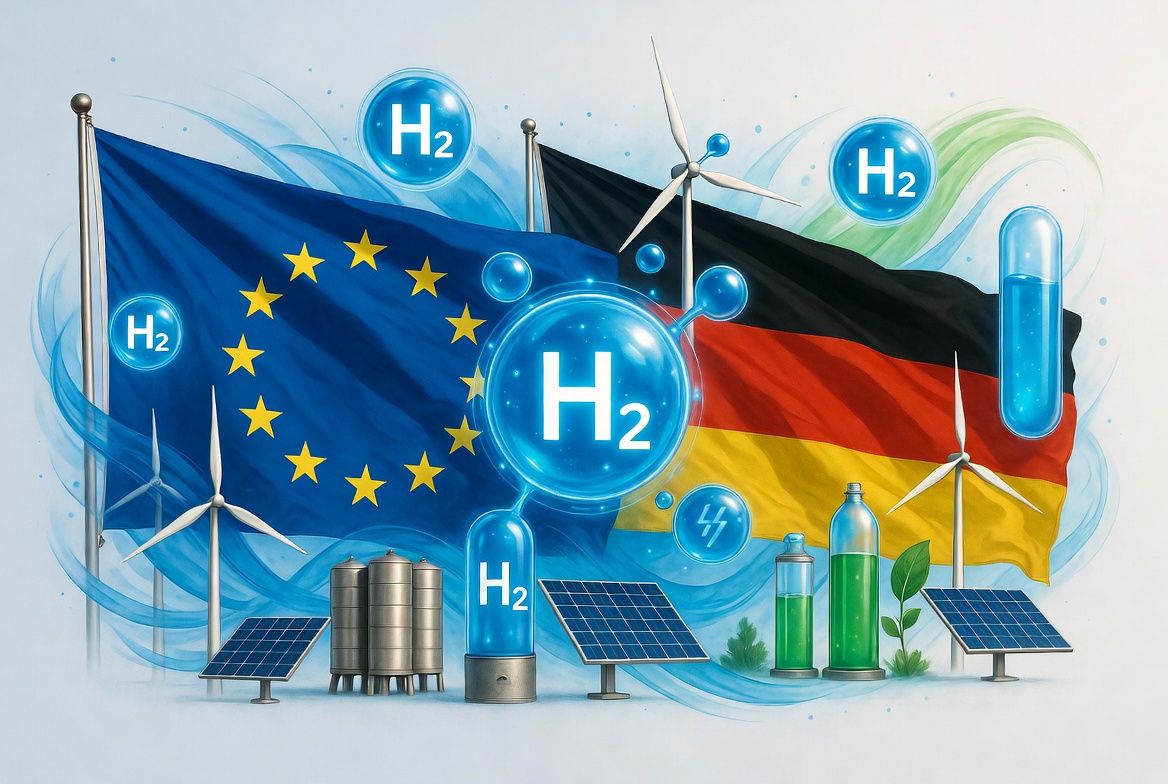
EU-Level Bottlenecks: Fragmented Implementation and Delays
1. Divergent Compliance Undermines a Unified Market
The EU's hydrogen strategy is anchored in the Renewable Energy Directive III (RED III), which mandates that by 2030, 42% of hydrogen used in industry must be renewable, rising to 60% by 2035, and that 1% of transport fuels must be renewable hydrogen by 2030 . However, over a year after the May 2025 transposition deadline, only about half of the 27 member states have enacted these targets into national law . This fragmented implementation creates a "patchwork" of different rules, penalties, and ambitions, threatening to fracture the very market the EU aims to build and creating an uneven playing field where companies in Germany face a different reality than competitors in Poland or Greece .
2. The Penalty Gap and the Investment Case
Industry associations have sharply criticized the lack of harmonization. The Hydrogen Council warned that penalties in most member states are "too low" and that effective enforcement requires penalties above €10-12/kg . Poland's proposed €1.4/kg penalty was cited as the starkest example of a penalty that would fail to drive change . This disparity distorts the single market and hampers long-term investment decisions.
3. The RFNBO Rules Debate
A major point of contention is the strict regulation for Renewable Fuels of Non-Biological Origin (RFNBO). The stringent "additionality" and "time-matching" rules, designed to ensure green hydrogen's environmental integrity, have significantly increased compliance costs . The European Commission has acknowledged that progress is "far from expectations" and is considering loosening them. Eight major European electrolyser manufacturers, including Thyssenkrupp Nucera, ITM Power, and Siemens Energy, jointly urged the Commission President for more flexibility, arguing that the strict rules are stalling projects and leaving factories idle . However, this push faces opposition. Air Products has cautioned against reopening the rules, stating it would "freeze investment" decisions . The Green Hydrogen Organisation echoed this, warning it would "destabilise the market" .
4. Underutilised EU Hydrogen Bank Funds
Financial support mechanisms have also been ineffective. National hydrogen associations noted that in the EU Hydrogen Bank's second auction, only €300 million of the €1.2 billion available was effectively used, due to speculative low bids that were later withdrawn . The associations are calling for reforms, including extending the reallocation mechanism and continuing the auction programme to ensure full use of funds and maintain investor confidence .
Germany-Specific Bottlenecks: Between Ambition and Reality
1. The 10 GW Target is Unattainable
Germany aims for 10 GW of electrolyser capacity by 2030. However, a report from the Energy Economics Institute (EWI) painted a grim picture: only 181 MW is operational, with a further 1,271 MW at Final Investment Decision (FID) or under construction . This means only about one-eighth of the 10 GW target is secured. The EWI report noted that "under current conditions, the 10 GW target is likely to be missed," and the economy ministry has indicated plans to scrap the fixed target in favor of a more flexible one . The German government has acknowledged that the hydrogen ramp-up "has not worked as well as we had hoped" .
2. Financial Risks and Rethinking the ‘Blue Hydrogen’ Pivot
The Institute for Energy Economics and Financial Analysis (IEEFA) has warned that taxpayers could face an additional €45 billion in costs if demand is lower than expected, including €34.7 billion for pipeline costs . To address the shortage of green hydrogen, Germany's Hydrogen Acceleration Act (passed in February 2026) grants "overriding public interest" status to blue hydrogen, a move criticized by IEEFA as adding an expensive CO₂ pipeline network and re-establishing dependence on volatile global gas markets . This shift from an initial green-only strategy is seen by some as an erosion of climate goals.
Industry Outrage: Voices from Thyssenkrupp and Associations
1. Thyssenkrupp CEO Takes the Helm at Hydrogen Europe
In late July 2026, Miguel López, CEO of Thyssenkrupp, was elected Chair of the Hydrogen Europe board, signaling a stronger alignment with industrial competitiveness . López, who has been openly critical and helped form the European Resilience Alliance (ERA), calls on the EU to prioritize "industrially anchored" projects . The ERA is direct about the situation: despite a massive project pipeline, fewer than 7% of clean hydrogen projects have reached FID . More than 50 projects have been cancelled in the last 18 months, and renewable hydrogen costs around €8/kg against just over €2/kg for its fossil alternative .
2. 'Stranded Asset' Warning and Industry Calls
López has warned that Thyssenkrupp's €3 billion hydrogen-based steel plant risks becoming a "stranded asset" unless green hydrogen supply is ramped up . The German Energy and Water Association (BDEW) and the German Hydrogen Association (DWV) have raised alarms about the stagnation, calling for a more practical legal framework . The German National Hydrogen Council (NWR) has also warned that blending hydrogen into existing gas networks is limited, and high-voltage transmission networks are effectively capped at 2% hydrogen due to EU gas quality rules, preventing easy use of existing infrastructure for large-scale transport .
Conclusion and Analysis
The hydrogen industry in Europe is at a crossroads. Key bottlenecks include fragmented policy implementation, regulatory uncertainty, a wide gap between ambition and reality, and cost pressures, particularly from competitors like China who are capitalizing on lower costs and clear policy signals .
The appointment of the Thyssenkrupp CEO as Hydrogen Europe Chair is a strategic move signaling a shift toward prioritizing industrial competitiveness . To overcome these bottlenecks, the EU and Germany need decisive action to harmonize rules, strengthen enforcement, ensure policy stability, and provide clear economic signals to attract investment. Without these steps, their hydrogen ambitions will continue to lag, and the industry will remain vulnerable.
References
-
gasworld. (2026, July 29). Thyssenkrupp CEO named Hydrogen Europe chair amid competitiveness push.
-
TTWTO VCCI. (2026, July 18). Halfway Compliance Risks Fragmenting Europe’s Green Hydrogen Market.
-
Clean Energy Wire. (2026, January 19). Ramp-up of Germany's green hydrogen electrolyser capacity continues to lag behind.
-
Hydrogen Europe. (2026, May 27). EU H2 Bank – Ensuring effective allocation of support in upcoming auctions.
-
EIC Energy Focus. (2026, June 4). From industrial strength to strategic resilience: Europe's hydrogen moment.
-
PV Magazine. (2026, June 9). Only a quarter of funds from the second European hydrogen auction is turning into investment.
-
FuelCellChina. (2026). World Hydrogen Summit 2026: Europe Has the Technology, the Rules, and the Ambition.
-
Hydrogen Council. (2026, May 2). Why RED III implementation matters?
-
World Ports. (2026, July 7). EU RFNBO rules divide hydrogen industry.
-
IEEFA. (2026). Germany’s hydrogen strategy — a reset in progress.