
MHI Vietnam introduced Japan's Hydrogen Park Model
October 1, 2026, By Annie Nguyen, VAHC Secretariat
Speaker: Mr. Kamo Kohei, General Director of Mitsubishi Heavy Industries Vietnam Company Limited, presented at Vietnam Hydrogen Economy Workhsop by VAHC and HUTECH School of Engineering on September 30, 2026
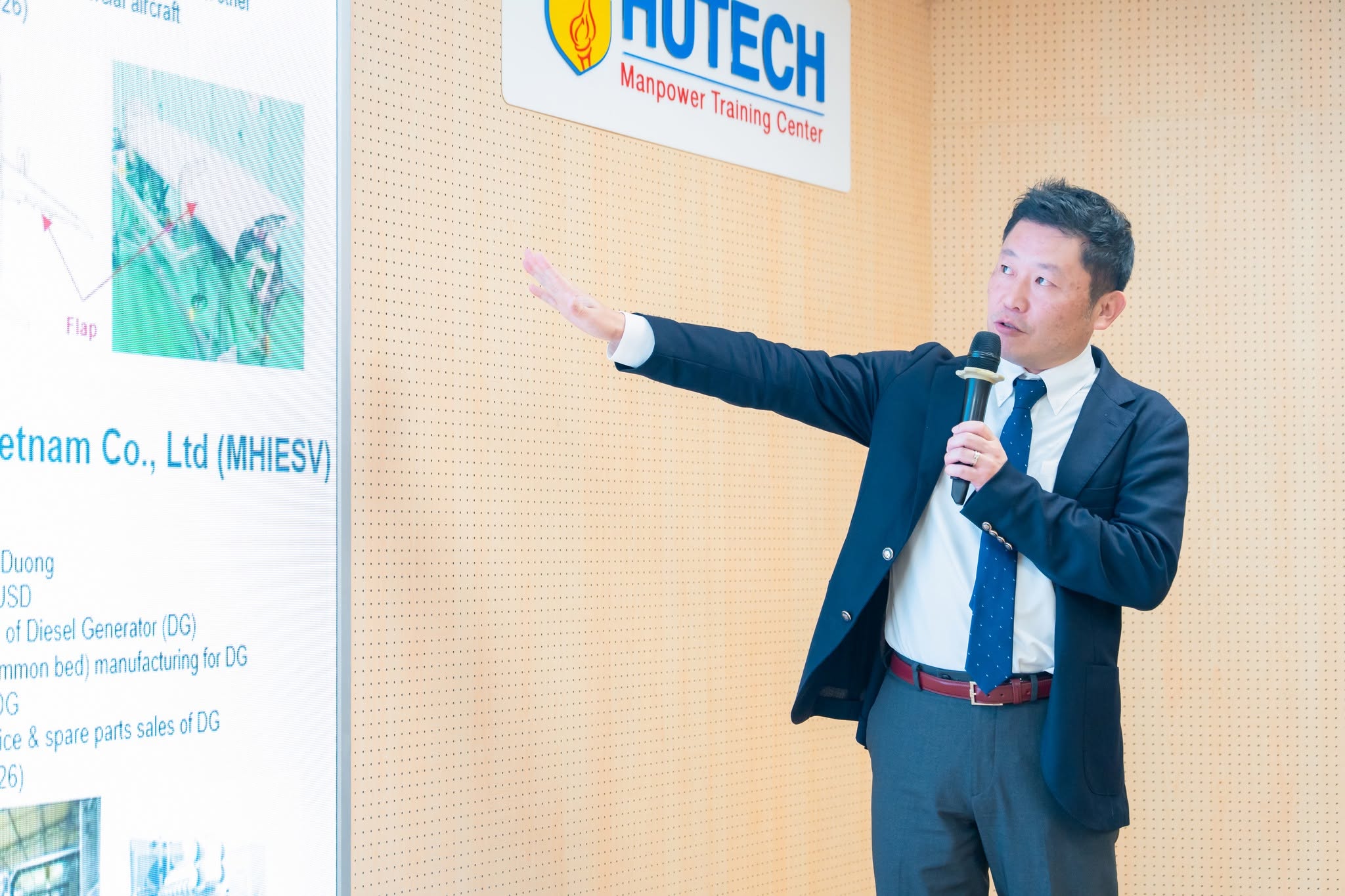
Mr. Kamo Kohei opened with an overview of Mitsubishi Heavy Industries (MHI). As of 31 March 2026, MHI has 78,793 employees and 246 group companies, with revenue of 4,974.1 billion yen in FY2025. MHI operates across diverse fields: gas turbines, compressors, aero engines, CO₂ capture plants, metals machinery, chemical plants, transportation, waste-to-energy, turbochargers, aerospace, rocket engines and defence.
Organisation Structure in Asia Pacific
Mr. Kamo presented MHI's organisation structure in the Asia Pacific region. MHI has a regional headquarters in Singapore (MHI Asia Pacific – MHI-AP), with offices in Malaysia, Thailand, Indonesia, the Philippines, Australia and India. In Vietnam, MHI has member companies: Mitsubishi Heavy Industries Vietnam Co., Ltd. (Hanoi Head Office and Ho Chi Minh Branch Office), MHI Aerospace Vietnam Co., Ltd (MHIVA) at Thang Long Industrial Park, Dong Anh, Hanoi with 414 employees manufacturing flaps and other components for commercial aircraft; MHI Engine System Vietnam Co., Ltd (MHIESV) at VSIP Binh Duong with 75 employees assembling diesel generators; and MPW-PVC (SPV for Power Project).
Delivery Record in Vietnam
Mr. Kamo introduced MHI's delivery record in Vietnam from 2002 to present. Notable projects include: Centrifugal Compressor for Ninh Binh Coal & Gas Fertilizer Plant (2010); Centrifugal Compressor for Thai Binh Mining Chemicals Plant (2013); Steam Turbine Generator for Vina Kraft Paper (26MW, 2009); Steam Turbine for Nghi Son 2 Thermal Power Plant (2022); CO₂ Recovery System for Phu My Fertilizer Plant (2010); Primetals Steel Making Plants Formosa Ha Tinh (2015); Centrifugal Compressor for Petro Vietnam Fertilizer Chemicals Corp. (2002); Centrifugal Compressor for Hyosung Vina Chemicals Co. Ltd (2020); Centrifugal Compressor for Long Son Petrochemicals Co. Ltd (2020); Phu My Combined Cycle Power Plant (1,090MW, 2002); O Mon 1-1 Oil-fired Power Plant (330MW, EPC 2009) and O Mon 1-2 Oil-fired Power Plant (330MW, BTG 2014); and Hydraulic Deck Cranes to Bach Dang Shipping Co. Ltd (2026).
Carbon Neutral Park Nagasaki
Mr. Kamo introduced the Carbon Neutral Park in Nagasaki – MHI's R&D and manufacturing facility focusing on key technologies for carbon neutrality: hydrogen production, biomass gasification, ammonia combustion and CO₂ capture. The facility includes the Nagasaki Design & Manufacture Plant, the Koyagi Plant and the Research & Innovation Center. Here, MHI conducts elemental experiments on ammonia co-firing in boilers, CO₂ capture equipment and hydrogen production.
Hydrogen Park Takasago
Mr. Kamo introduced in detail Hydrogen Park Takasago – a demonstration facility integrating hydrogen production, storage and utilisation. The Takasago Machinery Works manufactures high-efficiency gas turbines and develops ammonia and hydrogen combustors. Hydrogen Park Takasago started full-scale operation in 2023.
SOEC (Solid Oxide Electrolysis Cell) Technology: The SOEC system produces hydrogen using steam and electricity, based on proven SOFC technology. MHI's SOEC system delivers higher efficiency than other water electrolysis systems through efficient heat utilisation. The use of high-temperature, high-pressure steam enables easier scale-up, making SOEC well suited for industrial-scale applications. A 400 kW class SOEC test module is being operated at Hydrogen Park Takasago. SOEC process: steam at 700°C is sent into a cell stack, separating into oxygen and hydrogen. The system includes cell stack (separates steam into oxygen and hydrogen) and hot module (sends steam of 700°C into a cell stack). SOEC is an application of proven SOFC technology.
Methane Pyrolysis Technology (Turquoise Hydrogen): A technology that thermally decomposes natural gas into solid carbon and hydrogen at high temperatures. Existing LNG infrastructure enables the large-scale, low-cost supply of CO₂-free hydrogen. The carbon by-product is recovered in solid form, enabling easy transportation, storage and recycling. This technology is applicable worldwide, particularly in Japan and Southeast Asia, where renewable energy resources are limited and CO₂ storage capacity is constrained. Process: LNG from tanker and tank → methane pyrolysis → hydrogen (used for thermal power plant and power) + solid carbon (carbon fixation or recycling into carbon black, graphite). MHI is testing continuous pressurised fluidised bed test equipment at Carbon Neutral Park Nagasaki, with test results showing H₂ production increasing over time and by-product carbon being recovered.
M501JAC Gas Turbine Hydrogen Co-Firing: On 20 November 2023, MHI achieved 30% hydrogen co-firing at 100% load on the M501JAC gas turbine with Dry Low NOx combustor – the world's first for a large high-end gas turbine. H2 co-firing rate reached 30.5 vol%, gas turbine output at 100%, gas turbine speed at 3,598.6 rpm. This result reduces CO₂ emissions by 10% compared to natural gas. At McDonough, Georgia (USA), MHI collaborated with Georgia Power to achieve over 50% hydrogen co-firing at both full load and partial load, maintaining NOx emissions below 15 ppm. This is the world's largest hydrogen fuel blending demonstration to date on an advanced class gas turbine. The project uses the M501GAC gas turbine (283MW) with hydrogen transported by high-pressure H₂ gas trailers.
Synthetic Fuels Production Process
Mr. Kamo introduced the synthetic fuels production process using electricity, hydrogen, CO₂. SOEC co-electrolysis is a highly versatile technology capable of producing syngas (H₂ and CO) – a key feedstock for the synthesis of a wide range of synthetic fuels. By integrating SOEC co-electrolysis, CO₂ capture systems and a range of synthesis processes with MHI's diverse portfolio of products and technologies, MHI can provide high-value-added fuel manufacturing solutions. Process: renewable energy + CO₂ from biomass emissions → SOEC co-electrolysis → syngas → synthesis → SAF, e-fuel, methanol, methane → utilisation in existing or new supply chains.
Advanced Gas Turbine Technology – Hydrogen and Ammonia Fuel Conversion
Mr. Kamo presented advanced gas turbine technology. Development of hydrogen-fired gas turbines began in the 1970s. Fuel conversion from natural gas to hydrogen/ammonia is easily achieved by replacing combustor parts and adding fuel systems. MHI has developed three combustor types: Type 1, Type 2 (Dry Low NOx – successfully operated with 30% hydrogen co-firing) and Type 3. The M501JAC gas turbine with Dry Low NOx combustor achieved 30% hydrogen co-firing at 100% load.
Intermountain Power Project
Mr. Kamo introduced the Intermountain Power project in Delta, Utah (USA). Mitsubishi will supply two hydrogen-capable M501JAC gas turbine power trains (1X1) to Intermountain Power Agency. Plans are to co-fire 30% hydrogen in 2026 and operate on 100% hydrogen no later than 2045. The project includes an Advanced Clean Energy Storage facility with green hydrogen production and storage at Delta, Utah. Hydrogen is produced by electrolysers, stored in an underground salt dome, and used for power generation. The project includes: Electrolyzer, Salt Dome, GTCC Construction Site, and Unit 4 Centerline.
Global Hydrogen and Ammonia Projects
Mr. Kamo introduced a map of hydrogen and ammonia projects being developed by MHI worldwide. Hydrogen projects: Zero Carbon Humber (H2H Saltend) at Hull, Humber, UK (M701F, 1,200MW, 3 CCGT); Magnum at Eemshaven, Netherlands (M701F, 440MW); Intermountain Power at Delta, Utah, USA (M501JAC, 840MW, 2 CCGT); Advanced Clean Energy Storage at Delta, Utah, USA (green hydrogen production and storage); McDonough at Smyrna, Georgia, USA (M501G, 2,520MW, 3 CCGT, 20vol% hydrogen co-firing validated in 2022, 50vol% hydrogen co-firing validated in 2025); Meranti Power in Singapore (M701F, 340MW x 2); Keppel Infrastructure in Singapore (M701JAC, 600MW); Sembcorp Industries in Singapore (M701JAC, 600MW); PacificLight Power in Singapore (M701JAC, 670MW); PETROS Power in Malaysia (M701F, 500MW); PetroVietnam (M701JAC, 1,155MW). Ammonia projects: BLCP Steam Power Plant at Map Ta Phut, Thailand (NH₃ co-firing, 700MW x 2); Linkou Steam Power Plant at New Taipei, Taiwan (NH₃ co-firing, 800MW x 3); Guacolda Steam Power Plant at Atacama, Chile (NH₃ co-firing, 150MW x 5); ADNOC (MOU for Blue Hydrogen, Ammonia and CCS); OQ (MOU for Blue & Green); Yara Pilbara (MOU for Blue NH₃); PTT (Pre-FS for using NH₃ GT Power Generation); PTTGC (Pre-FS for Decarbonization of Petrochemical Plant); Port of Newcastle (Under discussion to establish H2 HUB and clean energy economy); Taiwan Fertilizer (MOU for NH3 Value Chain).
Hydrogen Co-Firing Gas Turbine Projects in Southeast Asia
Mr. Kamo introduced hydrogen co-firing gas turbine projects in Southeast Asia. Meranti Power in Singapore (680MW OCGT, M701F x 2, under commercial operation). Sembcorp Banyan in Singapore (600MW GTCC, M701JAC x 1, COD 2026). Keppel Sakra in Singapore (600MW GTCC, M701JAC x 1, under commercial operation). PacificLight Power in Singapore (670MW GTCC, M701JAC x 1, COD 2029). Miri in Malaysia (500MW GTCC, M701F x 1, COD 2027). O Mon IV in Vietnam (1,155MW GTCC, M701JAC x 2, COD 2028).