

Life Cycle Assessment of Hydrogen Produced by Solid Oxide Electrolysis Cell (SOEC) Systems
July 29, 2026 by VAHC Secretariat
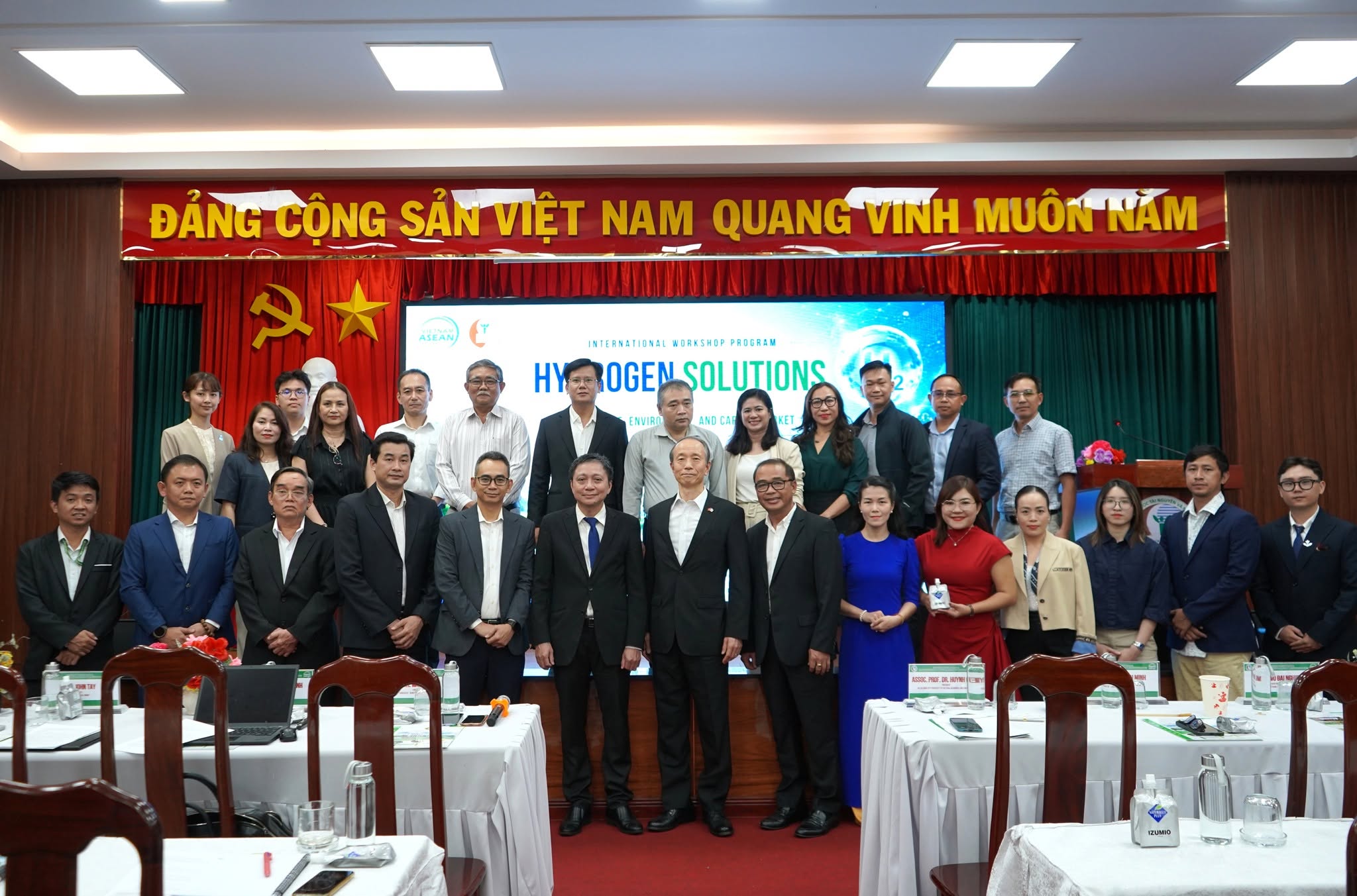
On July 29, 2026, at Ho Chi Minh City University of Natural Resources and Environment (HCMUNRE), the International Workshop on "Hydrogen Solutions for Agriculture, Environment, and Carbon Market" co-hosted by HCMUNRE and VAHC officially took place. The event brought together a large number of scientists, leading experts, domestic and international businesses, and diplomatic representatives from Japan, Malaysia, and South Korea. The workshop was organized to promote hydrogen applications in agriculture, environment, and carbon market development in Vietnam, while strengthening international cooperation in clean energy.
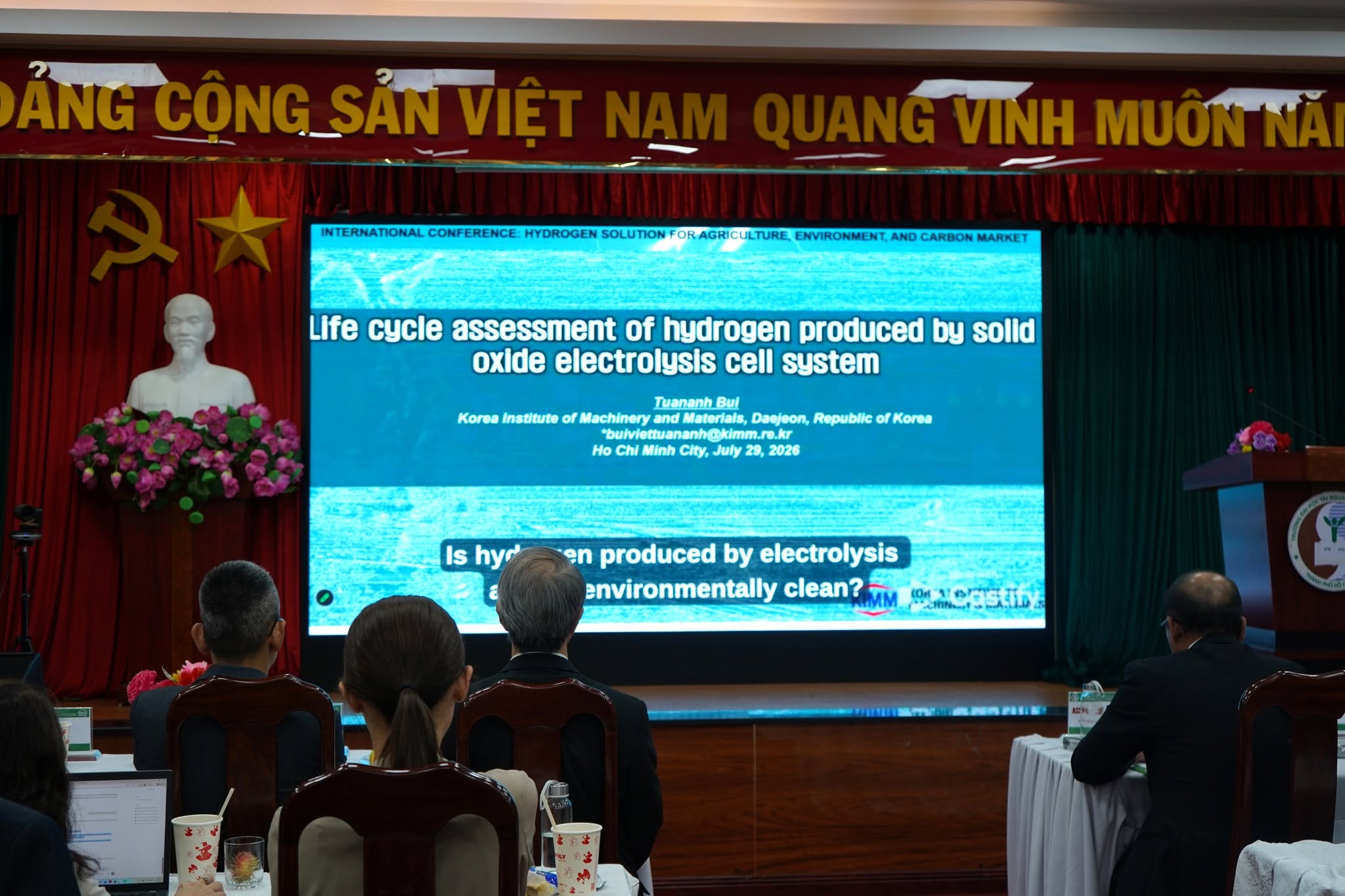
SPEAKER 5: DR. BUI VIET TUAN ANH – KOREA INSTITUTE OF MACHINERY AND MATERIALS (KIMM) – ONLINE FROM SOUTH KOREA
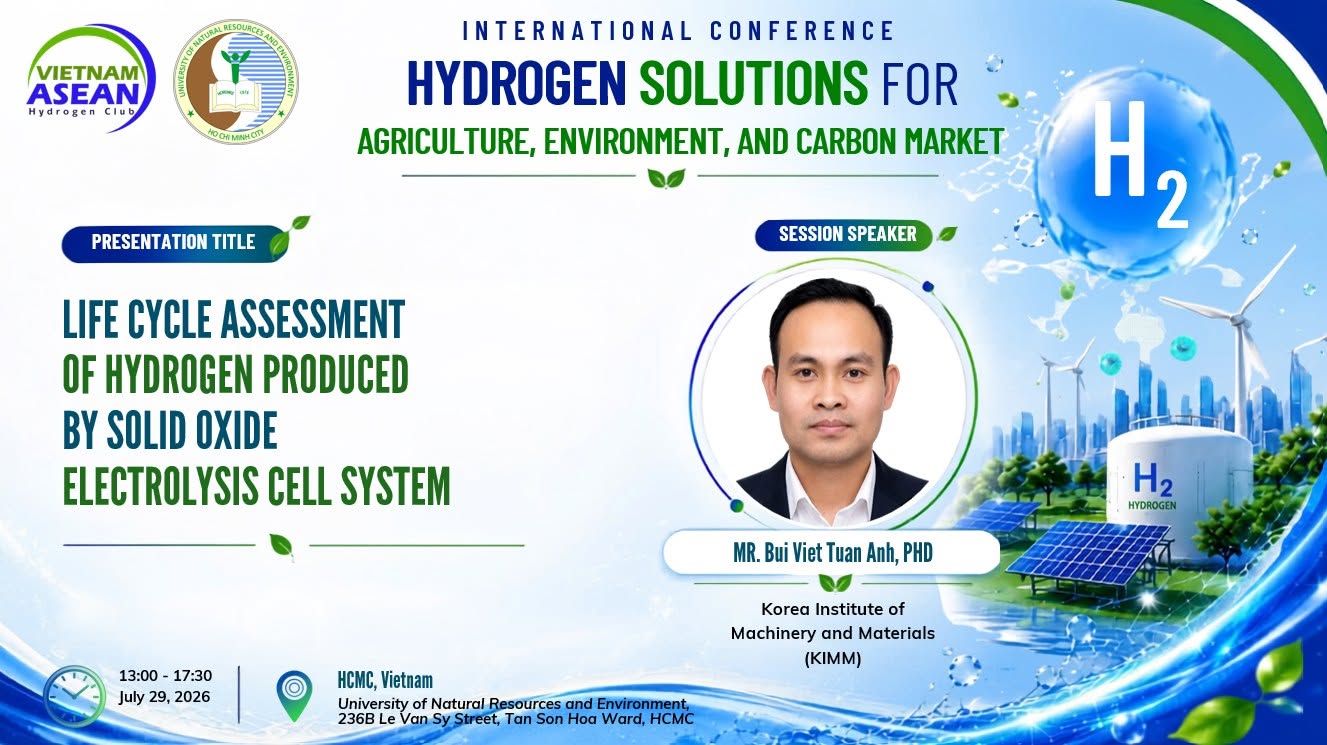
Topic: Life Cycle Assessment of Hydrogen Produced by Solid Oxide Electrolysis Cell (SOEC) Systems
Background and Research Motivation
Dr. Bui Viet Tuan Anh opened by setting the global context:
-
Global hydrogen production today is still dominated by fossil fuels (natural gas and coal).
-
Low-emission hydrogen still accounts for less than 1% of total production (IEA, 2025).
-
Hydrogen produced by electrolysis is considered the cleanest method.
-
Among electrolysis technologies, Solid Oxide Electrolysis Cell (SOEC) is highly regarded due to high efficiency and less catalyst requirement (no precious metals needed).
Two Research Questions:
-
Is hydrogen produced from SOEC really clean?
-
If there is environmental impact, which factor contributes most?
Research Objectives:
-
Quantify the environmental impact of 1 kg hydrogen produced by a 20-kW high-power SOEC system.
-
Identify the dominant contributor to environmental impact and suggest solutions.
SOEC System Specifications
HP-SOEC (High-Power SOEC) System:
| Parameter | Unit | Value |
|---|---|---|
| Electrical Efficiency | % | 81.5 |
| Electricity Input | kW | 21.2 |
| Steam Input | kg/h | 10.18 |
| Hydrogen Output | kg/h | 0.52 |
| HEX Effectiveness | - | 0.92 |
| System Lifetime | years | 20 |
SOEC Stack Specifications:
| Parameter | Unit | Value |
|---|---|---|
| Operating Temperature | °C | 715 |
| Cell Current Density | A/cm² | 1.0 |
| Cell Area | m² | 0.01 |
| Cell Voltage | V | 1.3 |
| Number of Cells | - | 145 |
| Fuel Utilization | - | 0.45 |
| Stack Lifetime | years | 5 |
LCA Methodology
Dr. Tuan Anh introduced the methodology:
LCA Definition: LCA quantifies the environmental impacts of a product or system throughout its entire life cycle, from raw material extraction to disposal.
Method: ReCiPe 2016 Endpoint (Hierarchist) V1.13
Library: Converted ecoinvent 3.6
Scope: Cradle-to-grave (from resource extraction to disposal)
Assessment Indicators:
-
18 midpoint indicators (single environmental problems)
-
Converted to 3 endpoint damages:
-
Human Health
-
Ecosystem
-
Resource Scarcity
-
System Boundary:
-
Includes: Raw material extraction, equipment manufacturing, transport, operation, maintenance, stack replacement, disposal.
-
Excludes: End-use hydrogen consumption and carbon capture.
Manufacturing Results
Contribution of Each Component in Manufacturing Phase:
| Component | Contribution Percentage |
|---|---|
| SOEC Stack Module | 32% |
| Air and Steam Supply System (blowers, valves, piping) | 23.3% |
| Heaters | 19.2% |
| Other Components | 25.5% |
Observation: SOEC stack has the highest contribution (32%) due to high-tech material requirements and complex manufacturing processes. The air and steam supply system accounts for 23.3%, heaters for 19.2%.
Full Lifecycle LCA Results
| Phase | Impact (Pt) | Percentage |
|---|---|---|
| System Manufacturing | 0.0195 | 0.58% |
| Operation – Electricity | 2.718 | 80.90% |
| Operation – Steam | 0.618 | 18.45% |
| Disposal | 0.000249 | 0.007% |
| Total | 3.35 | 100% |
Critical Conclusion:
-
Electricity dominates environmental impact (≈81%).
-
Steam contributes 18.45%.
-
Manufacturing and disposal have very small impacts (<0.6%).
Meaning: The environmental impact of SOEC hydrogen mainly comes from the operation phase, especially the electricity source used.
Comparison with Conventional Hydrogen Production Methods
Dr. Tuan Anh compared with IEA Global Hydrogen Review 2024 data:
| Production Method | CO₂ Emissions (kg CO₂/kg H₂) | Characteristics |
|---|---|---|
| SMR (without CCUS) | 10-15 | Dominated by direct process emissions |
| SMR + CCUS | 4-7 | Reduced by carbon capture |
| Coal Gasification (without CCUS) | 18-22 | Highest |
| Electrolysis (mixed grid) | Electricity dependent | Impact from upstream |
| Electrolysis (renewables) | Very low | Mainly from equipment manufacturing |
Key Takeaway: SOEC is not automatically low-carbon – it becomes low-carbon only with clean electricity and low-carbon steam.
Case Study: Using Different Electricity Sources
Dr. Tuan Anh presented simulation results using three different electricity sources:
| Electricity Source | Impact (Pt) | Reduction vs Mixed |
|---|---|---|
| Mixed (Korean Grid) | 3.35 | - |
| Photovoltaic (PV) | 1.14 | 66% |
| Nuclear | 0.13 | 96% |
Detailed Analysis:
-
With PV Electricity:
-
Two main contributors: electricity (44%) and steam (54%).
-
Impact shifts from climate/fossil depletion to land use, ecotoxicity, and metal depletion.
-
-
With Nuclear Electricity:
-
Electricity accounts for 77% of impact.
-
Significant impacts appear from ozone depletion and ionizing radiation.
-
Conclusions and Recommendations
Three Main Conclusions:
-
Electrolysis is not a "miracle machine" that automatically produces clean hydrogen – it simply converts electricity into hydrogen.
-
The environmental impact of SOEC hydrogen is governed mainly by the carbon intensity of the electricity used.
-
Switching from mixed-grid electricity to PV and nuclear power reduced total impact by 66% and 96% respectively, confirming that clean hydrogen comes mainly from clean electricity.
Strategic Implications for Vietnam:
-
To produce truly clean hydrogen, Vietnam needs to ensure electricity for electrolysis comes from renewable energy (wind, solar) or low-carbon sources.
-
Consider the cost and impact of steam production – waste heat from industrial processes could be utilized to improve overall efficiency.
-
Prioritizing renewable energy development and grid infrastructure is a prerequisite for green hydrogen production in Vietnam.
-
Policies incentivizing clean electricity use for hydrogen electrolysis projects are needed.
Please write email to contact@vahc.com.vn to receive the full presentation of Dr. Tuan Anh.