

Legal & Regulatory Framework for Hydrogen Projects in Vietnam
A Presentation by Hogan Lovells at the "Hydrogen Horizons" Workshop, March 31, 2026, USTH, Hanoi
April 3, 2026 by Annie Nguyễn
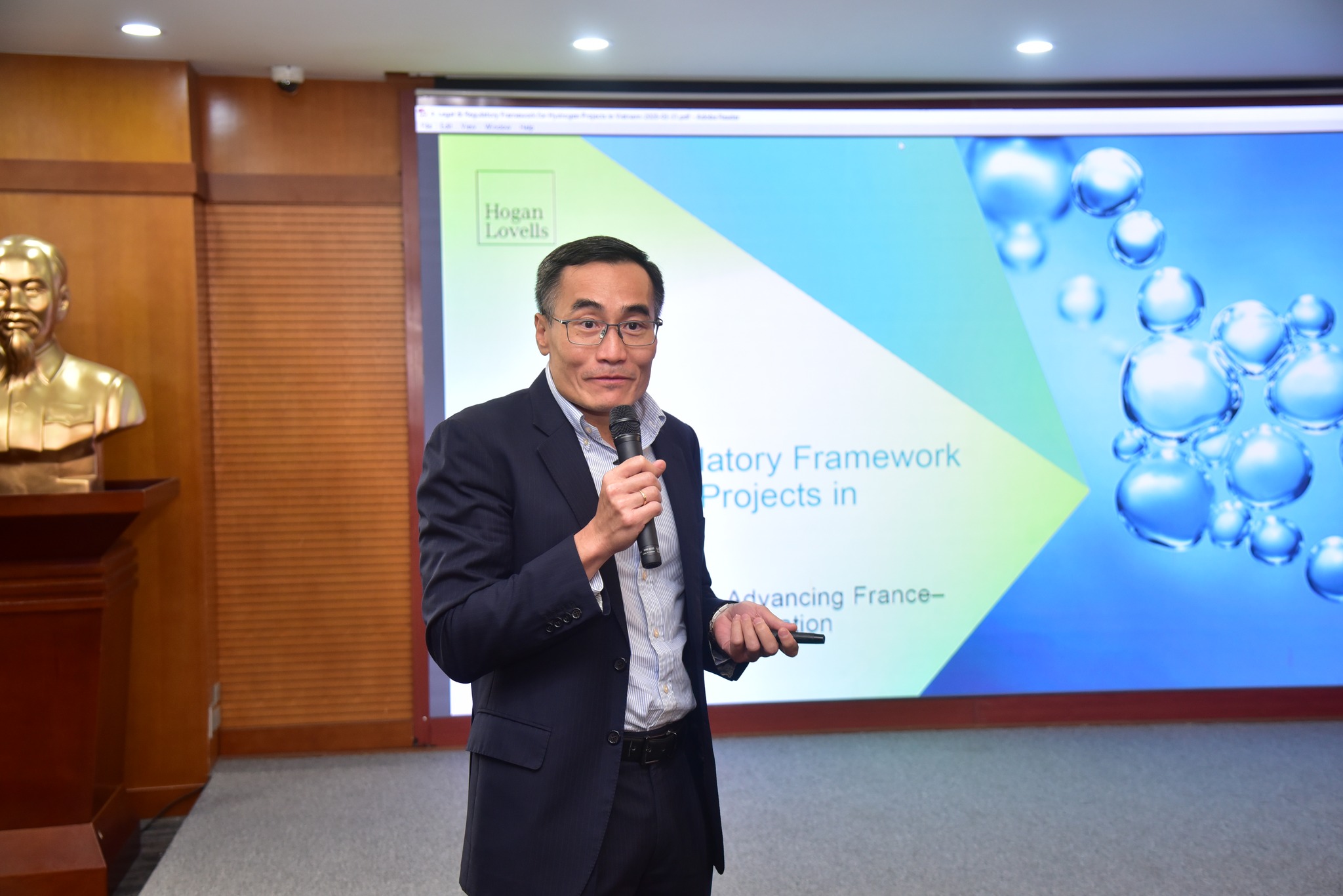
HANOI – On the afternoon of March 31, 2026, within the framework of the international workshop "Hydrogen Horizons - Advancing Vietnam-France Energy Collaboration" held at the University of Science and Technology of Hanoi (USTH), Mr. Duong Pham, Counsel from Hogan Lovells – one of the world's leading international law firms – delivered an in-depth presentation on the "Legal & Regulatory Framework for Hydrogen Projects in Vietnam" .
The presentation was delivered by the experienced legal team at Hogan Lovells, including Mr. Duong Pham (Counsel, Hanoi) – a seasoned advisor with over 20 years of experience in energy, infrastructure, and finance in Vietnam and Southeast Asia.
Key Difference: Green Hydrogen vs. Traditional Renewable Energy
The Hogan Lovells lawyer opened the presentation by pointing out that the development process for a green hydrogen production facility (hydrogen produced via electrolysis using renewable electricity) in Vietnam differs in several important ways from standard renewable energy projects such as solar or wind farms.
Similarity: Both project types are governed by the same overarching legal framework, including the Law on Electricity No. 61/2024/QH15 (effective February 1, 2025) and Decision 768/QD-TTg dated April 15, 2025 (Revised Power Development Plan 8) .
Core Difference: Green hydrogen projects are classified as "new energy" rather than traditional renewable energy, leading to distinct eligibility rules, incentives, approvals, and technical considerations.
"Renewable energy projects focus primarily on electricity generation and sale to the grid, self-consumption, or via DPPA. In contrast, green hydrogen/ammonia facilities typically involve a renewable electricity source, electrolysis, and potential end-uses such as electricity generation, industrial feedstock, fuel, export, or co-firing in power plants," the Hogan Lovells representative explained.
Incentives for Hydrogen Projects – Significant Opportunities with Strict Conditions
According to Decree 58/2025/ND-CP dated March 3, 2025 on the development of renewable energy and new energy, new energy electricity projects are entitled to special incentives but must meet strict eligibility conditions:
-
Must produce electricity entirely (100%) from green hydrogen/green ammonia, or a 100% mixture of both (produced from renewable energy sources).
-
Must supply electricity to the national power system (connected to the grid and selling to EVN or the wholesale market).
-
Must be the First-of-a-Kind (FOAK) project by the investor (pioneering status).
Enhanced incentives include:
-
Sea Area Use Fee Exemptions/Reductions: Full exemption during the capital construction period (up to 3 years), followed by a 50% reduction for the next 9 consecutive years.
-
Land Use Fee and Land Rental Exemptions/Reductions: Full exemption during the capital construction period (up to 3 years).
-
Guaranteed Minimum Offtake (Electricity Output Commitment): The government (through the power purchaser, typically EVN) guarantees a minimum contracted electricity output of at least 70% during the loan repayment period (not exceeding 12 years).
"This offtake guarantee provides revenue stability and improves bankability for financing, addressing a key risk in early-stage new energy technologies," the Hogan Lovells representative emphasized.
Additionally, hydrogen projects may also access general investment incentives such as preferential corporate income tax rates (often 10% for certain energy projects), import duty exemptions on equipment and materials not domestically produced, and access to investment credit and green finance mechanisms.
Project Development and Approval Process
The core steps overlap with renewable energy projects (investment registration, environmental impact assessment, construction permits, grid connection, MOIT/provincial approvals). However, hydrogen projects have additional requirements:
-
Planning Alignment: Must fit within the Revised Power Development Plan 8 and provincial energy plans. Large-scale or pioneering projects may need Prime Minister or National Assembly approval.
-
Pioneering/New Energy Status Verification: Requires MOIT or government verification to access special incentives.
-
Technical & Safety Requirements: Hydrogen involves high-pressure storage, transport, and safety standards (explosion risks, material compatibility). Additional permits from industrial safety authorities, fire prevention, and chemical management authorities may be required.
-
Electricity Sourcing: Most green hydrogen projects pair with dedicated renewable energy (on-site or via private wire/DPPA).
Regulatory Gaps – What Still Needs to Be Issued
The Hogan Lovells representative candidly pointed out several regulatory gaps that need to be addressed:
-
Dedicated regulations on approving investment in hydrogen/ammonia production using renewables.
-
A legal corridor for fossil energy enterprises transitioning to hydrogen.
-
Hydrogen-specific tax, fee and land-rights incentive mechanisms (beyond generic renewable energy incentives).
-
Updated mandatory technical regulations and standards on hydrogen energy aligned with international standards.
-
Regulations on hydrogen storage, transportation and distribution infrastructure.
-
Certification and traceability standards for green hydrogen.
-
Offtake mechanisms or hydrogen procurement mandates for industrial consumers.
-
Cross-border trade rules for hydrogen and ammonia exports.
Key Legal Documents
The Hogan Lovells team summarized the most important strategic documents and regulations currently in place:
Prime Minister-Level Strategies:
-
Decision 165/QD-TTg (February 7, 2024) – National Hydrogen Energy Development Strategy to 2030, vision to 2050. Targets: 100,000-500,000 tons/year by 2030 and 10-20 million tons/year by 2050.
-
Decision 768/QD-TTg (April 15, 2025) – Revised Power Development Plan 8, including specific green hydrogen project sites and capacity targets.
Key Laws:
-
Law on Electricity No. 61/2024/QH15 – Formally defines green hydrogen; encourages development combined with BESS or green hydrogen/ammonia production; provides special incentives.
-
Law on Investment No. 143/2025/QH15 – CIT incentives, import duty exemptions, land/water fee reductions for hydrogen projects as encouraged investments.
-
Law on Environmental Protection No. 72/2020/QH14 – EIA requirements for large-scale hydrogen production facilities.
-
Law on Chemicals No. 69/2025/QH15 – Hydrogen production is a priority industry.
Key Implementing Decrees:
-
Decree 58/2025/ND-CP – Details incentives for new energy electricity projects (sea area fee exemptions/reductions, minimum 70% offtake guarantee).
-
Decree 56/2025/ND-CP – Governs how hydrogen power projects are incorporated into national and provincial power development plans.
-
Decree 57/2025/ND-CP – Direct Power Purchase Agreement (DPPA) mechanism, applicable to hydrogen-powered electricity projects.
Conclusion – Strategic Opportunities for Investors
The Hogan Lovells representative concluded that while the legal framework for hydrogen in Vietnam is still being refined, Decision 165/QD-TTg and recent implementing documents have created a solid foundation. The special incentives for new energy projects, particularly the minimum 70% offtake guarantee and sea area use fee exemptions/reductions, are very positive signals for pioneering investors.
However, investors need to prepare for navigating a complex approval process, meeting stringent conditions to access incentives, and closely monitoring forthcoming implementing regulations. With deep experience in energy and infrastructure in Vietnam, Hogan Lovells stands ready to accompany investors in realizing hydrogen projects in Vietnam.
Reported by: VAHC Secretariat
Email: contact@vahc.com.vn