

Legal Classification of Hydrogen under Vietnamese Law: Strategy, Standards, and International Comparison
Annie Nguyễn
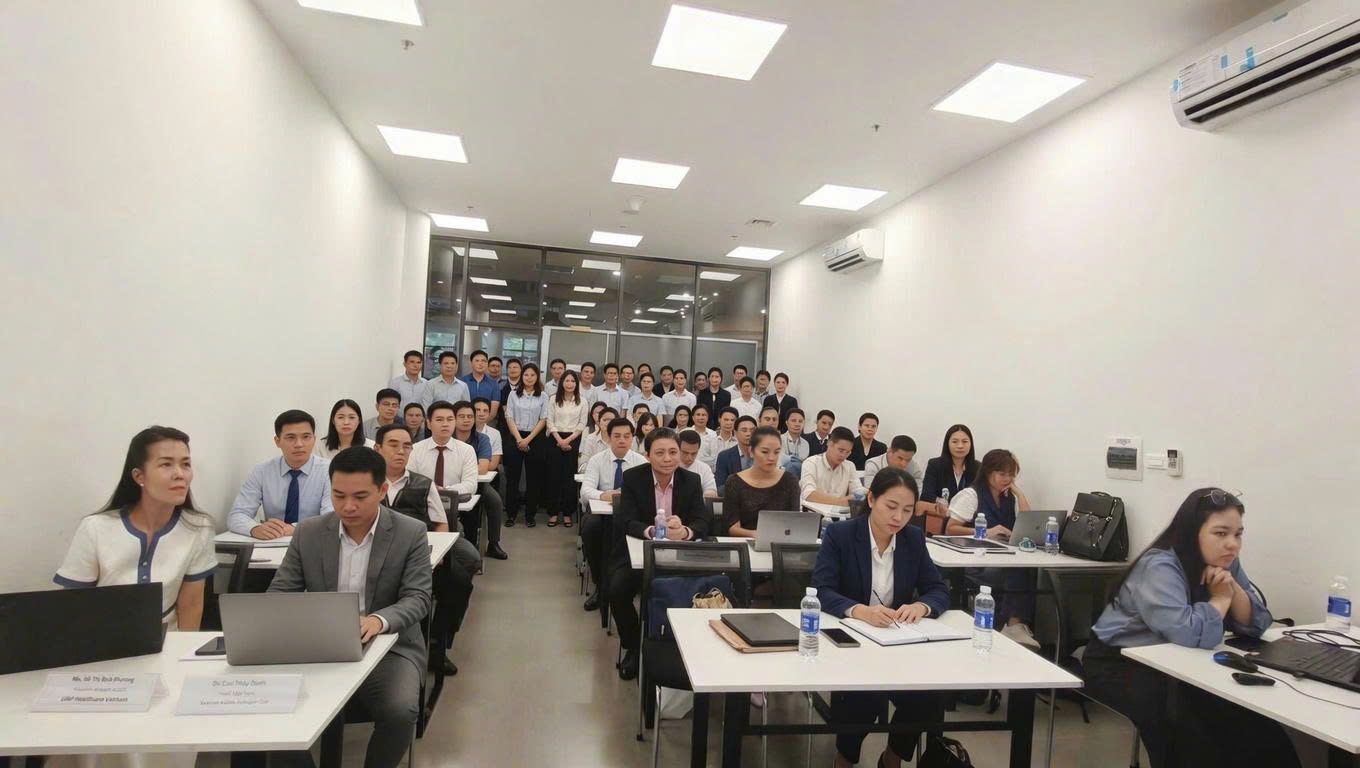
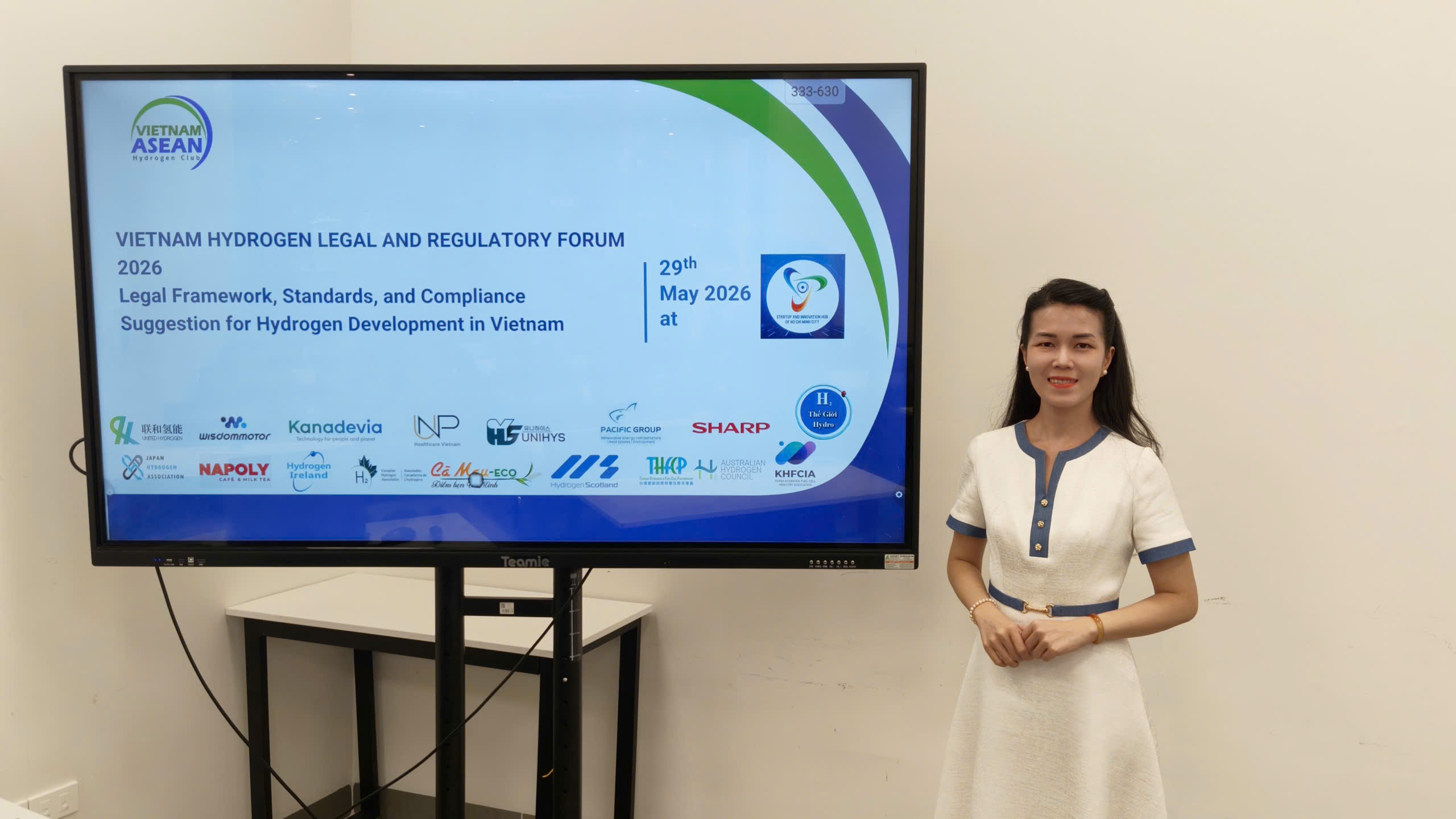
May 29, 2026 – Saigon Innovation Hub (SIHUB), Ho Chi Minh City
Hydrogen: from the Net Zero 2050 commitment to a test of policy implementation capacity.
At the Vietnam Hydrogen Legal and Regulatory Forum 2026 organized by the ASEAN Vietnam Hydrogen Club (VAHC), Dr. Cao Thúy Oanh, Head of Research & Development Group of VAHC, delivered a comprehensive presentation on the legal framework for hydrogen. Her presentation focused on three objectives: (1) clarifying what hydrogen is and how it is used; (2) analyzing the layers of laws and standards governing hydrogen in Vietnam and internationally; and (3) comparing Vietnam's hydrogen strategy with major country groups and proposing a practical roadmap.
If we do not grasp hydrogen today, we will lose our competitive advantage tomorrow.
1. What is Hydrogen and How is it Used?
1.1. Scientific and Economic Overview
Hydrogen is not an energy source – it is an energy carrier of the new era.
Hydrogen is the lightest and most abundant element in the universe, but it rarely exists as free H₂ on Earth; it is mainly found in water and organic compounds. In energy terms, hydrogen is an energy carrier, not a primary energy source. It can be produced from fossil fuels (with or without carbon capture) or from renewable and nuclear power.
According to the International Energy Agency (IEA), global hydrogen production in 2024 reached approximately 100 million tonnes, but only about 1% was low-emission hydrogen. The majority of demand still comes from oil refining, ammonia production, methanol, and steelmaking.
The issue is not whether we have hydrogen, but whether it is clean or dirty hydrogen.
1.2. Industrial Applications
The largest hydrogen market today still lies in traditional industries.
-
Oil refining: Hydrocracking, hydrodesulfurization.
-
Chemicals and fertilizers: Ammonia production (Haber–Bosch), methanol.
-
Metallurgy: Partially replacing coke in steel production, acting as a reducing agent while reducing CO₂ emissions.
-
Mining and non‑ferrous metallurgy: Used in reduction processes, surface treatment, and protective gases in special smelting.
If we want green hydrogen tomorrow, we must replace grey hydrogen in industry today.
1.3. Energy Applications (Electricity, Heat)
Hydrogen is the memory bank of wind and solar power systems.
-
Fuel cell power plants: South Korea targets 15 GW of fuel cell power by 2040; Japan has deployed ENE‑FARM – residential fuel cell systems – and considers 2015 the "first year of hydrogen" after decades of R&D and demonstration.
-
Integration with nuclear heat: Research in the US and Europe considers using high‑temperature reactor heat (VHTR) for high‑efficiency hydrogen production.
Without hydrogen storage, renewable power grids cannot go far.
1.4. Transport Applications
Batteries for light vehicles – short distances; hydrogen for heavy vehicles – long distances.
-
Fuel cell electric vehicles (FCEVs), buses, heavy trucks, trains, ships: Japan, South Korea, the EU, and the US have launched numerous demonstration programs. South Korea aims for about 6 million H₂ vehicles and 1,200 refueling stations by 2040.
-
Germany and Nordic countries are developing cross‑border hydrogen corridors, focusing on buses and fixed‑route trucks.
Refueling infrastructure must come half a step first – the vehicle market will follow.
1.5. Agricultural Applications
Hydrogen does not only go into factories – it can also go into the fields.
-
H₂‑enriched irrigation water: Improves soil microbiology, reduces oxidative stress in plants; initial experiments in Japan and South Korea have shown positive results.
-
Low‑emission fertilizers: Using green H₂ or NH₃ to produce fertilizer, reducing dependence on natural gas.
These applications are still at the R&D and demonstration stage, suitable for Vietnam to monitor and conduct small‑scale pilots linked to high‑tech agriculture.
From green fertilizers to hydrogen‑rich water: agriculture is a soft gateway for hydrogen.
1.6. Health Applications
Hydrogen applications in health are promising, but must be accompanied by evidence.
Japan has developed hydrogen therapy: hydrogen hot springs, hydrogen gas inhalers, hydrogen‑rich drinking water... aimed at supporting treatment for oxidative stress, skin aging, and some metabolic diseases. Scientific literature emphasizes the need for larger‑scale clinical evidence before this can be considered mainstream medical treatment. These products are generally classified as medical devices or wellness products, not as medicine.
Communication must be cautious so that benefits come first, and "miracle cures" come later.
2. Laws and Standards for Hydrogen
2.1. Hydrogen as an Industrial Gas
Legally, hydrogen today resembles LPG more than a "fuel of the future."
Internationally, hydrogen is classified as a flammable, high‑pressure industrial gas, regulated by standards and codes for production, storage, transport, and use similar to other industrial gases (oxygen, N₂, LPG...). In the US, the Department of Energy has established hydrogen safety, codes, and standards programs in coordination with NFPA, SAE, and ISO to support infrastructure commercialization.
Suggestion for Vietnam: Classify hydrogen as a hazardous, flammable industrial gas, similar to LPG, LNG, oxygen, under labor safety, fire protection, and dangerous goods transport regulations. Mandate risk assessment, safety distances, refueling station design, vessel and pipeline standards according to TCVN (based on ISO/TC 197).
Managing hydrogen as a hazardous industrial gas is the mandatory foundation for safety.
2.2. Hydrogen as a Chemical
Even if called a "new energy," hydrogen is first and foremost a hazardous chemical.
Under the OECD approach, hydrogen is classified as a flammable hazardous chemical in the Globally Harmonized System (GHS). Therefore, it requires an MSDS (Material Safety Data Sheet), hazard classification, labeling, declaration, warehouse management, and transport as a hazardous chemical. In Vietnam, hydrogen is a single‑substance chemical under the Law on Chemicals and is subject to regulation if listed as a hazardous or restricted chemical. The Chemical Agency could serve as the focal point for registration and safety control of H₂ in production, storage, and transport projects.
Without proper MSDS, hazard classification, and labeling, every hydrogen strategy will be built on sand.
2.3. Hydrogen as an Energy Carrier
Hydrogen is falling through the cracks between the Chemical Law, the Petroleum Law, and the Electricity Law.
Vietnam's current energy legal framework has gaps:
-
Petroleum Law: Focuses on oil and gas exploration and production; hydrogen is only indirectly related via natural gas (LNG, associated gas) and low‑emission hydrogen projects from gas and coal with CCUS.
-
Electricity Law and Power Development Plan VIII: By 2050, under the Net Zero scenario, hydrogen and green ammonia will account for a large share of power generation; many gas‑fired plants will be upgraded to "H₂‑ready."
-
National Hydrogen Strategy – Decision No. 165/QĐ‑TTg (February 7, 2024): Positions hydrogen as a strategic pillar for energy transition, prioritizing electricity, transport, and heavy industry. Emphasizes full value chain development: production – storage – transport – distribution – use, linked to green economy, circular economy, energy security, and national defense.
Legal implication: Vietnam needs a dedicated legal regime for hydrogen energy, to prevent hydrogen from "floating" between existing laws. Sub‑law documents implementing Decision 165 should clearly define hydrogen energy, the "colors" of hydrogen linked to emission criteria, and hydrogen's position in electricity, carbon, and gas markets.
If we want a hydrogen market, we must treat hydrogen as a clear energy object in the law.
2.4. Hydrogen Standards according to ISO/TC 197
No standards – no projects; with the right standards – projects become bankable.
ISO/TC 197 – Hydrogen technologies is the international technical committee covering hydrogen technologies: safety, transport, storage, refueling stations, vehicles, fuel cells, etc. As of 2024, there are more than 25 full member countries and over 15 observer countries. Key standard groups include:
-
General safety and guidance: ISO/TR 15916 – Basic considerations for the safety of hydrogen systems.
-
Refueling stations and road vehicles: ISO 13984 – Liquid hydrogen – Land vehicle fuelling system interface.
-
Containers and materials: Standards for high‑pressure composite cylinders, leak testing, burst testing, pressure cycling.
-
Fuel cells and usage systems: Standards for FCEVs, residential and industrial hydrogen distribution systems.
*ISO/TC 197 is the skeletal framework for all modern hydrogen infrastructure.*
2.5. Vietnam's Current Context
Projects come first, standards come later – Vietnam is running after investors.
-
International projects in Vietnam: The low‑emission hydrogen plant in Tây Ninh, developed by Obayashi (Japan) and funded by NEDO, is being implemented from 2024 to 2028, applying Japanese and ISO standards for safety, refueling stations, and alkaline electrolysis. Vietnamese companies (LILAMA, HB‑GREEN, Ikonomy...) have begun manufacturing electrolyzer modules and H₂ components.
-
Domestic standard situation: Vietnam does not yet have a dedicated TCVN set for hydrogen equivalent to ISO/TC 197. Some existing codes for industrial gases, fire safety, pipelines, and pressure vessels are being used as temporary patches, but they are insufficient for 70 MPa refueling stations, composite cylinders, fuel cell vehicles, etc.
Without TCVN standards for hydrogen soon, each project will be a different translation of international standards.
2.6. Recommendations
We cannot do hydrogen alone – we need an alliance between law, standards, and enterprises.
-
Inter‑ministerial coordination and the Directorate for Standards, Metrology and Quality: Review and develop a TCVN "H₂‑core set" based on ISO/TC 197. Use data from actual projects (Obayashi Tây Ninh, PV Gas Long Hải, JCM...) to verify technical feasibility.
-
Mobilize consulting enterprises and project‑implementing enterprises: Share real‑world cases on refueling station design, risk assessment, operation, maintenance, and the adaptation of ISO standards to Vietnamese conditions.
-
Vietnam should join ISO/TC 197 as an observer as soon as possible: This would allow access to draft standards, attendance at meetings, proactive localization, and avoiding being caught off guard by partners' standard requirements (EU, Japan, South Korea).
*Vietnam needs a TCVN that mirrors ISO/TC 197 and an observer seat at ISO as soon as possible.*
3. Hydrogen Strategies of Vietnam and Other Countries
3.1. Vietnam
Vietnam's hydrogen strategy is very clear – but the implementation path is still hazy.
Decision No. 165/QĐ‑TTg (National Hydrogen Energy Development Strategy to 2030, vision to 2050) sets targets:
-
2030: 100,000 – 500,000 tonnes of H₂/year from renewables and processes with carbon capture.
-
2050: 10 – 20 million tonnes/year for domestic use and exports.
However, a survey of 930 enterprises across 14 provinces/cities conducted by The Center for Industrial and Trade Information, in coordination with the Department of Oil, Gas and Coal, Ministry of Industry and Trade, shows:
-
About 58.5% of enterprises consider hydrogen important or very important in the long term.
-
Yet 80% have not used hydrogen, and 68% have no significant deployment activities.
-
Three main barriers: (1) high costs – lack of infrastructure – immature technology; (2) unclear policy and institutional framework; (3) market and social awareness.
Enterprises do not oppose hydrogen – they just do not yet see it as cheap enough and safe enough to dare invest.
3.2. Northeast Asia Group: Japan, South Korea, China, Taiwan
Japan: the "first year of hydrogen" is the result of a century‑long roadmap.
-
Japan: Has had a Hydrogen & Fuel Cell Roadmap since 2014 and a Hydrogen Energy White Paper. It considers 2015 the "first year of hydrogen" when FCEVs, refueling stations, ENE‑FARM, and the LH₂ project with Australia began commercialization. The roadmap follows steps: R&D → demonstration → commercialization.
-
South Korea: Announced the "Hydrogen Economy Roadmap" (2019) and the Hydrogen Act (effective 2021) – the world's first dedicated hydrogen law. Targets: 6 million H₂ vehicles, 1,200 refueling stations, 15 GW of fuel cell power by 2040; about 17 million tonnes of H₂/year, accounting for about 21% of energy demand by 2050.
-
China and Taiwan: China has a national hydrogen strategy, supporting hydrogen industrial clusters, commercial H₂ vehicles, and thousands of refueling stations by 2035. Taiwan focuses on R&D, FCEV trials, and H₂ systems for island power grids.
South Korea: to move fast, you need a Hydrogen Act and let enterprises lead.
3.3. EU Group: Germany, France, UK, Spain
Europe shows that if standards are too strict, the market will not run.
-
Germany and Nordic countries: Germany invests heavily in R&D and large‑scale system demonstrations (HyWays, EQHHPP), considering "very large‑scale system laboratories from early on" as a condition for a major roadmap. The Nordic countries developed the Scandinavian Hydrogen Highway Partnership, sharing refueling stations and linking H₂ with wind, hydro, and biomass.
-
France and the EU: The RED III and RFNBO frameworks impose strict conditions for green hydrogen (additionality, temporal and geographic matching), increasing costs. France promotes a multi‑technology, multi‑source approach, including natural hydrogen.
-
UK and Spain: The UK has deployed UK H2 Mobility, building a roadmap with concrete numbers for FCEVs, refueling stations, and tonnes of H₂ per phase. Spain is developing port‑linked hydrogen corridors aimed at exporting H₂/NH₃ to Northern Europe.
Hydrogen must be practical first – absolutely green later – if it is to get past the initial phase.
3.4. ASEAN and Oceania Group: Singapore, Indonesia, Malaysia, Australia
Australia is the hydrogen battery of Asia – Vietnam could be the next important link.
-
Australia: One of the largest potential H₂/NH₃ export hubs, focusing on green hydrogen from wind and solar for export to Japan and South Korea.
-
Singapore: Strategy to import H₂/NH₃, develop parallel LNG/H₂ infrastructure, and trial NH₃/H₂ power plants.
-
Indonesia and Malaysia: Linking hydrogen with coal phase‑out, utilizing hydropower, geothermal, and CCUS potential.
Hydrogen in ASEAN will not go it alone – it will go along with the regional energy corridor.
3.5. Recommended Hydrogen Roadmap for Vietnam
No project – No market: without concrete projects, there will never be a hydrogen market.
Based on international experience and the survey data of 930 Vietnamese enterprises (this survey by The Center for Industrial and Trade Information, in coordination with the Department of Oil, Gas and Coal, Ministry of Industry and Trade), Dr. Cao Thúy Oanh proposes a three‑phase roadmap:
Phase 1 (2025–2030): Targeted launch
-
Complete the minimum legal framework: framework decree + TCVN "H₂‑core set" based on ISO/TC 197.
-
Deploy 5–10 bankable pilot projects:
-
Diesel engine retrofit with H₂ injection (case study: PV Gas – Greentek – Long River at Vũng Áng, Hà Tĩnh).
-
Hydrogen for food processing, steel, chemicals – where grey H₂ demand already exists.
-
1–2 H₂ refueling stations for fixed‑route buses or trucks.
-
-
Establish 2–3 "hydrogen hubs" linked to industrial‑port clusters.
Phase 2 (2030–2040): Selective scaling
-
Based on real data on costs and demand (learn from Ontario: "count each vehicle, each kg of H₂ by region").
-
Develop pipeline, storage, and refueling infrastructure in power – heavy industry – port logistics corridors.
-
Expand to 5–7 hydrogen hubs.
Phase 3 (2040–2050): System optimization and exports
-
Diversify production pathways: green, blue, biomass, natural (white) hydrogen as a "long‑term strategic bet."
-
Deeply integrate into the regional H₂ market, export H₂/NH₃, electrolyzer equipment, and consulting/certification services.
The roadmap should be built as a "national business plan," with concrete numbers of vehicles, stations, tonnes of H₂ per year, costs, and funding sources – "what to do in which year." At the same time, the roadmap must be closely linked to Vietnamese enterprise data (the 930‑enterprise dataset) to prioritize high‑emission, high‑transition‑pressure sectors (food processing, steel, mechanical engineering, chemicals) and to design appropriate financial instruments (carbon credits, tax incentives, green credit).
The hydrogen roadmap should be a national business plan, with numbers of vehicles, stations, tonnes, and what to do in each year.
4. Conclusion
Hydrogen is both a Net Zero opportunity and a test of Vietnam's policy coordination capacity.
Dr. Cao Thúy Oanh concluded that hydrogen is not only a new technology but also a test of Vietnam's ability to design laws, standards, and implementation roadmaps. If Vietnam does three things well:
-
Clear legal classification (industrial gas – hazardous chemical – energy carrier),
-
Alignment with ISO/TC 197 and international standards,
-
Learning to move from strategy to concrete projects as Japan, South Korea, the EU, and North America have done,
then Vietnam can simultaneously achieve Net Zero 2050, upgrade industrial capacity, and avoid the trap of non‑bankable projects.
*Vietnam's hydrogen roadmap should follow a "3‑in‑1" formula: Japanese‑style vision, European‑style policy framework, and North American/Nordic‑style practical, region‑based implementation.*
This article is based on the presentation delivered by Dr. Cao Thúy Oanh, Head of Research & Development Group of VAHC, at the Vietnam Hydrogen Legal and Regulatory Forum 2026, organized by the ASEAN Vietnam Hydrogen Club (VAHC) on May 29, 2026, at the Saigon Innovation Hub, Ho Chi Minh City.