
Japan's International Hydrogen Policy and Recommendations for Vietnam
Date: August 2, 2026
R&D Team, VAHC
1. Overview of Japan's International Hydrogen Strategy
Japan is a global pioneer in hydrogen strategy, with targets of 3 million tons of hydrogen per year by 2030 and 20 million tons by 2050. Due to limited domestic energy resources, Japan focuses on building cross-border supply chains, partnering with countries rich in renewable resources to import hydrogen and its derivatives.
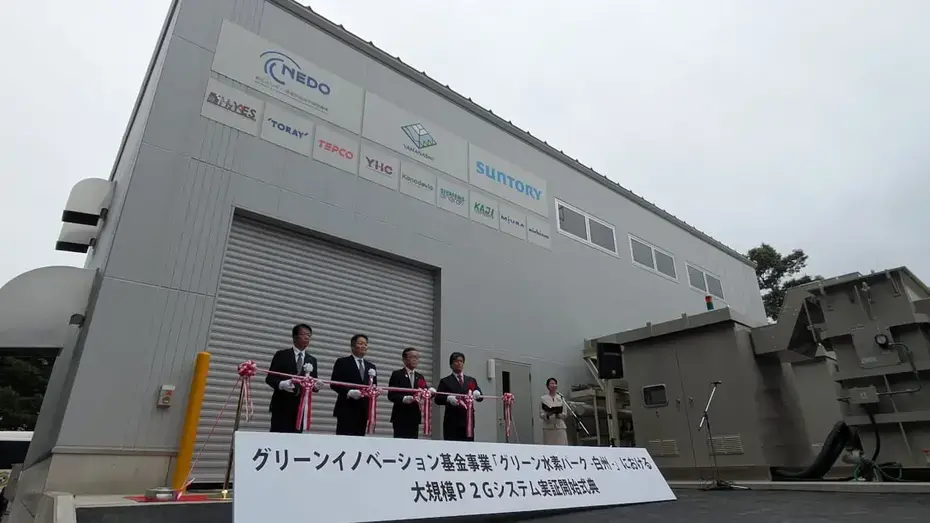
Green Hydrogen Park Hakushu opening ceremony (11th, Hokuto City, Yamanashi Prefecture, 2025)
NEDO (New Energy and Industrial Technology Development Organization) plays a central role in advancing international hydrogen programs through:
-
R&D and technology demonstration funding: Programs like the "Competitive Hydrogen Supply Chain Technology Development Project" (P23004) support production, storage, transportation technologies, and international standardization.
-
Bilateral and multilateral international cooperation: NEDO organizes joint workshops, signs MoUs, and participates in global initiatives.
-
Promoting standardization and policy coordination: NEDO participates in programs like IEA H2TCP Task 50 to compare costs and carbon intensity of hydrogen supply chains, laying the foundation for international standardization.
2. Japan's International Hydrogen Partners
2.1. Australia: Hydrogen Supply Chain and Co-firing Projects
Australia is a key partner for Japan in hydrogen supply chain development, leveraging its abundant renewable resources and established energy export infrastructure. Key initiatives include:
-
Japanese electrolyser deployment: IHI plans to produce green ammonia at scale in India using Japanese electrolyzers and explore the use of Japanese-built vessels for transport, demonstrating Japan's strategy of deploying its technology in resource-rich partner countries.
-
Hydrogen co-firing: JERA is developing hydrogen co-firing and single-fuel power generation demonstration projects, which could create demand for hydrogen imports from Australia and other suppliers.
-
Green Innovation Fund projects: Several projects under Japan's ¥2 trillion Green Innovation Fund focus on developing international hydrogen supply chains, with Australia identified as a priority source country due to its low-cost renewable hydrogen production potential.
2.2. New Zealand: Japan-New Zealand Hydrogen Corridor
In March 2026, a consortium including Obayashi, Kawasaki Heavy Industries, Mitsui O.S.K. Lines, and Chiyoda established the Japan-New Zealand Hydrogen Corridor. The project studies the feasibility of producing green hydrogen from New Zealand's geothermal and hydroelectric resources and exporting it to Japan as liquid hydrogen or ammonia, with commercial operations expected in the early 2030s.
This model is particularly relevant for Vietnam as it demonstrates how a country with abundant renewable resources can partner with Japanese corporations to develop a hydrogen export corridor. New Zealand's approach involves multiple Japanese partners across different segments of the value chain, from production to shipping.
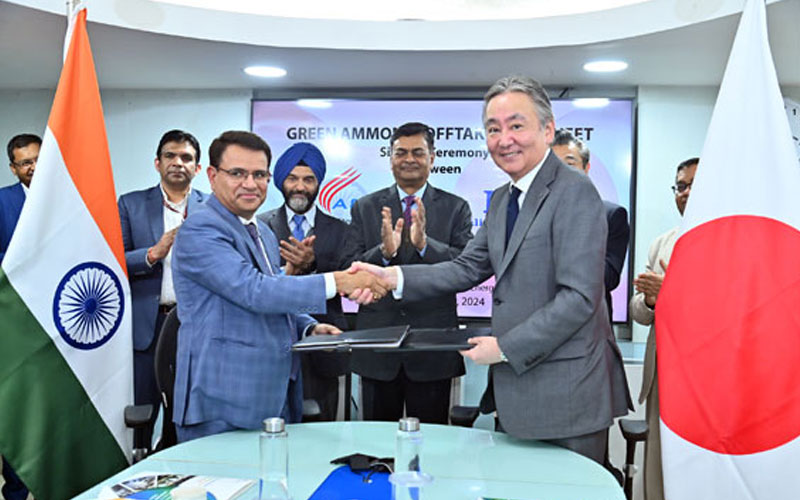
Mr. Manoj Upadhyay, Founder and Chairman of Acme Group; Mr. Hiroshi Ide, President and CEO of IHI Corporation
2.3. India: Strategic Cooperation and CfD Projects
Japan-India Leaders' Meeting (July 1-3, 2026): Prime Minister Sanae Takaichi visited Delhi and held a leaders' meeting with Prime Minister Narendra Modi. The two leaders issued the Japan-India Joint Declaration on Economic Security Cooperation, outlining the way forward for cooperation in five priority areas, including clean energy.
On June 30, 2026, Japan approved the seventh project under the Price Gap Support Scheme of the Hydrogen Society Promotion Act—IHI's green ammonia production project in India. The project will produce approximately 400,000 tons of green ammonia per year in Odisha, India, using renewable-powered electrolysis, and supply it to Japan. Users include Kobe Steel, Hokkaido Electric Power, Mitsubishi Gas Chemical, and Sumitomo Chemical.
Japan-India Joint Economic Forum (Hosted by JETRO) had over 150 Japanese companies and over 80 Indian companies participating. 129 cooperation projects were announced, including MoUs between IHI and the ACME Group and between ITOCHU and L&T Energy GreenTech Limited.
2.4. Germany: Strategic Cooperation from R&D to Market
The Japan-Germany Energy Partnership held an expert workshop in Tokyo (March 2026) with participation from METI, Germany's Federal Ministry for Economic Affairs, the H2Global Foundation, and the Japan Hydrogen Association (JH2A). Discussion topics included:
-
Financial mechanisms to stimulate the hydrogen market.
-
Joint research between leading institutes of both countries.
-
Liquid hydrogen supply chain development.
Notably: Germany and Japan are discussing the application of the H2Global auction mechanism in bilateral cooperation, opening opportunities for third-party producers (e.g., India, Vietnam) to participate.
2.5. Canada: Liquid Hydrogen Supply Chain
In April 2026, Kawasaki Heavy Industries signed an MoU with the Edmonton Region Hydrogen Hub (Alberta, Canada) to study a liquid hydrogen supply chain from Canada to Japan. Alberta's advantages include low-cost natural gas, CCS, and existing infrastructure, making it a promising source of low-cost, low-carbon hydrogen.
2.6. South Korea: Cross-Value Chain Hydrogen Cooperation
-
JERA (Japan) and Samsung C&T (South Korea) signed an MoU (July 2026) to enhance the resilience of the hydrogen and ammonia value chain, including carbon attribute management and segregation in storage infrastructure.
-
Hyundai E&C and ITOCHU (Japan) signed an MoU (May 2026) for hydrogen production and supply cooperation.
2.7. France and the EU
-
NEDO discussed the hydrogen situation in Europe and Japan with Air Liquide (France) in April 2026.
-
NEDO and the EU's Clean Hydrogen Joint Undertaking (CHJU) held a workshop on "Hydrogen Mobility" (May 2026) to promote R&D and commercialization cooperation.
2.8. United States
NEDO participated in VerdeXchange 2026 (Los Angeles, May 5-6, 2026), presenting Japanese hydrogen and ammonia projects and discussing cooperation with US stakeholders.
2.9. Vietnam (Local Cooperation)
In May 2026, the Governor of Yamanashi Prefecture, Mr. Nagasaki Kotaro, where the Japanese Government's hydrogen demonstration projects and initiatives are being implemented, signed a Memorandum of Understanding with Mr. Le Van Han, Chairman of the People's Committee of Tay Ninh Province, which includes cooperation on investment, development, and transfer of green hydrogen technology.
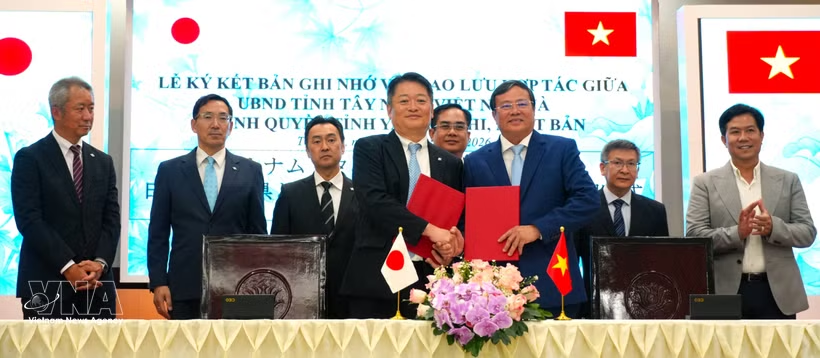
Chairman of the People's Committee of Tay Ninh Province, Mr. Le Van Han (front, right) and Governor of Yamanashi Province, Mr. Nagasaki Kotaro, signed a Memorandum of Understanding on May 8. (Photo: VNA)
3. Recommendations for Vietnam to Join Japan's International Hydrogen Network
Based on the experience of countries already cooperating with Japan, VAHC proposes the following recommendations:
| Recommendation | Specific Actions | Potential Partners |
|---|---|---|
| 1. Build strategic partnerships with Japan | Sign MoUs with NEDO, METI, or JH2A on hydrogen cooperation. Send delegations to workshops such as the Japan-Germany Energy Partnership and VerdeXchange. | NEDO, METI, JH2A, Japanese corporations (Obayashi, Kawasaki, Mitsui, ITOCHU) |
| 2. Participate in NEDO's funding and joint research programs | Submit applications for the "Competitive Hydrogen Supply Chain Technology Development Project" (P23004). Participate in joint research projects on standardization and cost analysis such as IEA H2TCP Task 50. | NEDO, Japanese research institutes (University of Tokyo, University of Yamanashi) |
| 3. Develop a hydrogen corridor with Japan | Learn from the Japan-New Zealand model: conduct feasibility studies on green hydrogen production from wind/solar and export to Japan. Identify potential port areas and H2 hubs (Vung Tau, Central Vietnam). | Japanese corporations (Obayashi, Kawasaki, Mitsui O.S.K. Lines, Chiyoda), Vietnamese energy companies (PV GAS) |
| 4. Participate in the H2Global auction mechanism with Japan and Germany | Leverage German and Japanese experience with H2Global. Negotiate for Vietnam to become a supplier in bilateral or regional auction rounds. | H2Global Foundation, German Ministry of Economics, METI Japan |
| 5. Strengthen cooperation with South Korean and EU partners | Sign MoUs with South Korean corporations (Hyundai E&C, Samsung C&T) and European companies (Air Liquide) to jointly develop the hydrogen value chain. | Hyundai E&C, Samsung C&T, Air Liquide, EU energy companies |
| 6. Leverage the Japan-India Joint Declaration framework | Study the India model to propose similar cooperation with Japan, including Japanese electrolyser deployment and CfD support for green ammonia projects in Vietnam. | METI, IHI, Japanese trading houses (Mitsui, ITOCHU) |
| 7. Participate in the Green Innovation Fund supply chain projects | Submit proposals for collaborative R&D or demonstration projects under Japan's Green Innovation Fund, particularly in the areas of green hydrogen production and supply chain development. | NEDO, Japanese corporations |
4. Conclusion
Japan is building a global hydrogen network with strategic partners in Australia, New Zealand, India, Germany, Canada, South Korea, the US, and the EU. Key partnership models include:
-
Australia: Hydrogen supply and co-firing projects.
-
New Zealand: A dedicated hydrogen corridor with multiple Japanese partners across the value chain.
-
India: Strategic government-to-government cooperation with CfD support for green ammonia projects, announced during a leaders' summit.
Vietnam, with its abundant renewable energy potential and favorable geographic location, can become a key link in Japan's hydrogen supply chain. However, this requires urgent action: signing MoUs with NEDO and Japanese partners, participating in funding programs, and building a hydrogen export corridor. If delayed, competitors (India, Australia, Canada, New Zealand) will capture the supplier position for the Japanese market.
Three priority actions in the next 6 months:
-
Sign an MoU with NEDO and/or METI on hydrogen cooperation.
-
Submit a proposal for NEDO's P23004 program or Green Innovation Fund supply chain projects.
-
Identify 2-3 potential hydrogen projects for export to Japan, learning from the New Zealand and India models.