

INTERNATIONAL WORKSHOP
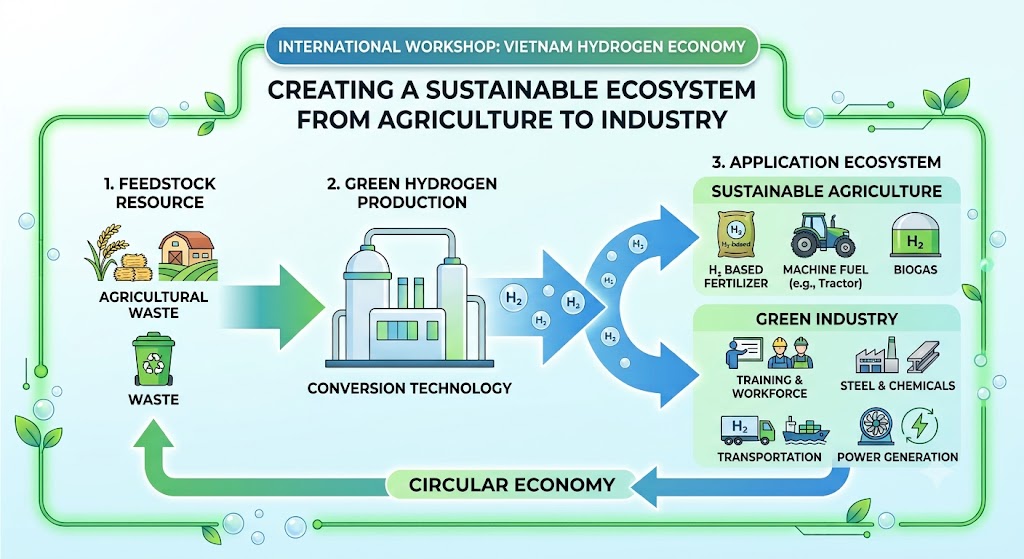
"VIETNAM HYDROGEN ECONOMY – BUILDING A SUSTAINABLE ECOSYSTEM FROM AGRICULTURE TO INDUSTRY"
Time: September 30, 2026 (tentative)
Location: Ho Chi Minh City or Hanoi
Organizers:
-
Vietnam ASEAN Hydrogen Club (VAHC)
-
Co-organizer: A Famed Domestic or International University of Economics
CONTEXT AND MISSION
The global hydrogen economy is shifting from research to large-scale commercialization. According to Vietnam's Hydrogen Energy Development Strategy (Decision 165/QD-TTg), the target is 100,000–500,000 tons/year by 2030 and 10–20 million tons by 2050. However, unlike the fragmented approach currently seen (focusing only on R&D, or only on production, storage, or consumption), this workshop aims to build a comprehensive hydrogen economic model – where scientific research, production, storage, transportation, domestic consumption, and exports form a closed value chain that generates profit and ensures sustainability.
1. Hydrogen Technology Included in the National Strategic Technology List
On April 30, 2026, the Prime Minister issued Decision No. 21/2026/QD-TTg, adding hydrogen production, storage, and application technologies to the List of High-Tech Products Prioritized for Investment and Development and the List of High-Tech Products Encouraged for Development. This Decision takes effect from July 1, 2026, replacing Decision No. 38/2020/QD-TTg.
This move affirms hydrogen as one of the nation's core technologies, alongside artificial intelligence, renewable energy, and advanced energy storage technologies. Including hydrogen in the strategic technology list opens up special incentive mechanisms on taxes, credit, and investment support for hydrogen ecosystem development projects.
2. Pilot Carbon Credit Exchange and Hydrogen Quota Trading Mechanism
On June 29, 2026, the domestic carbon exchange officially began operations at the Hanoi Stock Exchange (HNX) under the quota code VN2025. Tradable commodities include:
-
Greenhouse gas emission quotas: Total allocated quotas of 511,473,846.
-
Carbon credits: From verified emission reduction projects.
Initial participants: Over 100 large emission facilities in thermal power, steel, and cement sectors.
Quota trading mechanism for green hydrogen projects:
Under Decree No. 112/2026/ND-CP and Decree No. 29/2026/ND-CP, green hydrogen projects – identified as new, high-cost technologies not yet or rarely deployed in Vietnam – are eligible for special incentives:
-
Maximum carbon credit transfer rate: 90% of generated credits may be transferred to the exchange or exported internationally.
-
For comparison: Common emission reduction activities are only allowed to transfer up to 50%.
Financial impact on a green hydrogen project:
For a 100 MW electrolysis project (producing ~9,000 tons of hydrogen/year):
-
Emission reduction: 81,000 – 90,000 tons CO₂/year
-
Tradeable credits: 72,900 – 81,000 credits/year
-
Potential revenue: USD 364,500 – 1,215,000/year (at USD 5–15/credit)
Strategic significance:
This mechanism transforms the traditional hydrogen business model from "selling energy" to "energy + carbon" – creating an additional revenue stream that improves economic efficiency, attracts international investment, and shortens payback periods for green hydrogen projects.
KEY CONTENTS
1. Vietnam Hydrogen Economy – The Big Picture
Green hydrogen is a strategic pillar in the energy transition roadmap, especially for hard-to-abate sectors such as heavy industry and long-distance transport.
Vietnam has outstanding advantages: abundant renewable energy (offshore wind, solar power), and a geographical location close to major consumer markets like Japan and South Korea.
2. Lessons from Japan, South Korea, and China
Japan – "The Energy Sovereignty Bet"
-
The hydrogen strategy is not just about emission reduction but a strategic lever to reduce energy import dependency (only 15.3% self-sufficiency), while building an industry for technology exports (hydrogen carriers, fuel cells, turbines).
-
Long-term targets: 3 million tons of hydrogen by 2030, 20 million tons by 2050 (including ammonia); over JPY 15 trillion committed across the entire value chain.
-
Agricultural application: Green hydrogen and ammonia are being researched to replace chemical fertilizers, reducing emissions in food production.
South Korea – A Hydrogen Society from Policy to Practice
-
Launched the Hydrogen Economy Roadmap in 2019, with synchronized infrastructure deployment and large-scale financial support (in 2025, investing KRW 721.8 billion in hydrogen buses and cars).
-
World-first clean hydrogen power auction market (6,500 GWh, 15-year contracts).
-
Hyundai developed the HTWO brand, covering the entire value chain from production to application.
-
Cooperation with Vietnam: Korean companies (SK, EVEDI, KEPCO) are actively promoting hydrogen supply chain development in the Mekong Delta.
China – Electrolyzers as a New Export Commodity
-
Global green hydrogen demand has turned Chinese electrolyzers into a multi-million-dollar export item, with export growth doubling consecutively.
-
Peric Hydrogen's electrolyzer export revenue increased from RMB 70 million (2021) to nearly RMB 300 million (2023).
-
Lesson: As the hydrogen economy matures, countries can export not only hydrogen but also technology and manufacturing equipment.
3. Hydrogen Economy Models for Vietnam
Model 1: Agricultural Hydrogen Economy (Mekong Delta Advantage)
Based on the potential of the Mekong Delta region and its orientation as a hub for agricultural production and processing:
-
Production: Use solar and wind power from renewable energy farms to electrolyze water, producing green hydrogen and green ammonia right at the source area. Utilize agricultural by-products such as straw, rice husks, fruit tree residues, and livestock manure for hydrogen production.
-
Storage & Transport: Build BESS clusters and hydrogen refueling stations to serve agricultural machinery and agricultural product transport.
-
Domestic Consumption:
-
Clean fuel for tractors, fishing vessels, and trucks transporting agricultural products.
-
Replace chemical fertilizers with green ammonia, reducing emissions in cultivation.
-
Supply energy for food processing plants and agricultural drying facilities.
-
-
Exports: Export green ammonia and green agricultural products (meeting low-carbon standards) to Japan and South Korea – countries with high demand for food and clean energy.
Model 2: Industrial Hydrogen Economy (Southern Key Industrial Zone Advantage)
Based on clean energy demand from industrial zones and export potential:
-
Production: Build large-scale green hydrogen hubs (100–500 MW) in provinces with wind and solar potential (Binh Thuan, Ninh Thuan, Ba Ria – Vung Tau). Collaborate with international corporations to transfer advanced electrolysis technology.
-
Storage & Transport: Develop pipeline systems to nearby industrial zones, combined with refueling stations for trucks and buses. Utilize seaports to export liquid hydrogen/ammonia.
-
Domestic Consumption:
-
Replace fossil fuels in oil refineries, steel, cement, and fertilizer plants.
-
Fuel for power plants converting to hydrogen/ammonia combustion.
-
Clean fuel for urban bus fleets, trucks, and waterway transport.
-
-
Technology Exports: Aim to export electrolyzers, storage systems, and technical solutions to ASEAN and other developing markets.
4. Implementation Solutions and Recommendations
-
Develop demonstration projects: Establish pilot projects, seek local and central government approval, and collaborate with international partners to implement agricultural and industrial hydrogen economy demonstration models in Vietnam.
-
Complete the legal framework: Develop technical standards, pilot DPPA mechanisms combined with storage, and two-part electricity tariffs to support hydrogen production.
-
International cooperation: Strengthen public-private partnerships (PPP) with advanced nations, leverage funding and technology transfer from partners such as Germany, Japan, and South Korea.
-
Human resource development: Enhance the quality of hydrogen engineer training through cooperation with economics and technical universities, attracting talent from international research programs.
-
Unlock capital flows: Develop green credit mechanisms, venture capital funds, and mobilize capital from global climate funds and private investors.
CONTACT INFORMATION
For inquiries regarding participation, co-organization, and sponsorship, please contact:
Vietnam ASEAN Hydrogen Club (VAHC) – Secretariat
Email: contact@vahc.com.vn
Website: https://vahc.com.vn/