
IFC's Perspective on Green Finance for Energy and VAHC's Assessment of Hydrogen at the Vietnam Green Finance Conference 2026
August 08, 2026
Annie Nguyễn, VAHC Secretariat
1. Context: The Global Green Capital Race and Vietnam's Position
At the Vietnam Green Finance Conference 2026 organized by VIFC-HCM, Nam Á Bank and FiinGroup supported by GGGI, Mr. Paul Xavier, Program Officer at the International Finance Corporation (IFC) – a member of the World Bank Group, delivered a significant presentation on global green capital flows and opportunities for Vietnam.
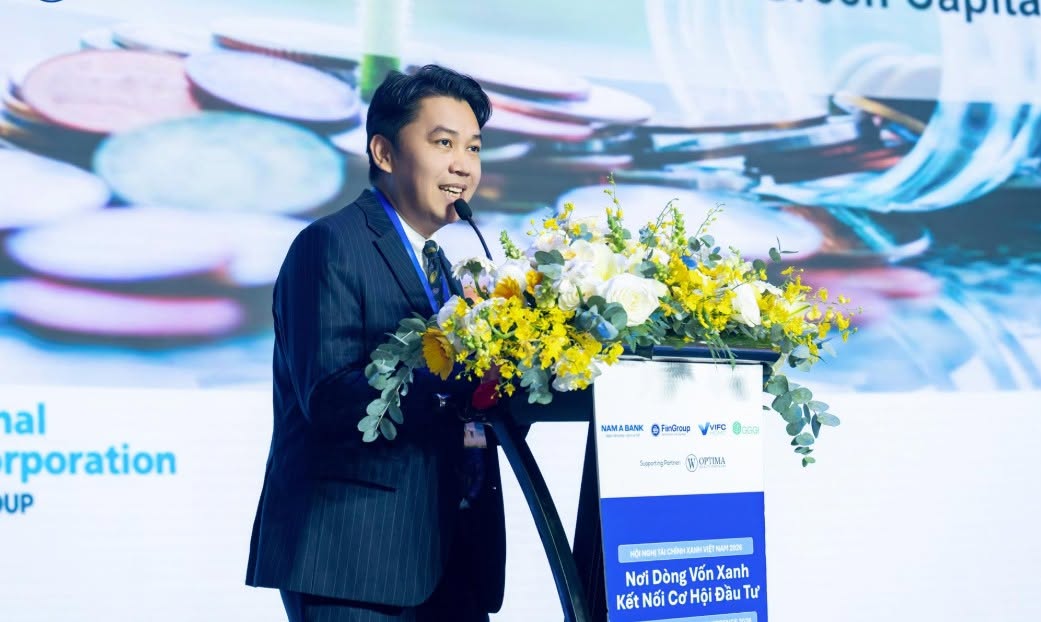
Mr. Paul Xavier, Program Officer, International Finance Corporation (IFC) (World Bank), shared at the event.
According to Mr. Xavier, green capital has transformed from a niche segment into mainstream financing and investment globally. By Q1 2026, cumulative global sustainable labelled bond issuance reached $7.25 trillion**, while sustainable funds' assets under management (AUM) totaled **$3.51 trillion. Green bonds accounted for the largest share, exceeding 64% of total labelled bond issuance in Q1 2026.
However, emerging markets contributed only about 15% of global sustainable labelled bond issuance, while the public sector accounted for 25% in emerging markets compared to 43% in developed markets. This indicates significant growth potential for Vietnam and other developing countries.
2. Reality and Challenges: Capital is Not Scarce, but Projects Are Not Compliant
Mr. Xavier emphasized an important reality: the market does not lack funding for sustainable development projects. Investors worldwide are actively seeking sustainable investment opportunities. The key question is no longer "is there capital available?" but "why does capital flow into some markets more easily than others?".
According to him, as the sustainable finance market develops with more instruments, investors need a "common language" to evaluate projects. The lack of a unified green taxonomy and assessment standards makes it difficult for international investors to make decisions. Vietnam's Decision 21/2025/QD-TTg on the Green Classification List is an important step, not just policy issuance but also contributing to improving financial market infrastructure, creating conditions to attract private capital and international investment.
3. Energy and Climate Finance Needs in Vietnam
According to IFC, Vietnam will need approximately $368 billion in climate financing by 2040, of which:
-
$254 billion for adaptation/resilience: upgrading public and private infrastructure, protecting vulnerable populations.
-
$114 billion for mitigation/decarbonization: energy, transport, agriculture, and industry transitions to reach net-zero emissions by 2050.
With current public resources mobilized at only about 2% of GDP per year, mobilizing private capital will be key to achieving Vietnam's ambitious targets.
Priority sectors for climate finance include: energy, transport, agriculture, manufacturing, and construction. IFC particularly emphasizes the importance of transition finance – the "second pillar" alongside green finance – to support hard-to-abate sectors such as steel, cement, chemicals, and heavy transport in their transition to a low-carbon economy. 2026 is forecast to be a breakout year for the transition bond market, with approximately $40 billion, nearly double the record $21 billion in 2024.
4. VAHC Assessment after the Conference: Potential and Roadmap for Green Hydrogen in Vietnam
Although Mr. Xavier did not directly mention hydrogen in his presentation, IFC's messages offer important insights for Vietnam's hydrogen sector:
First, green hydrogen falls within the group of renewable energy sectors requiring large and long-term capital, therefore transition finance instruments such as transition bonds, sustainability-linked bonds (SLB), and blended finance will be key to mobilizing capital. The ICMA Climate Transition Bond Guidelines (November 2025) provide the first dedicated framework for hard-to-abate sectors, including hydrogen projects.
Second, IFC's lessons on transparency and standardization are particularly relevant to green hydrogen. Establishing Measurement, Reporting, and Verification (MRV) standards for hydrogen projects is a key factor in attracting international capital. Initiatives such as the International Maritime Financial Center (IMFC) within VIFC-HCMC could be a potential channel for hydrogen projects in maritime transport and logistics.
Third, the Vietnamese Government's support policies are creating a positive foundation. According to IFC, the Government plans to provide a 2%/year interest rate support for eligible green, circular, and ESG projects (applicable from 2026) – this mechanism can be fully applied to green hydrogen projects. Additionally, international cooperation programs such as the Green Finance Program supported by GIZ and IFC are training and building capacity for financial professionals in green hydrogen.
VAHC will continue to act as a bridge between international investors and Vietnamese enterprises, promoting the adoption of international standards for hydrogen projects in Vietnam, while supporting the development of compliant hydrogen projects to access global green capital.
References: IFC's Green Hydrogen and Hydrogen Derivatives Project Financing Activities
Below is a summary of IFC's financing activities for green hydrogen and hydrogen derivatives projects globally:
1. India: First Direct Investment in Green Hydrogen
In June 2026, IFC led a $105 million equity investment in Hygenco Green Energies – marking IFC and its partners' first direct investment in green hydrogen in India.
Investment structure:
-
IFC: $25 million from its own account
-
Siemens Financial Services: $25 million
-
Fullerton Carbon Action Fund: $30 million
-
Clean Technology Fund (CIF): $20 million (blended finance facility managed by IFC)
-
Frontier Opportunities Fund (German Government): $5 million (blended finance facility managed by IFC)
The investment will support Hygenco in building 3-4 new plants during 2026-2027, expanding the "Hydrogen-as-a-Service" model and producing green hydrogen and derivatives (including green ammonia) for hard-to-abate industries.
Hygenco commenced construction of its green ammonia facility in Odisha in June 2025 and is collaborating with Mitsubishi Heavy Industries on export studies to Singapore.
2. Nigeria: Partnership to Develop Methanol and Ammonia Plant
IFC is partnering with Africa Finance Corporation (AFC) and Blackrose to develop Africa's largest methanol plant in Akwa Ibom, Nigeria.
The project is being implemented in two phases, each with a capacity of 1.8 million tonnes/year. The first phase will produce low-carbon methanol, while the second phase will expand into ammonia production.
3. Global Strategic Partnerships
IFC has signed a Memorandum of Understanding (MoU) with Técnicas Reunidas to promote decarbonization in Eastern Europe, including the development of low-carbon technologies along the hydrogen value chain such as green ammonia and e-methanol.
In Africa, IFC is partnering with Masdar to develop a green hydrogen platform for emerging markets, including a 4 GW green hydrogen project in Egypt (in partnership with Hassan Allam Utilities).
4. Global Support Initiatives
According to a World Bank report, IFC is one of the largest providers of concessional financing for hydrogen in emerging markets (approximately $2 billion in 2023).