

Hydrogen Research at 20 Years: A Progress Report (Part 1) – University of Tokyo Professor Emeritus Karaki Reviews the Latest Science, "Promising but Still Developing"
Translation by Annie Nguyễn, VAHC Secretariat
August 31, 2026
It has been over a decade since "hydrogen water" became a major craze, igniting fierce debates over its health benefits. While products touting their effects flooded the market, skeptical voices questioning the scientific basis grew equally strong. In 2013, the magazine Shukan Bunshun made waves with a provocative cover story, independently measuring the hydrogen concentration of commercial hydrogen water and supplements, dividing them into "real" and "fake" categories. This sparked heated arguments and rebuttals from manufacturers, eventually drawing in the National Consumer Affairs Center for product testing and the Consumer Affairs Agency for administrative actions.
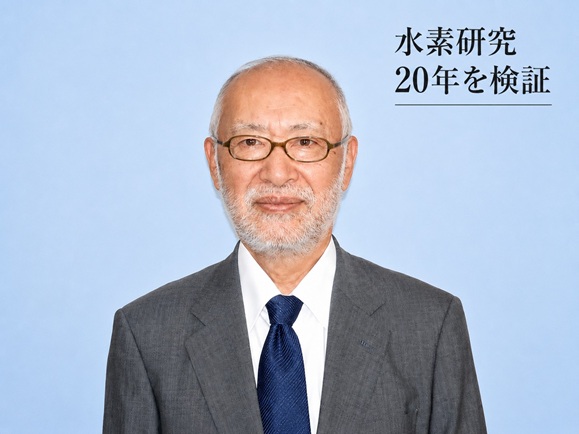
So, what has happened to the science of hydrogen since then? Professor Emeritus Hideaki Karaki of the University of Tokyo, who had neither dismissed the medical potential of hydrogen nor accepted its efficacy as a health food due to insufficient evidence at the time, now revisits approximately 20 years of hydrogen research based on the accumulated findings.
Hydrogen Research: From 2007 to the Present
A major turning point that propelled molecular hydrogen (H₂) into the health and wellness spotlight came in 2007, when a research group led by Professor Shigeo Ohta (then at Nippon Medical School) published a paper in Nature Medicine. They reported that hydrogen could act as a selective antioxidant, neutralizing the highly toxic hydroxyl radical.
Nearly two decades have passed. Research on hydrogen continues across various fronts: hydrogen gas inhalation in medicine; hydrogen water, hydrogen-infused gels, and hydrogen-containing supplements in the food industry; and, more recently, studies on hydrogen produced by gut bacteria. However, an increase in research volume does not equate to scientifically established health benefits.
An overview of current studies reveals reports suggesting improvements for certain diseases or conditions, but also large-scale clinical trials that failed to confirm these effects. As for the mechanisms through which hydrogen acts on living organisms, several hypotheses have been proposed, yet they remain at the theoretical stage.
How Hydrogen Works: Still a Hypothesis
In 2007, the leading hypothesis was that hydrogen acts as a direct antioxidant scavenging hydroxyl radicals. As research progressed, new hypotheses emerged. In 2022-23, it was suggested that hydrogen activates the "Nrf2 pathway," responsible for cellular antioxidant stress responses. Another proposed that the target molecule for hydrogen might be "Fe-porphyrin (hemin)." In 2025, yet another hypothesis targeted proteins involved in the mitochondrial electron transport chain. However, all of these remain hypotheses. This means that even after roughly two decades of research, the fundamental question – "Why does hydrogen affect living organisms?" – still lacks a definitive answer.
Another critical issue is the method of hydrogen delivery to the body. There are four main external routes: inhaling hydrogen gas; drinking hydrogen water; consuming hydrogen-infused gels; and taking supplements that generate hydrogen internally (e.g., using magnesium). Additionally, our gut bacteria naturally produce hydrogen during fermentation of dietary fiber, meaning the body is constantly exposed to it. Each route has a different delivery mechanism and pharmacokinetics, and the volume of research varies greatly. Therefore, it is misleading to group all these delivery methods under a single term like "hydrogen."
5 Hydrogen Supply Pathways and the Current Status of Evidence
| Form | Hydrogen supply pathway | Current status of evidence | Safety reports | Official positioning |
|---|---|---|---|---|
| ① Hydrogen gas inhalation | From lungs into blood (inhaled with device at approx. 2–4%) | Centered on small-to-medium RCTs. Promising for cerebral infarction, pneumonia, etc. Multi-center RCTs (HYBRID II) showed primary endpoints were not significant | Very few reports of serious adverse events. However, as it is a flammable gas, device management is required | Centered on free medical treatment using medical devices. No drug approval for specific indications |
| ② Hydrogen water (oral) | Absorbed from the gastrointestinal tract (drinking H₂ dissolved in water) | Small-scale RCTs and meta-analyses exist but sample sizes are small and heterogeneity is high. Reports of mild improvement in intestinal and liver function | No reports of serious adverse events. FDA judges it as GRAS (Generally Recognized As Safe) | Cases of notification as functional food exist |
| ③ Hydrogen jelly | Hydrogen molecules sealed in jelly are supplied to the digestive tract | The paper used as the basis for notification is questionable. A new placebo-controlled RCT showed sleep improvement effect was not significant | No reports of serious side effects | First domestic notification in Japan as a functional food (e.g., for “sleep”) |
| ④ Hydrogen-containing supplements (others) | H₂ is generated in the digestive tract by Mg, etc. | Few controlled trials; most remain small-scale observational studies | No reports of serious side effects, but the number of trials is small, making evaluation difficult | Handled as food. Drug-like efficacy claims may violate the Pharmaceuticals and Medical Devices Act |
| ⑤ Intestinal bacteria (endogenous) | Intestinal bacteria constantly produce H₂ through fermentation of dietary fiber | Reports exist showing changes in microbiota in IBD, IBS, Parkinson’s disease, etc. | Normal physiological phenomenon | Not a target of treatment |
Hydrogen Gas Research in Medicine
Hydrogen gas inhalation – using a medical generator to inhale a mixture of hydrogen with air or oxygen through a nasal cannula or mask – has been the most actively researched medical application. Because hydrogen is absorbed directly into the bloodstream via the lungs, it is considered more bioavailable than oral ingestion.
Clinical trials have been conducted on various conditions, including post-cardiac arrest syndrome and acute cerebral infarction, led by Keio University and others. A 2023 review analyzed 81 clinical trials and 64 studies on molecular hydrogen therapy, covering cardiovascular diseases (e.g., post-infarction, post-cardiac arrest), cancers (lung, liver, colorectal, pancreatic), respiratory diseases (COPD, asthma, COVID-19 pneumonia), central nervous system disorders (cerebral infarction, Parkinson's, cognitive decline), and lifestyle-related diseases (type 2 diabetes, obesity).
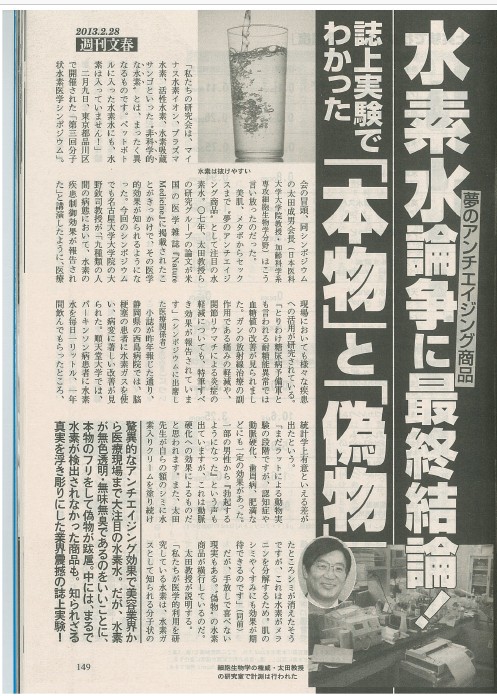
The February 28, 2013 issue of *Shukan Bunshun* published a significant article regarding the "hydrogen water controversy." The translation of article is below:
The Dream Anti-Aging Product
Final Conclusion to the Hydrogen Water Debate!
Magazine Experiment Reveals “Genuine” vs “Fake”
Shukan Bunshun
February 28, 2013
Page 149
Our research group led by Professor Shigeo Ohta (Department of Cell Biology, Nippon Medical School) published in the prestigious international scientific journal Nature Medicine the findings that “hydrogen water” (water containing hydrogen gas) has a strong antioxidant effect.
Since then, products labeled “hydrogen water” have flooded the market. However, many of them turned out to be “fakes” containing little or no hydrogen.
Our research team conducted a direct experiment for this magazine to distinguish between “genuine” and “fake” products.
Experiment results:
- Only products with sufficiently high hydrogen concentration showed actual effects.
- Many heavily advertised products contained almost no hydrogen or had extremely low concentrations.
- Hydrogen dissipates very quickly, so storage and drinking methods are critically important.
Professor Ohta stated:
“True hydrogen water does have a powerful antioxidant effect, but only when it is the ‘genuine’ product with high enough hydrogen concentration. Many products currently on the market are fakes or of poor quality.”
This magazine experiment has provided a clear final conclusion to the long-running debate over hydrogen water.
A notable trial in Japan was "HYBRID II," a multicenter, randomized, double-blind, placebo-controlled study on patients with cerebral ischemia from post-cardiac arrest syndrome. Registered as "Advanced Medical Care B," it aimed to enroll 360 patients. However, due to the strain on emergency medical systems from the COVID-19 pandemic, only 73 patients were enrolled. Results published in 2023 showed no statistically significant difference in the primary endpoint (neurological outcomes) between the hydrogen gas inhalation group and the control group. The final evaluation by the Advanced Medical Technology Assessment Subcommittee was "C (equivalent to existing treatments)." While secondary endpoints like survival and social reintegration showed promising trends, HYBRID II was withdrawn from the Advanced Medical Care B list, mainly due to practical patient enrollment difficulties. The research team aims to conduct a larger Phase III trial in the future.
Overall, large-scale, multicenter, placebo-controlled trials on hydrogen gas inhalation are still scarce, with most being small pilot studies. For some conditions, like cognitive impairment, larger trials have not confirmed significant benefits. Currently, no indication has received pharmaceutical approval in Japan, and its use remains primarily in the private medical sector.
Regarding safety, almost no reports of severe adverse events have emerged from studies. Hydrogen does not bind to hemoglobin, does not form toxic blood gases, and has a long safety record in deep-sea diving using high-concentration (around 49%) hydrogen mixtures. Studies on prolonged (several hours) inhalation also report no major issues. However, hydrogen is flammable and explosive when mixed with oxygen at certain ratios, necessitating strict concentration management and device safety design for medical use. It is crucial to distinguish between "low biological toxicity" and "operational safety."
The Hydrogen Water Craze: What Went Wrong?
Hydrogen water, a general term for water containing dissolved molecular hydrogen, brought the concept of hydrogen to the broader public. Various production methods exist, and products are sold in bottles or pouches, alongside home generators. The saturation concentration at 20°C and 1 atm is approximately 1.62 mg/L. In 2017, the International Hydrogen Standards Association defined and certified hydrogen water, but in Japan, there remains no official definition or concentration standard.
In 2016, the National Consumer Affairs Center tested 10 bottled hydrogen water brands and 9 generators. Two major issues emerged. First, the actual hydrogen concentration at the time of opening was often lower than labeled values (e.g., "at filling" or "at shipment"). Two bottled brands even showed no detectable hydrogen. Hydrogen easily escapes from the water. The second issue was advertising. Many products made explicit health claims (e.g., "neutralizes harmful free radicals," "effective against atopic dermatitis") that risked violating the Pharmaceuticals and Medical Devices Act and the Act against Unjustifiable Premiums and Misleading Representations. At the time, the National Institute of Health and Nutrition noted a lack of reliable data supporting human efficacy.
Thus, the problem with hydrogen water around 2016 involved at least three overlapping layers: (1) scientific questions about hydrogen's health effects, (2) quality control issues regarding actual hydrogen content, and (3) advertising that overstepped scientific evidence.
A Series of Administrative Actions
Subsequent administrative actions followed. In 2016, the Consumer Affairs Agency issued a business suspension order to a multi-level marketing company for promoting hydrogen water as a cure for all diseases, including cancer. In 2017, three companies were ordered to cease misleading claims under the Act against Unjustifiable Premiums, and supermarket employees were referred to prosecutors for suspected violations of the Pharmaceuticals and Medical Devices Act. In 2021, four companies renting hydrogen water generators were similarly sanctioned for claims like "prevents aging" and "prevents disease." The pattern of marketing claims exceeding scientific evidence persisted alongside ongoing research.
Products Have Since Improved
The situation has not remained exactly as it was in 2016. Following the consumer tests, many manufacturers improved packaging to reduce hydrogen loss. Surveys in 2023 reported that commercial products generally met their stated hydrogen concentrations. However, the volatile nature of hydrogen remains: in an opened 500 mL container, the concentration drops by half in roughly 2 hours. While improvements have been made, the instability of dissolved hydrogen persists.
Hydrogen Water Now a Food with Function Claims
Significant regulatory changes have also occurred. In 2016, no product listing hydrogen as a functional component existed under the "Foods with Function Claims" (FFC) system. In March 2023, a "high-concentration hydrogen gel" was registered as an FFC for functions related to "sleep" and "stress," marking the first such case with molecular hydrogen as the active ingredient. In January 2026, a hydrogen water product became the first bottled water to be registered as an FFC, claiming to "reduce temporary fatigue in daily life for healthy individuals with moderate oxidative stress."
Does this signify a major shift in the scientific evaluation of hydrogen water? Caution is warranted. The evidence for this product relies on a 2018 crossover trial comparing high-concentration hydrogen water to regular water on fatigue from daily work in 23 individuals. In the primary analysis of all 23 participants, the change in fatigue indicators did not reach statistical significance compared to placebo. A statistically significant improvement was only observed in a subgroup analysis of 9 individuals. Furthermore, the company behind this product was among those subject to the 2016 National Consumer Affairs Center tests and the 2017 sanctions. Thus, the FFC registration does not equate to scientifically established efficacy.
Over the past two decades, many clinical trials with hydrogen water have been conducted on various targets (Parkinson's, lipid metabolism, exercise fatigue, COVID-19, etc.). Some promising results from small studies were not replicated in larger trials, while other meta-analyses have hinted at certain trends. To understand the current state of hydrogen research, one must examine each study's scale, quality, objectives, and metrics, rather than focusing solely on isolated "positive" or "negative" findings.
Part 2 will delve into the clinical trials centered on hydrogen water, examining to what extent health benefits have been confirmed through 20 years of research.
Profile of the Author: Professor Emeritus Hideaki Karaki (University of Tokyo), Ph.D. in Agriculture. Graduated from the Faculty of Veterinary Medicine, University of Tokyo. He has served as a professor at the University of Tokyo, member and vice-president of the Science Council of Japan, and expert member and advisor to the Cabinet Office's Food Safety Commission. He actively researches and communicates on the efficacy and safety of health foods and food safety. He is currently the representative of the "Association for Improving Trust in Food" and the representative of the "Study Group on Health Food Testing Methods."
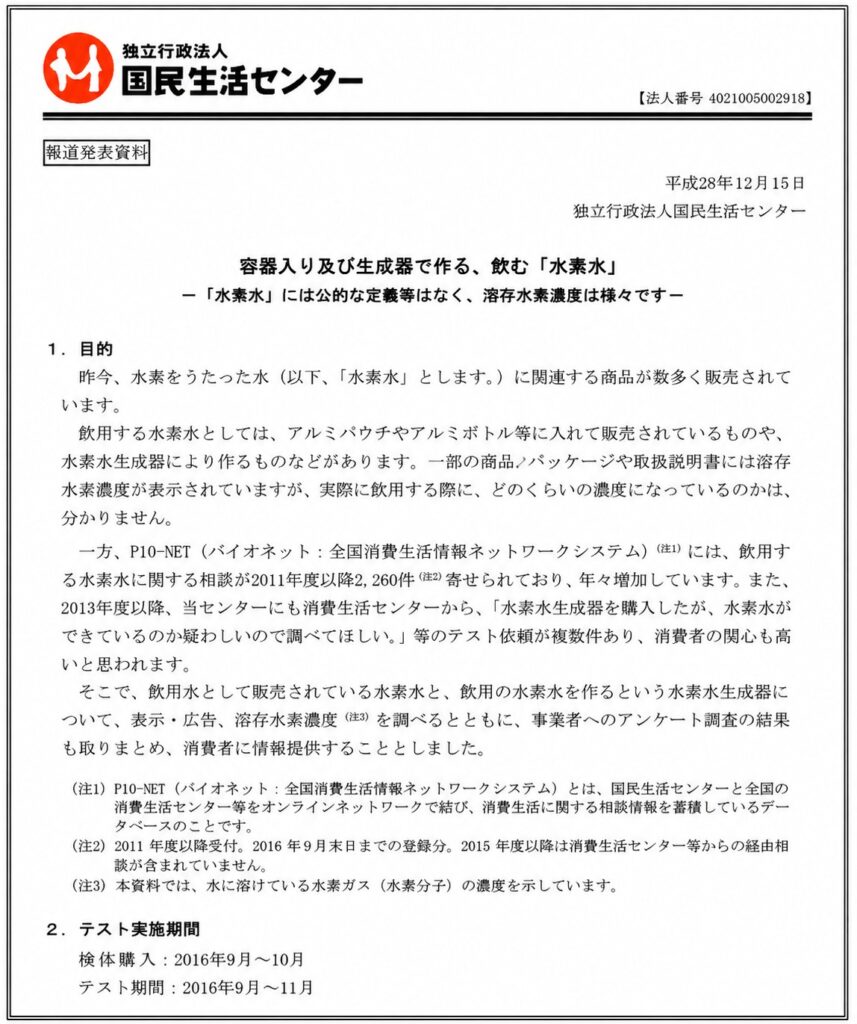
Cover page of the "Survey Report on Hydrogen Water by the National Consumer Affairs Center"
Incorporated Administrative Agency
National Consumer Affairs Center of Japan
【Corporate Number 4021005002918】
【Press Release Material】
December 15, Heisei 28 (2016)
Incorporated Administrative Agency National Consumer Affairs Center of Japan
Bottled and Generator-Produced Drinking “Hydrogen Water”
- There is no official definition of “hydrogen water,” and dissolved hydrogen concentrations vary widely -
1. Purpose
In recent years, a large number of products related to water containing hydrogen (hereinafter referred to as “hydrogen water”) have been sold on the market.
As for hydrogen water intended for drinking, there are products sold in aluminum pouches or aluminum bottles, as well as those produced by hydrogen water generators. Some products/packages or instruction manuals indicate the dissolved hydrogen concentration, but it is unclear how much concentration remains when actually consumed.
On the other hand, the P10-NET (Bio-Net: Nationwide Consumer Life Information Network System) (Note 1) has received 2,260 consultations related to drinking hydrogen water since fiscal year 2011 (Note 2), and the number has been increasing year by year. In addition, since fiscal year 2013, this Center has also received multiple test requests from local consumer affairs centers stating “I purchased a hydrogen water generator but am suspicious whether hydrogen water is actually being produced, please investigate,” indicating high consumer interest.
Therefore, we examined the labeling, advertising, and dissolved hydrogen concentration (Note 3) of hydrogen water sold for drinking and hydrogen water generators that produce drinking hydrogen water, and also compiled the results of a questionnaire survey of businesses, in order to provide information to consumers.
(Note 1) P10-NET (Bio-Net: Nationwide Consumer Life Information Network System) is a database that connects the National Consumer Affairs Center with consumer affairs centers nationwide via an online network and accumulates consultation information related to consumer life.
(Note 2) Accepted from fiscal year 2011 onward. Figures registered up to the end of September 2016. From fiscal year 2015 onward, consultations received via consumer affairs centers are not included.
(Note 3) In this document, the concentration refers to hydrogen gas (hydrogen molecules) dissolved in water.
2. Test Implementation Period
- Sample purchase: September – October 2016
- Test period: September – November 2016