


Hydrogen (H₂) and Ammonia (NH₃): Two Sides of the Same Energy Equation – Both Energy Carriers and Direct Fuels
September 4, 2026, Le Ngoc Anh Minh
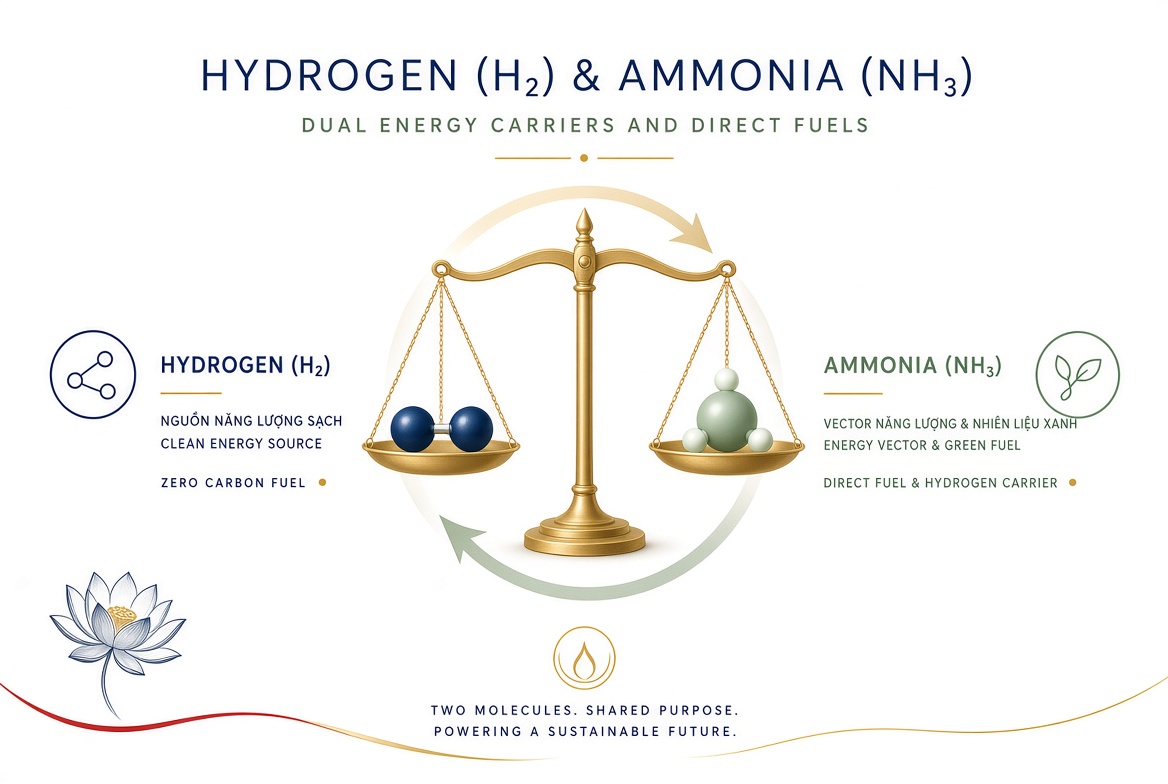
In the context of the energy transition, hydrogen and ammonia are often referred to as "energy carriers" – molecules used to transport and store energy from production sites to consumption points. However, this perspective is becoming increasingly incomplete as both molecules are now being deployed directly as fuels across various sectors, from transportation to power generation. The distinction between "carrier" and "fuel" lies not in the molecular structure, but in the purpose of use and the energy conversion technology applied.
1. Ammonia (NH₃): Both a Hydrogen Carrier and a Direct Combustion Fuel
Ammonia as an Energy Carrier
The traditional and most prominent role of ammonia in the energy value chain is as a hydrogen carrier. With a higher volumetric hydrogen density than liquid hydrogen and easier liquefaction at moderate temperatures and pressures, ammonia is considered an ideal medium for transporting hydrogen over long distances. In this scenario, ammonia is produced from green or blue hydrogen, shipped to the consumption point, and then cracked back into hydrogen for use in applications requiring pure hydrogen (e.g., fuel cells for heavy-duty trucks or steel production).
Specific Examples:
-
Japan's Ammonia Import Projects: Japanese energy conglomerates are securing offtake agreements for green ammonia from Australia (HESC project) and Saudi Arabia (NEOM). In Japan, this ammonia is cracked into hydrogen for use in existing thermal power plants to reduce CO₂ emissions.
-
Fertilizer Production: A significant portion of ammonia is used as a feedstock to produce nitrogen-based fertilizers (urea). In this case, ammonia acts as an energy carrier (and nitrogen source) necessary for the chemical process.
Ammonia as a Direct Fuel
A breakthrough development in recent years is the direct application of ammonia as a combustion fuel, bypassing the cracking step. Ammonia internal combustion engine technology has made significant strides, enabling its use in marine engines, gas turbines, and even modified internal combustion engines. In this model, ammonia becomes a low-carbon fuel similar to LNG, but without CO₂ emissions.
Specific Examples:
-
Ammonia-Powered Marine Engines: Shipbuilders and engine manufacturers like MAN Energy Solutions and WinGD are developing and beginning to commercialize engines that run primarily on ammonia (as the main fuel). The Viking Energy project, owned by Eidesvik Offshore, using ammonia fuel on a supply vessel, is a prime example.
-
Ammonia Co-firing in Coal Power Plants: Japanese and South Korean utilities are conducting co-firing trials of ammonia with coal in existing thermal power plants, using ammonia as a supplementary fuel to reduce CO₂ emissions.
-
100% Ammonia-Fired Gas Turbines: Mitsubishi Power has successfully developed and tested gas turbines operating on 100% ammonia, opening prospects for using ammonia as a primary fuel for power generation.
2. Hydrogen (H₂): Both an Energy Carrier and a Direct Combustion/Electrochemical Fuel
Hydrogen as an Energy Carrier
Hydrogen is typically produced from primary energy sources (renewable electricity, natural gas) and then used as an input for industrial processes or to synthesize other molecules. Its role as an energy carrier emerges when hydrogen is used to store and transport energy from the production source to specific applications.
Specific Examples:
-
Green Ammonia Production: Green hydrogen produced from renewable electricity is used as a feedstock to synthesize ammonia (NH₃), which is then shipped and used for purposes like fertilizer production or marine fuel. Here, hydrogen plays the role of an energy (and chemical) carrier for ammonia.
-
Green Methanol Production: Similarly, green hydrogen is used as a feedstock to produce methanol (CH₃OH), another liquid fuel and chemical feedstock.
-
Green Steel Production (Hydrogen-DRI): Hydrogen is used as a reducing agent to replace coke in the direct reduction of iron (DRI) process, eliminating CO₂ emissions. In this application, hydrogen acts as an energy carrier and reducing gas.
Hydrogen as a Direct Fuel
Hydrogen can also be used directly as a fuel source, releasing energy through two primary pathways: electrochemical reaction (in fuel cells) and combustion (in internal combustion engines or gas turbines).
Specific Examples:
-
Fuel Cells for Transportation: Passenger cars (Toyota Mirai, Hyundai Nexo), buses, and heavy-duty trucks powered by hydrogen fuel cells use hydrogen to generate electricity directly to drive electric motors. Here, hydrogen is a direct fuel.
-
Hydrogen Internal Combustion Engines (H2-ICE): Manufacturers like Cummins and JCB are developing modified internal combustion engines to burn hydrogen directly (H2-ICE) for construction equipment and trucks. This is a direct use of hydrogen as a combustion fuel.
-
Hydrogen Gas Turbines: Power plants are testing co-firing and 100% hydrogen combustion in gas turbines to generate electricity, leveraging hydrogen as a direct replacement for natural gas.
-
Rocket Fuel: Liquid hydrogen (LH2) has long been used as a direct combustion fuel in rocket engines by space agencies (NASA, SpaceX).
Conclusion
Categorizing H₂ and NH₃ solely as "energy carriers" is incomplete and risks overlooking their vast potential as low-carbon direct fuels. These two molecules occupy a unique intersection between the energy and chemical value chains:
-
When used to transport energy from one place to another or as a feedstock to produce other products, they serve as energy carriers (e.g., H₂ used to produce NH₃; NH₃ used to transport H₂).
-
When "burned" (via chemical or electrochemical reaction) to directly extract their chemical energy into mechanical, thermal, or electrical power, they function as a fuel (e.g., burning H₂ in an H2-ICE; burning NH₃ in a marine engine).
This distinction is not semantic; it has critical implications for infrastructure planning, technology development, and market strategy. The fact that ammonia can be combusted directly in marine engines without cracking, and that hydrogen can be burned in internal combustion engines, opens diverse, flexible, and more adaptable pathways for the energy transition, leveraging both existing infrastructure (internal combustion engines) and new technologies (fuel cells). A comprehensive energy strategy must consider both the "carrier" and "fuel" roles of H₂ and NH₃ to optimize system-wide efficiency and minimize emissions.