


Hydrogen Finance Study: Insurance Trends
September 12, 2026
Annie Nguyễn, VAHC Secretariat, according to Council Fire Organization
New research from Council Fire published on September 3, 2026 shows the hydrogen insurance landscape is shifting fast. If you want to know what gets hydrogen projects financed in 2026, the short answer is: insurance alone is not enough. Track insurance terms, public guarantees, EPC risk and offtake strength as one package.
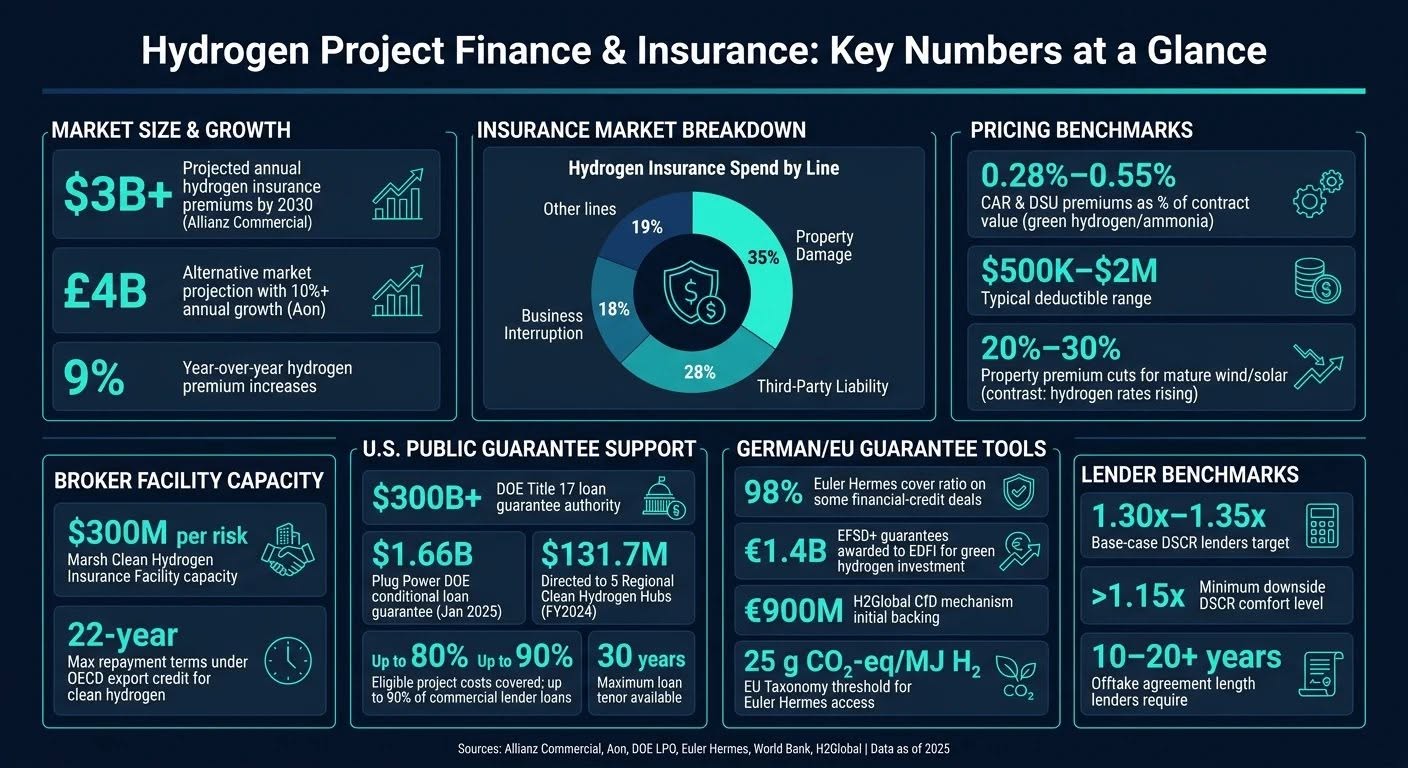
Insurer appetite is growing, but capacity stays selective
Hydrogen is pulling more insurer interest across several lines, especially energy and property damage, third-party liability and business interruption. That makes sense: these risks sit close to industrial and power exposures insurers already know how to price. Allianz Commercial projects more than USD 3 billion in annual hydrogen premiums by 2030, while Aon points to GBP 4 billion and at least 10% annual growth. Most premium volume sits in three buckets: property at about 35% of the hydrogen infrastructure insurance market, liability at roughly 28%, and business interruption at around 18%.
Capacity, however, remains selective. Insurers tend to back projects that look like risks they already know: refinery feedstock, ammonia and petrochemicals; strong EPC contractors; investment-grade sponsors; and firm offtake arrangements backed by documented process-safety controls. The thin loss record keeps many underwriters cautious. That caution shows up fast in newer projects. Large green hydrogen plants, novel electrolyser set-ups and first-of-a-kind export hubs often face lower limits, tighter wording, sub-limits for business interruption and delay in start-up, and layered placements spread across reinsurers and specialty markets. In the U.S., sponsors should also expect deep underwriting questions before placement is signed off, including risk-engineering reports that fit U.S. lender standards and hazard analyses built around multiple scenarios.
Dedicated hydrogen insurance facilities and what they signal
Dedicated hydrogen facilities are starting to shape placements and lender terms in a more direct way. Their role is simple but important: they turn scattered underwriting interest into insurance that lenders can actually work with. That usually means pre-agreed wordings, lender-aligned terms and multi-line capacity built to cut placement time and help support debt raising.
Marsh Clean Hydrogen Insurance Facility covers construction and start-up, with an option to extend into early operations. It includes construction all risks, property damage, delay in start-up, business interruption, marine cargo and third-party liability, plus optional environmental, professional indemnity, equipment, political risk, sabotage and terrorism, and technology failure cover. It targets global low-carbon, blue and green hydrogen projects seeking lender-aligned, standardised insurance programmes.
Zurich–Aon Clean Hydrogen Facility covers construction and operational phases under a single multi-line structure, including construction, delay in start-up, operational cover, business interruption, marine cargo and third-party liability, and can include CCUS-related risks. It targets blue and green hydrogen projects, especially small-to-mid-scale developments needing turnkey multi-line cover.
Munich Re HySure approaches the problem from another angle. Instead of covering construction or property, it focuses on product, performance and availability warranties for electrolysers and fuel cells. That matters because those exposures are often excluded under standard policies or covered only with tight limits.
Pricing pressure and policy wording are changing deal economics
After capacity, pricing is the next bankability test. Property cover for renewables is getting cheaper. Hydrogen is not. That split is starting to shape financing terms in a direct way.
Well-engineered wind and solar portfolios are seeing 20%–30% premium cuts on property damage programmes. Smaller or less-established accounts are landing 10%–15% reductions, and long-term coverage agreements can add another 5%–10% discount in later years. In some Nordic markets, pricing for new renewable projects hit five-year lows in 2025. Reinsurance costs have steadied after the sharp jumps in 2022 and 2023, and carriers are competing hard for established clean-energy accounts.
Hydrogen sits in a very different lane. For lenders, that spread matters because hydrogen is still underwritten more like specialty industrial risk than like a mature renewable class. Benchmark data for green hydrogen and ammonia construction all risks and delay in start-up programmes shows premiums at 0.28% to 0.55% of contract value, deductibles from USD 500,000 to USD 2 million, and year-over-year premium increases of about 9%. A new electrolyser design paired with remote export logistics can still be priced like a specialty industrial process exposure.
When pricing stays high and terms stay narrow, public guarantees end up carrying more of the bankability load.
Policy wording changes lenders and sponsors should track
Pricing is only half the story. Wording can still make or break bankability. Underwriters are revising forms around embrittlement, corrosion, serial loss, cyber risk, delay in start-up and pollution liability. A small tweak in language can shift a project from insurable to unfinanceable.
Embrittlement is a good example. It can create hidden failure patterns that standard property forms were never built to address. Insurers are answering with express exclusions or with conditional cover tied to approved alloys, inspection schedules and monitoring systems. Serial loss is another pressure point: one design flaw in an electrolyser fleet can hit many identical units at the same time, so underwriters are tightening defect and serial loss clauses to cap aggregation exposure. Cyber risk is moving up the list too, since hydrogen facilities depend on automated sensors, control systems and safety shutdowns that open new attack surfaces.
Construction All Risks is seeing tighter defect language, explicit serial loss clauses, detailed commissioning conditions and equipment testing requirements. Delay in Start-Up has narrower triggers, more documentation requirements, and explicit treatment of regulatory approval delays and supply chain failures. Property Damage has tighter causation standards, and exclusions or sublimits for embrittlement, corrosion and erosion unless engineering controls are demonstrated. Business Interruption has refined triggers for technology failure and production shortfalls, with no assumption that market price risk is covered. Liability has exclusions or endorsements for hydrogen leakage, fire, explosion and contamination, plus stronger pollution liability requirements. Technology Failure and Performance cover fills gaps left by traditional property forms for electrolyser and compression failures.
For lenders, the key checks are plain: do delay in start-up periods line up with debt service schedules; do property damage definitions match the actual project set-up; are cyber and environmental exposures expressly covered rather than left to assumption. Sponsors also need to map policy wording against EPC warranties and OEM guarantees to catch gaps before financial close, not after a loss shows up.
Public guarantees are now central to hydrogen bankability
Private insurance is built to cover loss events. Public guarantees do a different job. They step in where markets still struggle to price hydrogen risk well: revenue uncertainty, policy shifts and the performance of newer hydrogen assets. When insurance stays expensive and policy language remains narrow, that gap gets bigger. In the deals that are actually getting financed, the pattern is clear: equity, senior debt, commercial insurance and public credit support are working side by side in one layered capital stack.
Germany has moved early here. Its Euler Hermes framework now explicitly supports green hydrogen, with cover ratios reaching 98% on some financial-credit deals. Access also depends on meeting the EU Taxonomy threshold of 25 g CO2-eq/MJ H2. Germany's UFK programme adds untied cover for cross-border hydrogen supply chains, which matters for projects that depend on imported equipment, shared infrastructure or overseas production links.
Multilateral lenders add another piece of the puzzle. The World Bank's partial risk guarantees protect private lenders from government-linked risks, including policy changes and contractual non-performance. Its partial credit guarantees help extend debt maturities, which can pull in commercial lenders that might otherwise sit on the sidelines. The EU's EFSD+ programme has also awarded EDFI Management Company EUR 1.4 billion in guarantees to manage facilities that can support green hydrogen-related investment through risk-sharing.
Germany's H2Global mechanism tackles the problem from the revenue side. It uses auction-based contracts for difference, backed at the start by about EUR 900 million, to close the gap between higher overseas green hydrogen supply costs and lower prices buyers are willing to pay at home. Put simply, it targets offtake risk head-on, which is often where projects stall.
In the United States, the biggest federal tool is the DOE Title 17 Clean Hydrogen Financing Program. It gives the Loan Programs Office authority to manage more than USD 300 billion in loan guarantees for hydrogen production, storage and related infrastructure. This is not insurance. It is credit support. The federal government takes on default risk so lenders can offer better pricing and longer repayment periods. In FY 2024, DOE issued a USD 1.6 billion conditional loan guarantee for hydrogen-related activity and directed USD 131.7 million to five Regional Clean Hydrogen Hubs.
Tenor is a big part of the value here. Loan terms can stretch to 30 years or 90% of a project's useful life. For hydrogen infrastructure with long operating lives, that can make all the difference, since private lenders often hesitate to finance these assets on plain-vanilla terms.
What sponsors, lenders and sustainability planners should take from current deal patterns
At the deal level, these tools matter only when risk is pushed into the financing documents, not left sitting in a term sheet. In financeable hydrogen deals, each major risk is assigned to the party that can control it best.
Construction risk usually sits with EPC contractors. That shows up through fixed-price, fixed-date EPC contracts, delay and performance liquidated damages, and CAR cover. Technology risk is handled through proven equipment choices and extended performance warranties from electrolyser suppliers. Those warranties often cover efficiency, degradation and availability, and in some cases include replacement duties if agreed thresholds are missed.
Offtake risk is where lenders tend to draw the hardest line. They want long-term take-or-pay agreements with investment-grade counterparties, often lasting 10 to 20+ years and matching or outlasting the debt tenor. They also look for base-case debt service coverage ratios of about 1.30x to 1.35x, with downside DSCRs above 1.15x.
Insurance has to work for the financing structure, not just the project team. Policies must be assignable, include loss payee language and direct claims proceeds into secured accounts. From there, recoveries are usually used either to restore the project or to prepay debt, depending on what the financing documents require.
The same discipline shows up in diligence and draw conditions. HAZOPs and independent engineer sign-offs help shape disbursement conditions, completion tests and contingency reserves.
Sponsors still hold the leftover risk. Completion guarantees, cost overruns and debt service undertakings usually stay in place until completion tests are passed. That puts more sponsor capital at risk, but in an early-stage market like hydrogen, it is often the price of lower-cost debt.
Insurance and guarantees do not do much on their own if the rest of the project is out of sync. The hydrogen deals getting financed show a clear pattern: the whole project stack has to line up. Renewable power supply needs to be secured. Grid upgrades and water supply need to move on the same timeline. Land use and permitting need to be sequenced well. Hydrogen transport and storage need to be built into the plan from day one.
That kind of coordination takes early work with policymakers, ECAs and MDBs. It also calls for structured stakeholder processes that bring environmental and social risks to the surface early enough to address them in project design, not later during lender due diligence.
Put all of this together, and a clear pattern emerges. Sponsors tend to win or lose bankability based on how early they line up risk mapping, policy alignment and offtake structure. Insurance placement is not a standalone task; it reflects the quality of that earlier work. The sponsors that do this well are more likely to secure better terms, broader coverage and smoother credit decisions.
Conclusion
The hydrogen insurance market is maturing but remains fragmented and selective. Insurer interest is rising, but capacity remains concentrated on projects resembling familiar industrial risks. Premiums remain high compared with mature renewables, and policy wording is increasingly decisive. Public guarantees are carrying much of the hard-to-price risk. Dedicated facilities such as Marsh, Zurich–Aon and Munich Re HySure are shaping the market. For hydrogen projects in Vietnam and Southeast Asia, understanding these trends and planning risk transfer early is a prerequisite for securing financing.
References
-
Council Fire. (2026). Hydrogen Finance Study: Insurance Trends. https://www.councilfire.org/guides/hydrogen-finance-study-insurance-trends/
-
Allianz Commercial. (2025). Hydrogen: opportunities, uses and risks in the energy transition. https://commercial.allianz.com/news-and-insights/reports/hydrogen-energy.html
-
OECD. (2024). Leveraging De-Risking Instruments and International Co-ordination to Catalyse Investment in Clean Hydrogen. https://www.oecd.org/en/publications/leveraging-de-risking-instruments-and-international-co-ordination-to-catalyse-investment-in-clean-hydrogen_9a377303-en/full-report/executive-summary_af657894.html
-
Marsh. (2022). Hydrogen in the UK: Increasing insurability of a project. https://www.marsh.com/en/industries/energy-and-power/insights/hydrogen-in-uk-increasing-insurability-of-project.html
-
FERMA. (2025). Insurance gaps threaten Europe's net-zero transition. Insurance Business. https://www.insurancebusinessmag.com/uk/news/catastrophe/insurance-gaps-threaten-europes-netzero-transition-ferma-warns-548058.aspx
-
Vietnam ASEAN Hydrogen Club (VAHC). (2026). Vietnamese Businesses Unlock 2,000 Billion VND in Hydrogen Funding with JCM. LinkedIn. https://www.linkedin.com/posts/vietnam-asean-hydrogen-club_hydrogenworkshop2026-jcm-nipponkoei-activity-7445084506723827712-t3Yu
-
Pacific Group. (2026). TIN ĐỐI TÁC VAHC: ÔNG TRẦN HÀ THANH ĐỨC, BANK SINOPAC GIỚI THIỆU GIẢI PHÁP TÀI TRỢ CẤU TRÚC. https://pcgroup.vn/ong-tran-ha-thanh-duc-bank-sinopac-gioi-thieu-giai-phap-tai-tro-cau-truc-ho-tro-doanh-nghiep-thuc-hien-du-an-hydrogentai-viet-nam