


Hydrogen Energy and Human Survival on the Moon and Mars
August 19, 2026
Annie Nguyễn, VAHC Secretariat
As humanity begins to contemplate long-term settlement on the Moon and Mars, questions about energy and survival become paramount. If the Moon is a stepping stone, Mars represents the ultimate challenge, and hydrogen is the key to both. Not just an energy source, hydrogen plays a central role in a closed-loop cycle, allowing humans to utilize local resources on the Red Planet to survive and thrive.
Hydrogen: The Core of In-Situ Resource Utilization (ISRU)
In long-duration space missions, transporting everything from Earth is impossible and extraordinarily expensive . Thus, the "In-Situ Resource Utilization" (ISRU) strategy emerges, with hydrogen as its central element on Mars.
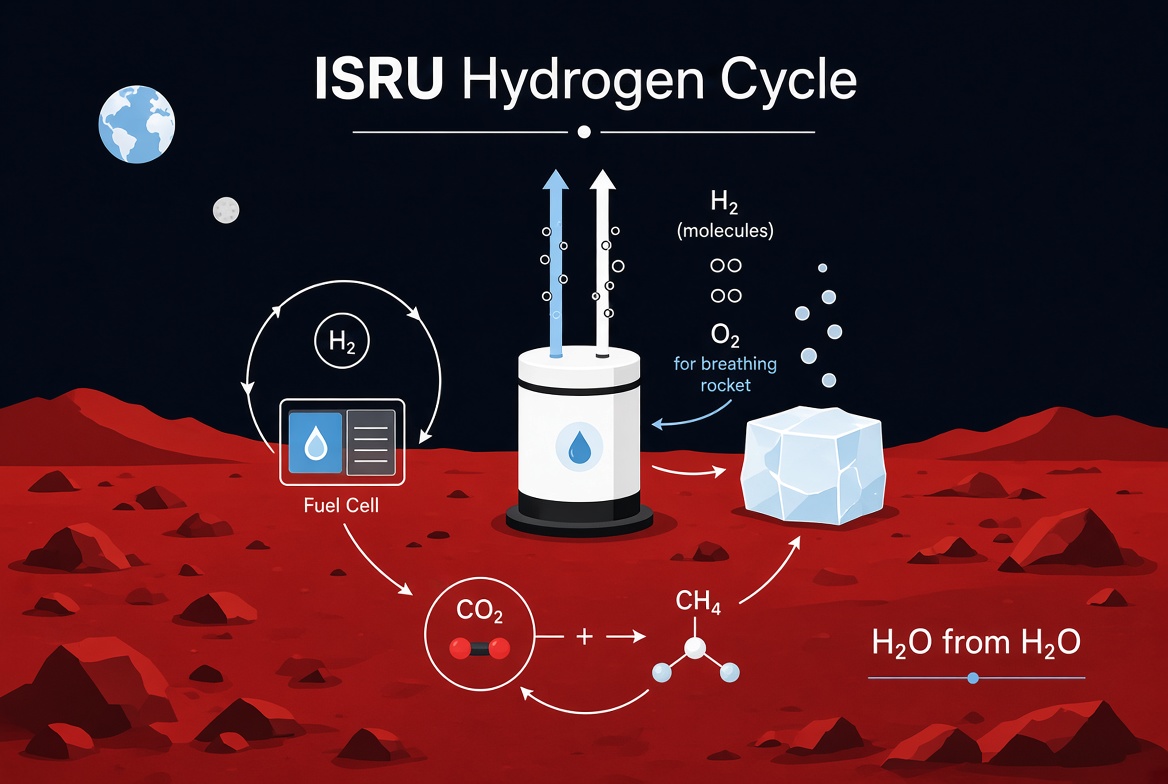
The most precious resource on Mars is water ice. Studies have confirmed the existence of vast quantities of subsurface water ice, particularly within the Medusae Fossae formation near the equator . From this water ice, humans can perform water electrolysis (H₂O) – a process that splits water into its two essential components: hydrogen (H₂) and oxygen (O₂) . This process is the cornerstone of human survival and activity on Mars.
Applications of Electrolysis Products on Mars
Oxygen and hydrogen, once produced, address two critical needs:
-
Oxygen (O₂) for Life and Propellant:
-
Breathable Air: Mars' atmosphere is over 95% CO₂ , containing virtually no free oxygen. Oxygen produced from ice electrolysis is the sole supply for sustaining astronaut life in habitats and spacecraft .
-
Rocket Fuel (Bipropellant): Liquid oxygen (LOX), combined with hydrogen or methane (synthesized from CO₂), creates a powerful propellant to launch spacecraft off Mars for the return journey to Earth .
-
-
Hydrogen (H₂) for Energy and Synthetic Fuel Production:
-
Energy: Hydrogen can be used in fuel cells to generate electricity, powering bases and rovers, especially during periods without sunlight (night or dust storms) . Hydrogen acts as an efficient "energy storage," more sustainable than batteries alone.
-
Fuel and Chemical Production (Sabatier and Fischer-Tropsch Processes): This is a critically important role, transforming Mars into a giant chemical plant. Hydrogen (H₂) reacts with atmospheric CO₂ (95%) to produce water (H₂O) and methane (CH₄) via the Sabatier reaction . Methane is an excellent fuel. It can be used as an alternative to or combined with hydrogen as rocket propellant, fuel for surface vehicles, or as feedstock for producing plastics and building materials .
-
Metal Extraction: Hydrogen can also serve as a reducing agent to extract metals from Martian soil (regolith) for construction and manufacturing .
-
Mars: A Driver for Technological Breakthroughs
Mars' challenging atmosphere (95% CO₂) is both a hurdle and an opportunity. It forces humanity to develop superior technologies:
-
Advanced Electrolysis: Research focuses on pulse electrolysis, which can save up to 54% energy compared to traditional methods – a critical factor on a planet with limited power resources.
-
Efficient CO₂ Capture and Conversion: Technologies are being developed to extract CO₂ from the atmosphere and convert it with H₂ into methane fuel, even using catalysts made from iron (available on Mars) instead of nickel (unavailable) .
-
Leveraging Temperature Differences: Scientists at the University of British Columbia (UBC) have demonstrated that thermoelectric generators can exploit the temperature difference between the warm interior of a habitat (around 20°C) and the extremely cold exterior (down to -153°C) to generate electricity, powering CO₂ conversion processes.
The Energy Loop and Lessons for Earth
This creates a remarkable energy cycle:
Energy (Solar/Nuclear) → Water Ice Electrolysis → Oxygen (breathing, propulsion) + H₂ (energy) → H₂ + CO₂ → Methane + Water → (Water cycles back to electrolysis, Methane as fuel producing CO₂ and energy) → ...
It is thought-provoking that to survive in an environment with 96% CO₂ like Mars, humanity must achieve an extremely high level of technological civilization – capable of "magically" transforming toxic CO₂ into breathable oxygen and operational fuel. This leads to an intriguing question for present-day Earth. The current CO₂ concentration in Earth's atmosphere is about 423 ppm (0.0423%) . This level has significantly increased since pre-industrial times and is approaching unprecedented levels in human history. If emissions continue, forecasts suggest CO₂ could reach 600 ppm by the end of this century.
When would Earth's CO₂ concentration reach 95%, similar to Mars? In reality, reaching 95% (950,000 ppm) at current average growth rates would take a geological timescale of millions of years. However, the key message is not about a specific number. The core insight is: When Earth faces extreme environmental challenges partly of its own making, humanity will be forced to invent similarly revolutionary technologies as needed for Mars. Survival on a CO₂-rich planet demands a civilization capable of highly efficient energy recycling and turning waste into resources. Investing in ISRU technologies is not just the path to Mars, but also a necessary preparation for building a sustainable future right here on Earth.