

Hydrogen Cooking vs. Gas Stoves: Why Does Food Taste Better?
October 10, 2026
Annie Nguyen, VAHC Secretariat
When hydrogen burns, the chemical reaction produces only water vapor. This property makes hydrogen a unique cooking tool, fundamentally different from traditional gas stoves. According to the Japan Gas Appliances Inspection Association, the hydrogen grill jointly developed by Rinnai and Toyota received the first domestic certification as a demonstration "hydrogen cooking appliance" in December 2024.
The Mechanism Behind the Difference
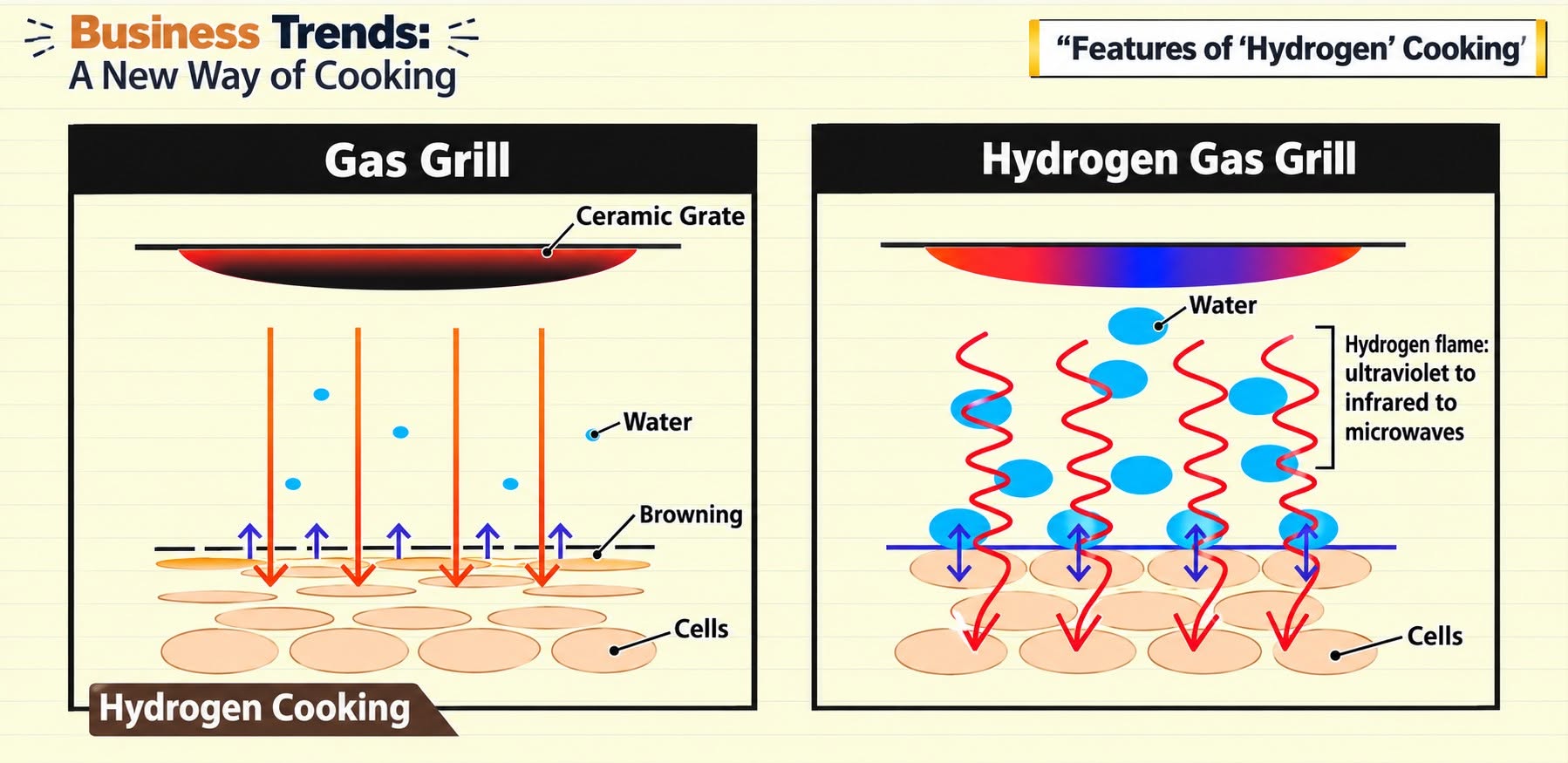
Conventional gas stoves burn fossil fuels, producing CO₂ and dry heat. This dry heat rapidly evaporates water from food cells, causing meat to become dry and tough. Hydrogen, on the other hand, combines with oxygen when burned to form water vapor (H₂O), increasing humidity around the cooking zone. The result is food cooked in an environment that both grills and steams, a state known as "steam-grill."
Cooking Time and Moisture
The flame temperature of hydrogen can reach up to 2,500°C, roughly 1,000°C higher than conventional gas. This high temperature allows food to cook faster, reducing exposure time to heat and minimizing moisture loss. A real-world test at a restaurant in Kanagawa showed that chicken breast cooked with hydrogen turned white evenly in just about 30 seconds, markedly faster than a gas oven. When cut open, the hydrogen-cooked meat was noticeably juicier, more tender, and richer in flavor.
Texture and Aroma
The result is food with a crispy, fragrant exterior and a tender, juicy interior. Direct comparative tests have proven this. In an experiment with king oyster mushrooms, mushrooms cooked with LP gas lost moisture and shrank to about half their size, while those cooked with hydrogen remained almost unchanged in size, and when cut open, moisture gushed from inside. Similar tests with sardines and chicken yielded consistent results: more tender meat, better moisture retention, and more natural flavor.
A scientific study on the effect of hydrogen cooking on food aroma found that aldehyde compounds—products of lipid oxidation—tended to decrease when cooking with hydrogen. Specifically, Hexanal, known for its fishy and "green" off-odor, had a smaller peak area when cooked with hydrogen compared to city gas. This suggests that hydrogen cooking may reduce unpleasant odors and better preserve the natural aroma of ingredients.
Real-World Experiences
Feedback from practical settings confirms these differences. At a tasting event in Oita, participants noted that meat cooked with hydrogen was "fluffier and more tender" than with gas. An American guest at a restaurant in Hakone described a beef steak cooked with hydrogen: "When you chew, the juices overflow. Just pressing lightly with chopsticks, the juices come out."
Beyond flavor, hydrogen also has an environmental advantage as it emits no CO₂ during combustion. However, hydrogen fuel costs remain high, about three times that of propane gas, and hydrogen supply infrastructure for households is not yet widespread.
Conclusion
The core difference between hydrogen and gas cooking lies in the byproducts of combustion. Gas produces CO₂ and dry heat, which dehydrates food. Hydrogen produces water vapor and higher temperatures, retaining moisture and preserving food cell structure. The result is meat that is more tender and juicy, vegetables that retain their size and freshness, natural flavors that are better preserved, and reduced off-odors from lipid oxidation. Despite high costs and infrastructure challenges, hydrogen cooking is showing potential to reshape the culinary experience in the future.
TÀI LIỆU THAM KHẢO / REFERENCES
-
Japan Gas Appliances Inspection Association – Chứng nhận thiết bị nấu ăn bằng hydrogen
https://www.jia-page.or.jp/ -
Rinnai Corporation – Phát triển lò nướng hydrogen
https://www.rinnai.co.jp/ -
Toyota Motor Corporation – Hợp tác phát triển công nghệ nấu ăn bằng hydrogen
https://global.toyota/ -
Hydrogen Cooking Co., Ltd. – Nghiên cứu và phát triển thiết bị nấu ăn bằng hydrogen
https://www.h2-cooking.com/ -
Đại học Nông nghiệp Tokyo – Nghiên cứu tác động của hydrogen lên thực phẩm
https://www.tuat.ac.jp/ -
Hot Pepper Gourmet – Bài viết về nhà hàng Libero và nấu ăn bằng hydrogen
https://www.hotpepper.jp/mesitsu/entry/nao-morita/17-00008 -
Newswitch (Nikkan Kogyo Shimbun) – JTEKT thử nghiệm lò nướng hydrogen
https://newswitch.jp/p/46370 -
Kanagawa Business Up To Date – Chương trình giới thiệu công nghệ nấu ăn bằng hydrogen
https://www.tvk-yokohama.com/