

Hydrogen Applications in Military and Defense: Strategic Advantages and Challenges
R&D Team, VAHC
July 14, 2026
In the context of increasingly complex geopolitical competition, armed forces worldwide are seeking breakthrough technologies to gain battlefield advantage. Hydrogen, with its superior energy density and low-signature operational capabilities, is emerging as a strategic solution in defense, from portable power for infantry to propulsion for submarines and unmanned aerial vehicles (UAVs).
Strategic Advantages of Hydrogen on the Battlefield
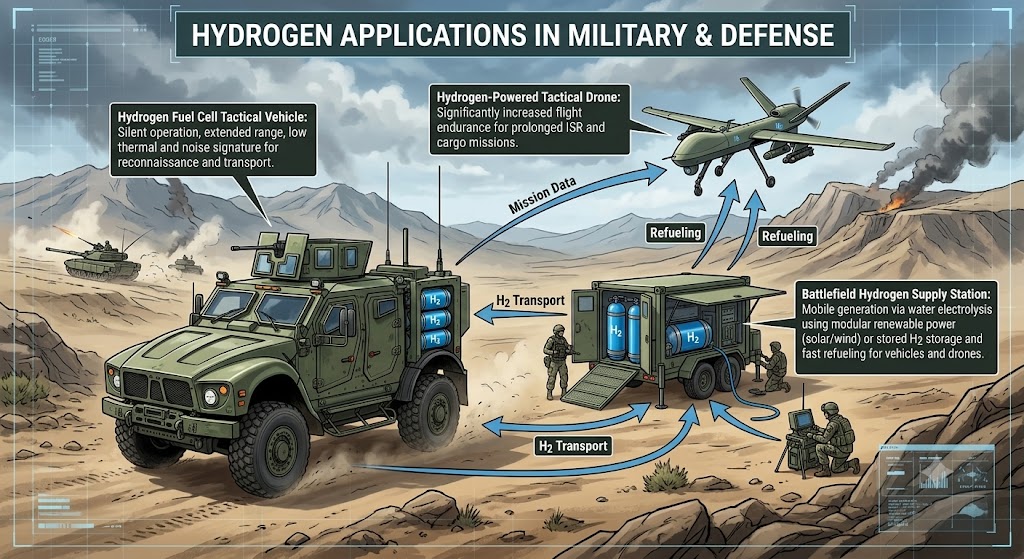
Hydrogen offers three key strategic advantages for military applications. First, extended range and endurance. While lithium-ion batteries have low energy density, limiting the operational time of UAVs and electronic systems, hydrogen allows for significantly longer flight and operational times. A multirotor drone equipped with a hydrogen-electric system can increase range and endurance fivefold at half load. The U.S. Navy's H2 Stalker system, using the same fuel cell as the H-SUP generator, has successfully completed multiple flight tests, demonstrating significantly enhanced range and endurance.
Second, superior stealth capabilities. Hydrogen fuel cells operate at much lower temperatures than typical UAV jet engines, with exhausts three times cooler. Electric propulsion systems are also significantly quieter, potentially reducing noise by up to eighty-five percent compared to jet engines, making systems harder to detect on the battlefield. This thermal and acoustic stealth is particularly critical in amphibious operations and reconnaissance missions.
Third, logistical flexibility and reduced fuel dependency. Hydrogen can be produced on-site from water and renewable energy, reducing dependence on vulnerable fuel supply chains. Systems like HyTEC (Hydrogen at the Tactical Edge of Contested Logistics) by the U.S. Defense Innovation Unit (DIU) enable hydrogen production in austere environments, enhancing survivability and range of disaggregated forces in contested logistics environments.
Real-World Applications and Notable Projects
Portable Tactical Power
The U.S. Naval Research Laboratory (NRL) has developed H-SUP (Hydrogen Small Unit Power), a portable fuel cell electric generator with greater energy per weight than batteries and lower audible and thermal signatures than combustion generators. H-SUP has been field-tested at various U.S. Marine Corps bases, including Camp Lejeune, Yuma, and Twentynine Palms.
The U.S. Army has also deployed a hydrogen "Energy Node" at the Fort Bliss Innovations Lab. This system, combining solar panels, electrolyzer, hydrogen storage, and fuel cells, provides backup, independent power for forward bases, reducing the need for liquid fuel transport and enhancing resilience.
The EHOSS (Expeditionary Hydrogen On Ship and Shore) project by DIU aims to develop a tactical "micro hydrogen supply chain" deployable both aboard ship and ashore, producing high-pressure hydrogen to power unmanned systems.
Unmanned Aerial Vehicles (UAVs)
Hydrogen fuel cell-powered UAVs offer significantly longer flight times than conventional batteries. The U.S. Defense Innovation Unit (DIU) has added Heven AeroTech's Z1 UAV to its Blue UAS Cleared List. The Z1 has up to ten hours of endurance, quiet operation, and low thermal signature. The system can be deployed in under five minutes and has vertical takeoff and landing (VTOL) capability.
A European aerospace company has also unveiled its supersonic prototype Destinus-3 at the Paris Air Show, using liquid hydrogen both as fuel and as a pre-coolant, enabling near-hypersonic flight and opening significant potential for future military applications.
Hydrogen-Powered Tanks and Armored Vehicles
South Korea is pioneering hydrogen-powered armored vehicles. Hyundai Rotem unveiled its H2 WAVe (Hydrogen Wheeled Armoured Vehicle Electric) at ADEX 2025. The vehicle uses an electric motor, hydrogen fuel cells, and a lithium-ion battery system, significantly reducing thermal signature and operating more quietly than internal combustion engines. However, storing hydrogen at extremely high pressure and hydrogen's highly flammable nature pose significant safety risks on the battlefield. When a hydrogen tank is breached, the escaping and igniting gas can create a very powerful thermobaric explosion. The company plans to begin trials in late 2025 and continue through the end of 2026, aiming to develop hydrogen-powered military vehicles by around 2035-2040.
Additionally, Hyundai Rotem is researching a next-generation K3 main battle tank concept using hydrogen fuel cells, completely replacing diesel engines and generators. This tank promises better acceleration, quieter operation, and radar-absorbing materials, equipped with a smoothbore gun and autonomous driving capability.
Submarines and Undersea Warfare
Air-independent propulsion (AIP) technology using hydrogen and fuel cells allows conventional submarines to extend their submerged endurance from days to weeks, enhancing stealth and combat capability. Third-generation hydrogen AIP systems have been installed on Spain's S-80-class submarines, with hydrogen produced on-board from bio-ethanol, offering safety and tactical advantages.
Geologic Hydrogen in Defense Applications
Beyond fuel cells, the U.S. Air Force is pioneering the extraction of geologic hydrogen – naturally occurring hydrogen trapped underground – for on-site power generation at military installations.
The Air Force has partnered with Renaissance Philanthropy's Chimaera Fund and commercial exploration companies (HyTerra Ltd., Helix Exploration PLC, Prometheus Hydrogen) to demonstrate the entire geologic hydrogen process, from exploration and extraction to storage, transport, and base use. The initial focus is on Malmstrom AFB in Montana and McConnell AFB in Kansas, aiming to meet a congressional mandate for energy availability at critical military sites by 2030.
Using geologic hydrogen allows the Air Force to avoid the high costs of transporting and producing hydrogen from other sources, while enhancing on-site energy security and reducing dependence on vulnerable fossil fuels and the electrical grid. Potential regions identified by the U.S. Geological Survey include the Four Corners states, the Midcontinent Rift System, the California coast, and the Eastern seaboard.
Challenges and Risks
Despite the benefits, military hydrogen applications face significant challenges.
Battlefield safety risks are a major obstacle. Hydrogen has a wide explosive range and is extremely flammable. The H2 WAVe armored vehicle carries eight high-pressure hydrogen tanks, effectively turning the vehicle into a "mobile thermobaric bomb," as breached tanks can create a powerful explosion, threatening the crew.
Cost and infrastructure are also significant challenges. Producing, storing, and transporting hydrogen requires complex and expensive technology. Hydrogen tends to volatilize and is more difficult to refine, store, and transport than diesel, posing significant operational challenges. For large-scale applications like tanks, military forces cannot rely on charging networks in isolated or war-torn areas. The lack of a comprehensive strategy for military hydrogen deployment (e.g., U.S. Navy) is also a barrier.
Legal and technical uncertainties regarding geologic hydrogen are also obstacles. There is currently ambiguity whether natural hydrogen is considered a 'leasable mineral' under the Mineral Leasing Act, and the Bureau of Land Management's jurisdiction over geologic hydrogen is unclear.
Conclusion
Hydrogen is emerging as a technology with enormous potential in the military domain, from portable power to propulsion for submarines and tanks, and on-site energy from geologic hydrogen. Strategic benefits in range, stealth, and reduced logistics dependence make hydrogen a top research and development priority for many nations. However, challenges in safety, cost, infrastructure, and legal frameworks must be addressed for hydrogen to truly realize its potential on the future battlefield.
Tham khảo / References
-
U.S. Naval Research Laboratory. (2025). Naval Research Hydrogen Tech Goes Tactical.
-
ScienceDirect. (2026). Designing an autonomous hydrogen-based energy hub for a military site.
-
Defense Express. (2025). H2 WAVe Hydrogen-Powered APC That Looks More Like Mobile Thermobaric Bomb.
-
S&P Global. (2025). US Air Force eyes geologic hydrogen for on-site power generation.
-
Air Force Office of Energy Assurance. (2026). Initial partners selected in Air Force geologic hydrogen energy resilience initiative.
-
Defense Innovation Unit. (2025). DoD To Prototype Expeditionary Hydrogen On Ship and Shore Generator.
-
ZeroAvia. (2025). ZeroAvia White Paper Highlights Hydrogen's Role in Defense.
-
Militär Aktuell. (2024). New hydrogen tank from Hyundai-Rotem?
-
Marine Corps Air Ground Combat Center Twentynine Palms. (2025). Naval Research Laboratories tests hydrogen fuel for Marines’ future fight.
-
The National Interest. (2026). Why the Pentagon Is Eyeing a Hydrogen-Powered Drone.
-
Janes. (2025). ADEX 2025: Hyundai Rotem showcases hydrogen-powered vehicles.
-
Air Force Office of Energy Assurance. (2026). Air Force Leading Geologic Hydrogen Research Initiative.
-
U.S. Army Engineer Research and Development Center. (2026). ERDC Hydrogen Energy Node Installed at Fort Bliss Innovations Lab.
-
Defense Innovation Unit. (2025). Prototypes Delivered for DIU’s HyTEC Project.
-
EDR Magazine. (2025). ADEX 2025 – Hyundai Rotem ready to test a hydrogen fuel cell hybrid 8×8 armoured vehicle technology demonstrator.