

Hydrogen, AI and Sustainable Governance: Navigating the Hydrogen–AI Nexus, Specialized Arbitration, Water Governance, and AI-Driven Evidence
Ho Chi Minh City, July 1, 2026 Annie Nguyễn
Ho Chi Minh City, June 30, 2026 – During the seminar “AI ⇄ Hydrogen – Two-Way Acceleration for the Energy and Intelligence Era” held at the Creative Startup Center of Ho Chi Minh City (SIHUB), experts presented an in-depth session on legal and governance aspects.
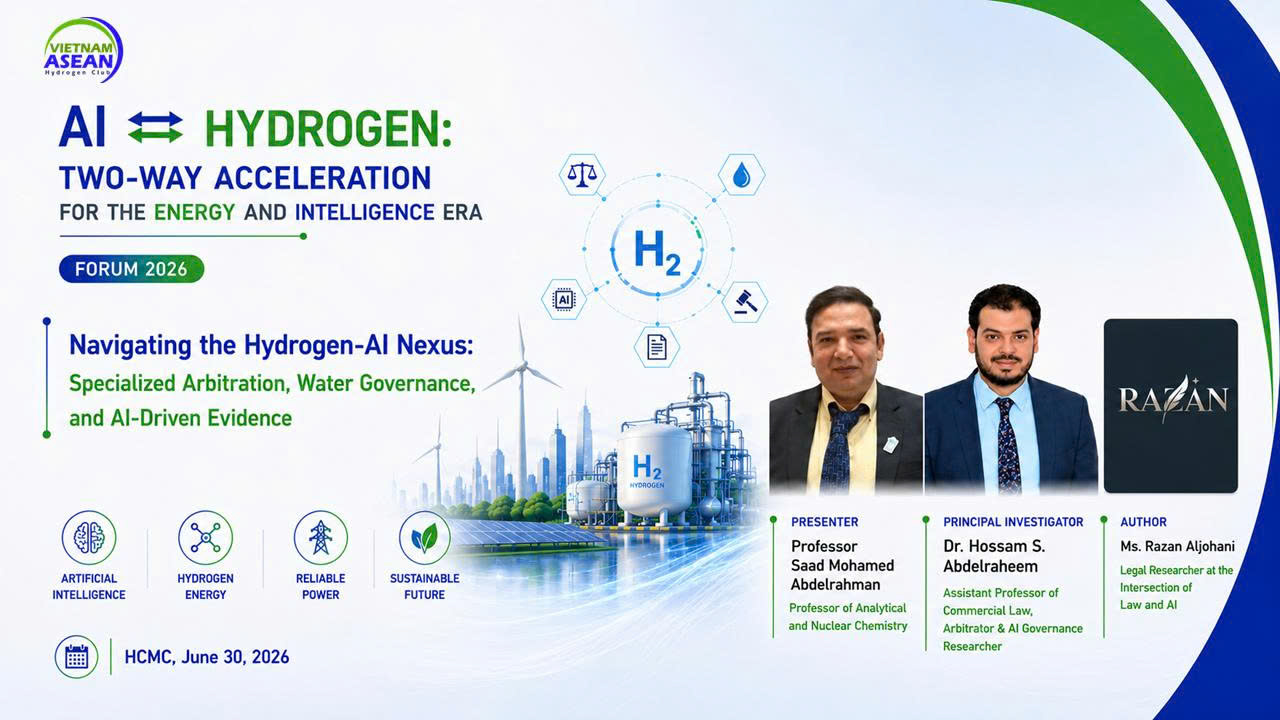
Dr. Hossam S. Abd El Raheem (Assistant Professor of Commercial Law – Practicing Arbitrator – Court Expert) together with Ms. Razan Al-Johani (Legal Researcher in Law & AI), produced by Prof. Saad Abd El Rahman (Professor of Analytical Chemistry), presented the document “Hydrogen, AI and Sustainable Governance”.
Main Content
The presentation is structured into 5 main sections:
- Hydrogen
- Energy
- Artificial Intelligence
- Governance
- Arbitration
Section I: The Science of Hydrogen
- Hydrogen makes up ~75% of normal matter in the universe.
- It is a core component of the human body, water, plants, and soil.
- Analysis of water contamination through hydrogen’s electric charge and its role in water purification (removing radiation and pesticides).
Section II: Hydrogen in Medicine & Nature Chemical structure analysis of compounds (e.g., Panadol with 9 hydrogen atoms vs. Heroin with 23), and hydrogen’s role in pharmacology and natural foods.
Section III: Hydrogen as Energy
- Hydrogen fuel cells.
- Clean combustion without CO₂ emissions.
- Applications in aviation, shipping, and heavy industry.
Section IV: Legal & Governance Framework (Core Section)
Potential Disputes in AI-Managed Hydrogen Projects:
- Environmental & water disputes (brine discharge, water allocation, transboundary issues such as the Mekong River in Vietnam).
- Cyber & smart infrastructure disputes.
- AI algorithmic liability.
- Intellectual property disputes (AI-generated inventions).
Specialized Arbitration Solutions:
- Hybrid Trio Tribunals (Legal + Technical + AI experts).
- Digital Arbitration using Smart Contracts, Blockchain, and Explainable AI (XAI).
Ethical & Legal Challenges:
- Algorithmic transparency, bias, data privacy, and deepfakes.
- Standards for admitting AI-supported evidence.
Proposed Governance Framework (4 Pillars):
- Technical & Safety Governance — Human-in-the-Loop, Zero Trust.
- Water & Environmental Governance — Prioritizing the Human Right to Water (SDG 6).
- Arbitration & Legal Governance — Specialized dispute resolution.
- Ethical & Data Governance — Transparency and accountability.
Strategic Synthesis Equation: (Technical Safety) + (Hydro-Environmental Sustainability) + (Specialized Arbitral Governance) + (Algorithmic Transparency) = A Smart and Sustainable Hydrogen Ecosystem.
Introducing Saudi Arabia's Hydrogen Strengths: Saudi Arabia is one of the world's leading countries in green hydrogen thanks to its Saudi Green Initiative and Vision 2030. The country possesses abundant renewable energy resources (powerful solar), a strategic geographical location, massive investment capital, and existing export infrastructure. Recent notable projects include:
NEOM Green Hydrogen Project (capacity of 600 tons/day, in partnership with ACWA Power and Air Products) – one of the world's largest green hydrogen plants, utilizing AI to optimize operations.
Amaala and Red Sea Project – integrating hydrogen into sustainable tourism.
Initiatives by Aramco and SABIC in applying AI to hydrogen production and decarbonization in the oil and gas industry.
Conclusion
The presentation emphasizes the need for an integrated governance framework combining science, technology, law, and ethics to ensure sustainable green hydrogen development, with particular relevance to Vietnam’s context.
Saudi Arabia is transforming from an "Oil Kingdom" to a "Green Hydrogen Superpower," where AI is a key factor in optimizing costs and scaling operations. Collaboration with countries like Vietnam in AI technology and supply chains will bring strategic benefits to both sides.