

How AI Reshapes the Green Hydrogen Value Chain from Production to End-Use – Perspective from the Netherlands
Trí tuệ Nhân tạo định hình lại chuỗi giá trị Hydrogen xanh từ sản xuất đến sử dụng cuối – Góc nhìn từ Hà Lan
Ho Chi Minh City, July 1, 2026 Annie Nguyễn
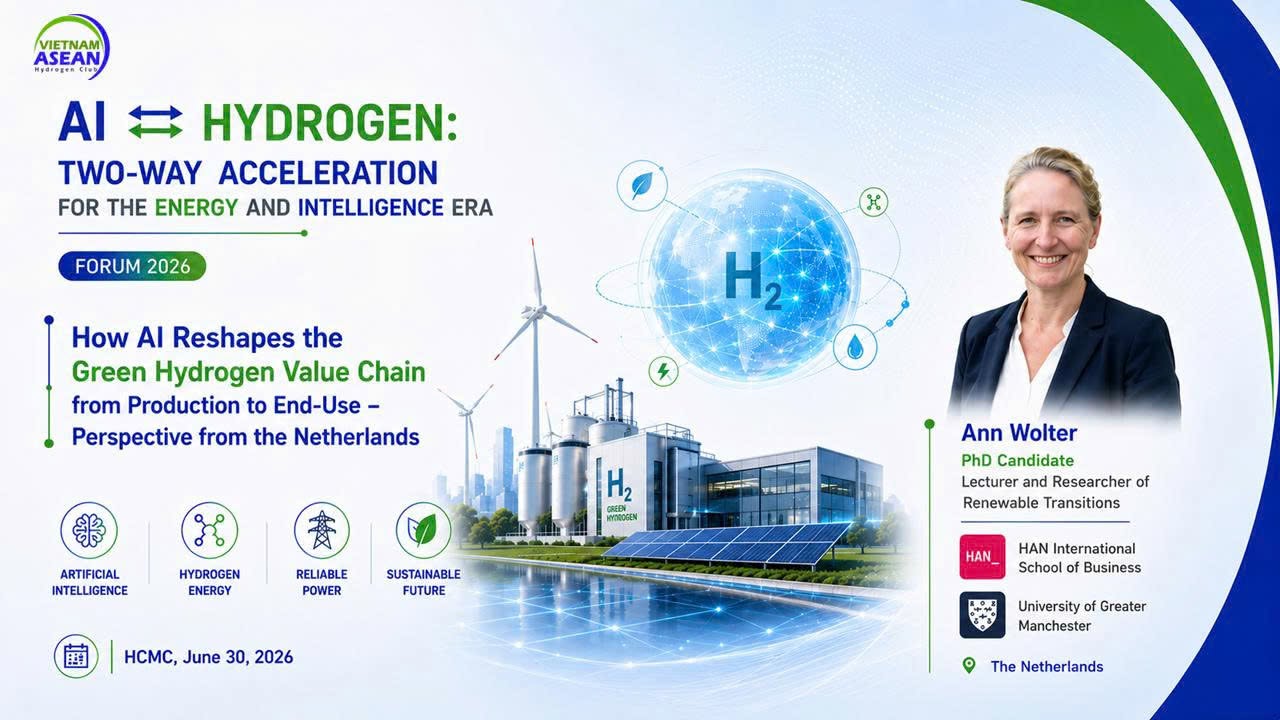
Ho Chi Minh City, June 30, 2026 – At the Creative Startup Center of Ho Chi Minh City (SIHUB), during the seminar “AI ⇄ Hydrogen: Two-Way Acceleration for the Energy and Intelligence Era” organized by Vietnam ASEAN Hydrogen Club, Ms. Ann Wolter – PhD Candidate, Lecturer and Researcher of Renewable Energy Transitions at HAN International School of Business (The Netherlands) and University of Greater Manchester (UK) – delivered an in-depth presentation sharing the European perspective.
Speaker Introduction and the Netherlands’ Strengths
Ms. Ann Wolter is an expert with extensive research experience in renewable energy transition and green hydrogen. The Netherlands is currently one of the leading countries in Europe in hydrogen, with an ambitious national strategy to become the “Hydrogen Hub” of Northern Europe. The country benefits greatly from the Port of Rotterdam – Europe’s largest logistics gateway, existing pipeline infrastructure, and strategic location connecting to offshore renewable energy in the North Sea. Recent major projects such as the 200MW ELYgator, Djewels, and the Hydrohub Innovation Programme have positioned the Netherlands as a living practical model for AI application in green hydrogen.
Main Content of the Presentation
1. Why Does Green Hydrogen Matter? Green hydrogen is considered a key technology for the clean energy future thanks to its ability to:
- Significantly reduce greenhouse gas emissions.
- Decarbonize hard-to-abate sectors such as steel production, aviation, and chemicals.
- Enhance national energy security.
- Store intermittent renewable energy from solar and wind sources.
2. AI Driving Green Hydrogen Production Across the Value Chain Key Motivations:
- AI improves production efficiency and reduces risks through data-driven optimization and forecasting.
- Supports decarbonization of hard-to-abate industries.
- Enables smart system integration between hydrogen, smart grids, energy markets, and storage.
- Explainable AI builds trust, supports regulatory compliance, and attracts stakeholders.
3. End-to-End Green Hydrogen Value Chain
- Renewable Energy Generation: Using wind, solar, or hydropower to power water electrolysis.
- Electrolysis Technologies: Alkaline, PEM (Proton Exchange Membrane), and Solid Oxide Electrolyzers.
- Storage and Transportation: Pressurized tanks, underground caverns, pipelines, trucks, or chemical carriers.
- AI-Enabled Optimization: Linking data across the entire chain for coordinated optimization, improving project resilience and economics.
4. Specific AI Applications in Hydrogen Production A. Renewable Energy Forecasting AI predicts solar irradiance, wind speed, power generation, and electricity demand using Neural Networks, Deep Learning, LSTM models, and Reinforcement Learning. AI also forecasts electricity market prices, supporting timely electrolyzer operation decisions and contributing to grid stability.
B. Fault Detection Green hydrogen systems are highly complex, including solar PV arrays, wind turbines, electrolyzers, battery storage, hydrogen storage systems, and power electronics. AI enables early fault detection, reducing downtime, saving maintenance costs, and enhancing safety.
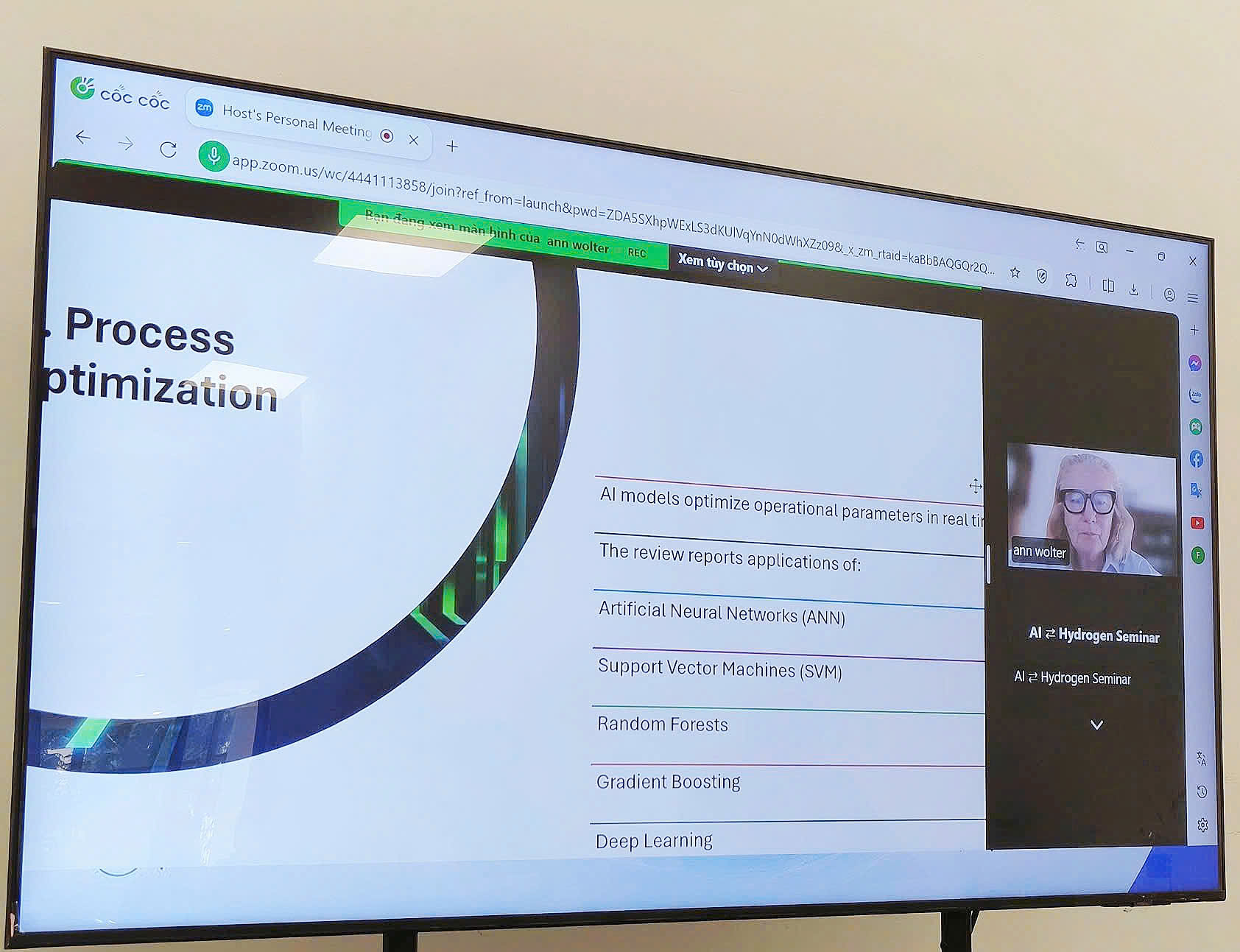
C. Process Optimization AI optimizes operational parameters in real time: temperature, pressure, voltage, flow rates, and catalyst loading. According to reviewed studies:
- Response Surface Methodology accounts for 43%.
- Artificial Neural Networks (ANN) account for 19%.
- Genetic Algorithms account for 16%.
- Machine Learning accounts for 14%.
5. Digital Twins – A Key Technology Digital Twins create virtual models that integrate real-time data, physics-based models, and AI to:
- Simulate the entire system.
- Provide real-time performance monitoring.
- Conduct risk-free “what-if” scenario analysis.
- Optimize design and operation throughout the project lifecycle.
6. Future Integrated AI Architecture The future lies in multi-layer AI-controlled hydrogen systems: from edge-level equipment control to system-wide optimization of energy and hydrogen flows. Hydrogen systems will provide flexibility services to smart grids (frequency regulation, congestion management). Major challenges include data interoperability and cybersecurity.
7. Practical Experience from the Netherlands The Netherlands is leading Europe with several large-scale projects:
- ELYgator 200MW at the Port of Rotterdam (Air Liquide & Siemens) – using AI and digital twins to orchestrate energy conversion.
- Djewels project in Delfzijl – one of the largest green hydrogen plants in Europe.
- Hydrohub Innovation Programme by the Institute for Sustainable Process Technology (ISPT) – focusing on grid integration and scalable facilities.
- Startup Elestor – developing advanced hydrogen-bromine flow batteries for balancing renewable energy grids.
These examples demonstrate that the Netherlands excels not only in policy but also in practical AI applications for hydrogen.
Conclusions by Ms. Ann Wolter
- Renewable-powered electrolysis is the most promising long-term pathway for green hydrogen.
- Hybrid systems (solar + wind + hydrogen storage) offer better reliability and economics than single-source systems.
- AI and Machine Learning are becoming indispensable tools for forecasting, control, diagnostics, and optimization.
- Future research should focus on advanced electrolyzers, catalysts, AI-driven control systems, storage technologies, and grid integration.
The presentation concluded with a strong call for international collaboration, especially between the Netherlands and ASEAN countries like Vietnam, to share experience and technology for advancing global green hydrogen development.