

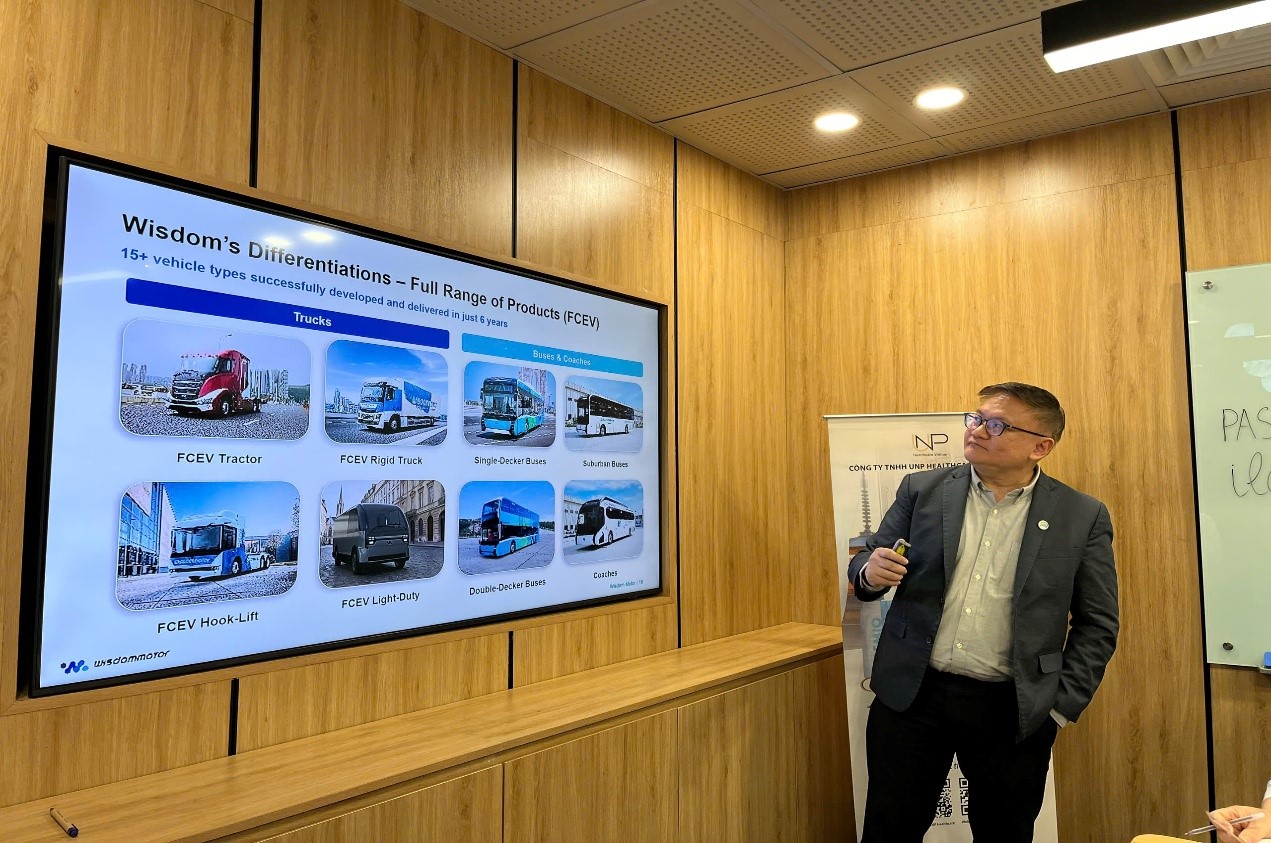
On February 5, 2026, the thematic workshop entitled “Renewable Hydrogen and Circular Energy Solutions for Vietnam and ASEAN’s Green Mobility Future: The Real Thing” was held at the ground-floor meeting room of the Serepok Phan Chu Trinh Building, 175 Phan Chu Trinh Street, Binh Thanh District, Ho Chi Minh City. The event was hosted by the Vietnam–ASEAN Hydrogen Club (VAHC) in collaboration with Wisdom Motor Group and UNP Healthcare Vietnam Co., Ltd., gathering experts, enterprises, and policymakers active in clean energy and sustainable transport.
At the workshop, Mr. Ivan Lim, Global Senior Vice President of Wisdom Motor Group, delivered a presentation titled “Hydrogen Mobility is Here!”, emphasizing that hydrogen-powered transport has moved beyond pilot experimentation and is now entering real commercial deployment in multiple advanced markets.
Heavy-Duty Transport: The Hardest Sector to Decarbonize
Mr. Ivan Lim began by highlighting that heavy-duty transport — including buses, long-haul trucks, tractor units, and industrial logistics vehicles — remains one of the most difficult sectors to decarbonize. These vehicles operate under high utilization rates, heavy payload requirements, and long-distance demands. Pure battery-electric solutions (BEVs), while effective in certain applications, face limitations in charging time, battery weight, and operational efficiency for continuous commercial use.
In this context, hydrogen fuel cell electric vehicles (FCEVs) have emerged as a viable alternative for high-intensity transport operations. FCEVs offer fast refueling comparable to diesel, long driving range, and zero tailpipe CO₂ emissions. These advantages make hydrogen particularly suitable for long-haul freight, port logistics, and high-frequency urban bus fleets.
Wisdom Motor Group: A Zero-Emission OEM with End-to-End Capability
Mr. Lim introduced Wisdom Motor Group as a premium zero-emission commercial vehicle OEM with comprehensive capabilities spanning research, design, manufacturing, certification, and deployment. Within just six years, the company has developed and delivered more than 15 FCEV and BEV vehicle models, including single-deck and double-deck buses, intercity coaches, rigid trucks, tractor heads, hook-lift trucks, and light-duty vehicles.
Wisdom has successfully entered highly regulated markets such as the United Kingdom, Germany, Switzerland, Austria, Sweden, Japan, South Korea, Australia, Singapore, and the UAE. Key milestones include:
-
Delivery of Australia’s first heavy-duty FCEV truck to PepsiCo.
-
Deployment of the first FCEV bus in the UAE.
-
Introduction of the world’s first three-axle double-decker FCEV bus in Hong Kong.
-
Supply of over 130 electric buses, including autonomous units, for Expo Osaka 2025.
-
Delivery of a 49-ton, 310 kW hydrogen fuel cell truck in Australia, witnessed by the Australian Deputy Prime Minister.
Wisdom’s products have obtained major international certifications, including EU Whole Vehicle Type Approval (WVTA), Japanese EV bus certification, Korean FCEV bus certification, and Australian hydrogen truck approval. The company holds more than 120 patents related to composite materials, monocoque body structures, vehicle control software (VCU, MCU, FCU), and advanced manufacturing processes.
Core Technological Advantages: Lighter, Stronger, More Efficient
A key highlight of the presentation was Wisdom’s proprietary innovations built on three pillars: new processes, new materials, and new technologies.
First, the company applies a full-load-bearing monocoque body structure instead of conventional chassis-frame assembly. By integrating high-strength composite materials with imported stainless steel, vehicles are approximately 10% lighter while achieving a design lifespan of up to 20 years.
Second, composite materials provide corrosion resistance and enhanced fire safety, significantly reducing lifecycle maintenance costs. Modular design further enables easier maintenance and faster component replacement.
Third, Wisdom’s in-house developed control systems — including the Vehicle Control Unit (VCU), Motor Control Unit (MCU), and Fuel Cell Control Unit (FCU) — act as the “brain” of the vehicle. These systems optimize hydrogen consumption, manage energy flows efficiently, and enhance overall vehicle performance and operational economics.
Comprehensive FCEV Product Portfolio for Heavy-Duty Applications
Mr. Lim detailed Wisdom’s broad hydrogen product lineup:
FCEV Trucks
-
FCEV Tractor Units for long-haul, 24/7 operations.
-
FCEV Rigid Trucks for regional transport.
-
FCEV Hook-Lift Trucks for municipal and industrial applications.
-
FCEV Light-Duty Trucks for urban logistics and last-mile delivery.
These vehicles are engineered to deliver long range, high payload capacity, and rapid refueling while maintaining zero emissions.
FCEV Buses and Coaches
-
12-meter urban buses.
-
Intercity coaches.
-
Double-decker buses.
-
Hydrogen-powered coaches for longer-distance passenger services.
Several of these models are already operating commercially in Abu Dhabi, Hong Kong, and other markets, demonstrating real-world feasibility.
Low-Carbon Manufacturing Model
Wisdom’s production facility spans 161,000 m², with annual capacity for 4,000 buses and 6,000 trucks. Notably, the company has eliminated traditional stamping and electrophoretic painting processes, significantly reducing capital expenditure and environmental impact.
According to Mr. Lim, this manufacturing model reduces annually:
-
140,000 tons of wastewater and sludge,
-
6 million kWh of electricity consumption,
-
520,000 cubic meters of natural gas usage.
This reflects a holistic zero-emission philosophy applied not only to vehicle operation but also to industrial production.
Opportunities for Vietnam and ASEAN
Connecting global experience to regional prospects, Mr. Lim emphasized that Vietnam and ASEAN are well-positioned to initiate hydrogen mobility deployment. Rapid logistics growth, rising urban air pollution pressures, expanding port infrastructure, and green economic strategies create favorable conditions.
He proposed a phased approach:
-
Launch medium-scale pilot projects in urban areas or seaports.
-
Develop centralized hydrogen refueling infrastructure for commercial fleets.
-
Establish public–private partnerships supported by green finance mechanisms.
-
Gradually scale up deployment as operational data and experience accumulate.
Hydrogen as a Pillar of Sustainable Transport
Concluding his presentation, Mr. Ivan Lim reaffirmed that hydrogen mobility is no longer a distant vision. With mature technology, international certifications, and proven commercial deployments, hydrogen-powered heavy-duty transport is positioned to become a key pillar in Vietnam’s and ASEAN’s long-term sustainable mobility strategies.
Hydrogen, he emphasized, is not merely an alternative fuel — it is a strategic pathway toward achieving net-zero transport in the decades ahead.