

Green Hydrogen and Ammonia that help the environment vs. grey ones and promising collaboration between Sarawak, Malaysia and Vietnam provinces for Green Hydrogen and Ammonia projects
July 29, 2026 by VAHC Secretariat
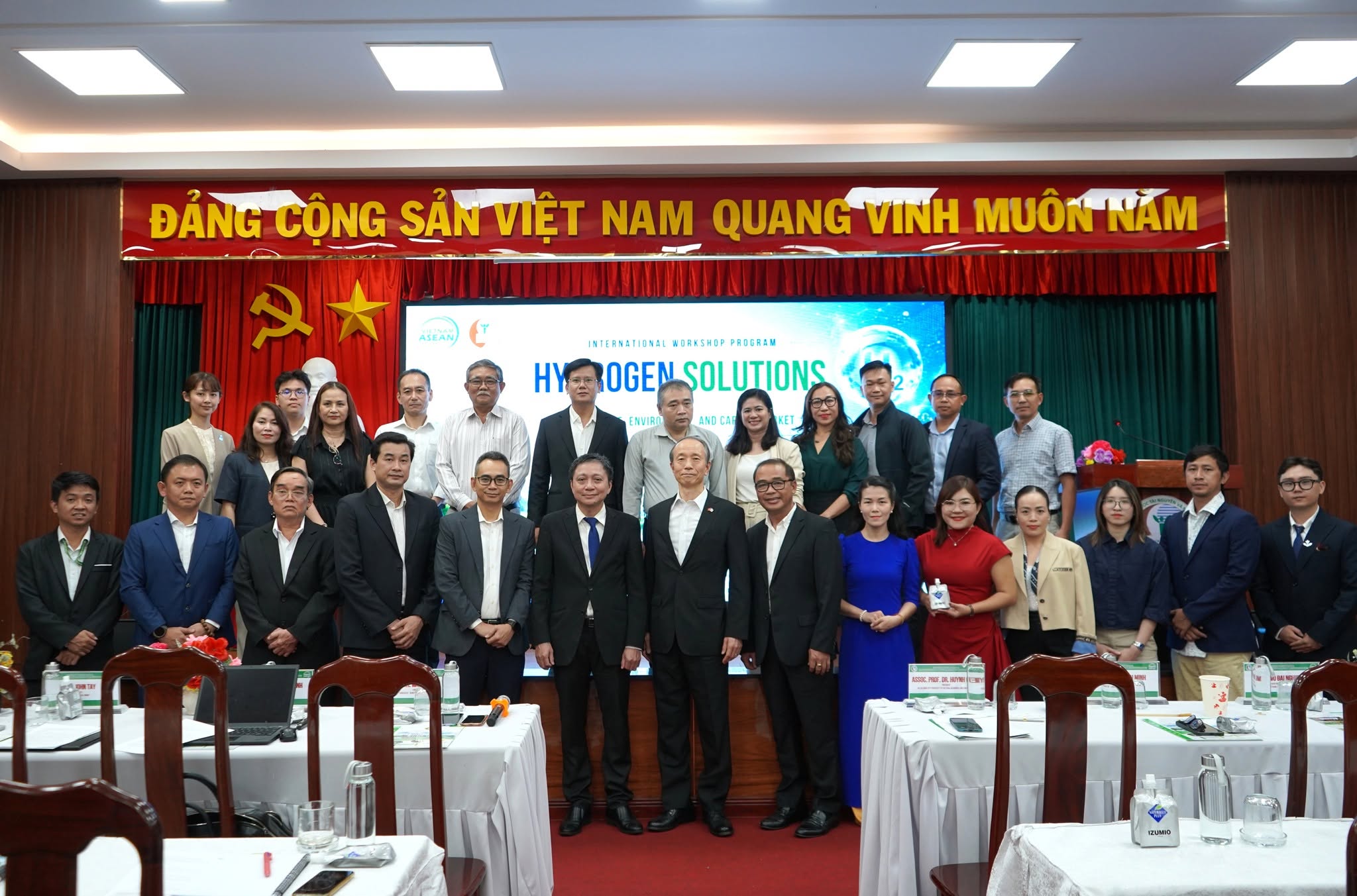
On July 29, 2026, at Ho Chi Minh City University of Natural Resources and Environment (HCMUNRE), the International Workshop on "Hydrogen Solutions for Agriculture, Environment, and Carbon Market" co-hosted by HCMUNRE and VAHC officially took place. The event brought together a large number of scientists, leading experts, domestic and international businesses, and diplomatic representatives from Japan, Malaysia, and South Korea. The workshop was organized to promote hydrogen applications in agriculture, environment, and carbon market development in Vietnam, while strengthening international cooperation in clean energy.
DETAILED SPEAKER REPORTS – SESSION 1
SESSION 1: HYDROGEN, ENVIRONMENT, AND CARBON CREDITS – OPPORTUNITIES AND INTEGRATION ROADMAP
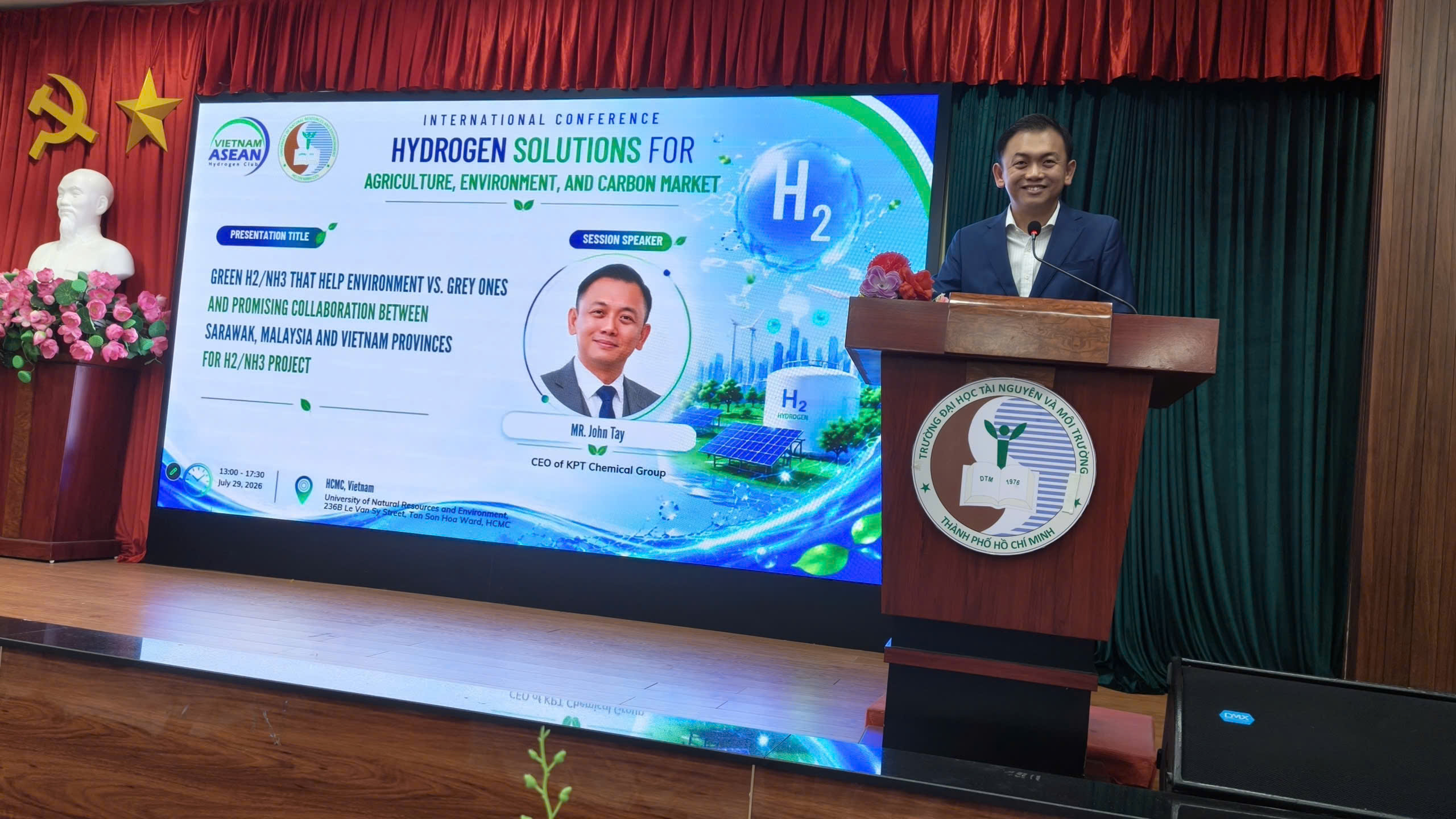
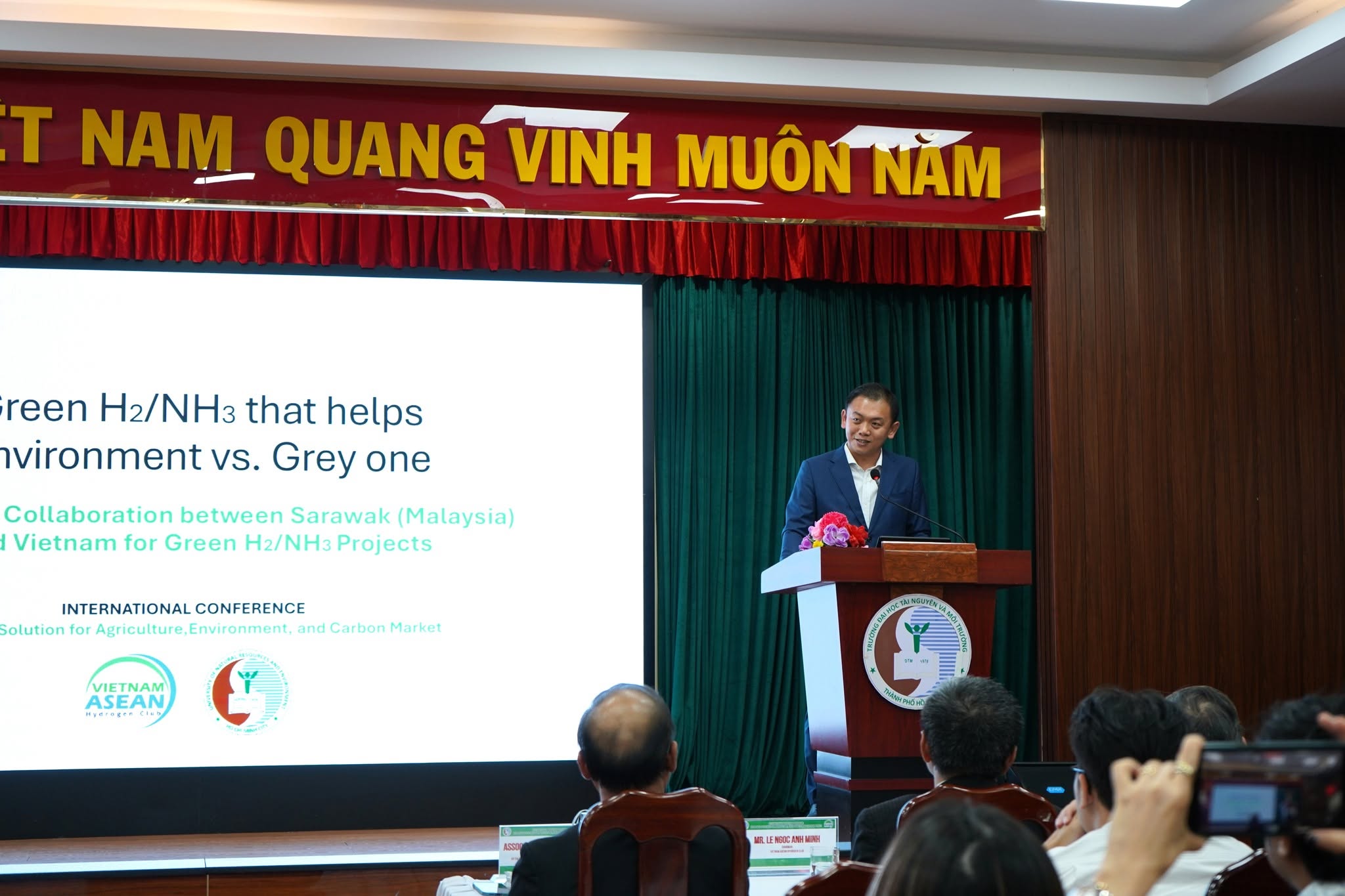
SPEAKER 1: MR. JOHN TAY – CEO OF KPT CHEMICAL GROUP (MALAYSIA)
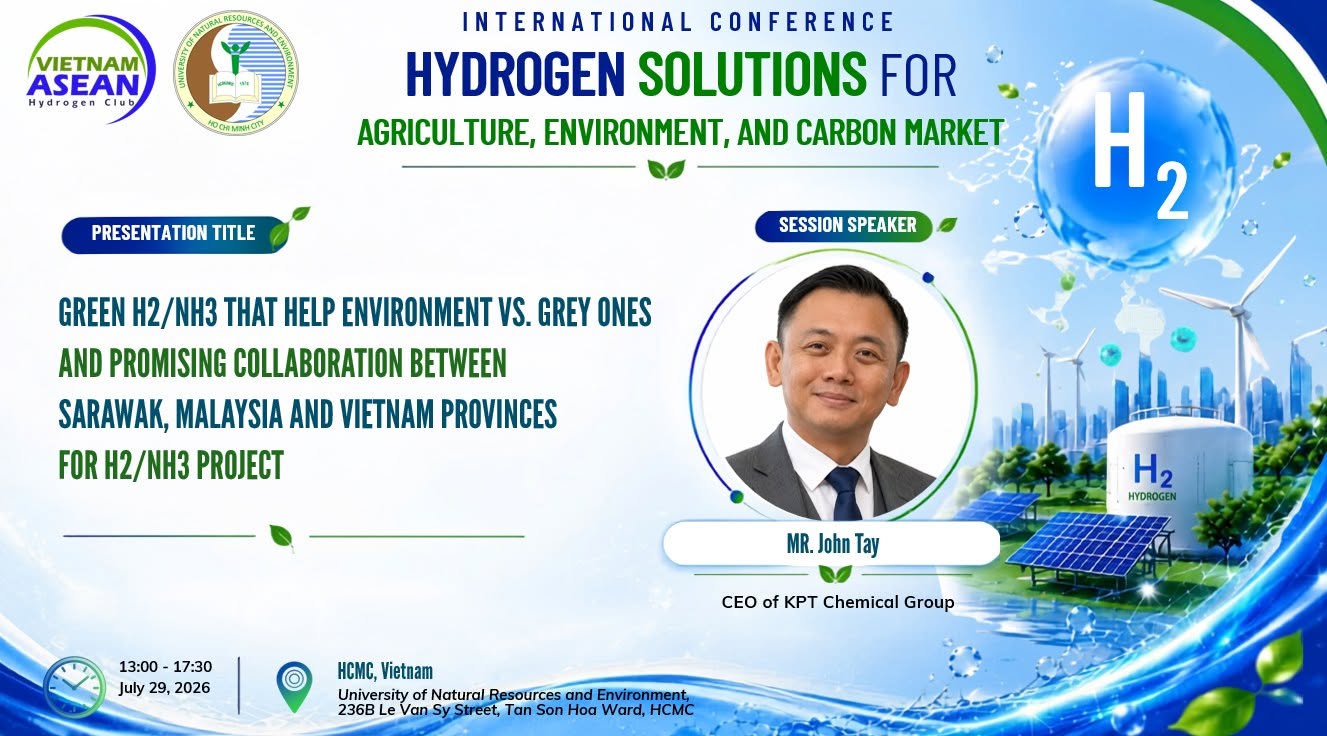
Topic: Green Hydrogen and Ammonia that help the environment vs. grey ones and promising collaboration between Sarawak, Malaysia and Vietnam provinces for Green Hydrogen and Ammonia projects
Introduction to KPT Chemical Group
Mr. John Tay opened his presentation by introducing KPT Chemical Group – a Malaysian enterprise established in 2009, with offices in Vietnam (62, Street 64, Area 14, Cat Lai Ward, HCMC) and global operations spanning Singapore, Malaysia, Indonesia, and China. The Group employs over 150 people with annual revenue exceeding 500 billion VND.
KPT Group operates in two main areas:
-
Pioneering D&C Safety Solutions: Supplying high-purity and industrial chemicals essential for modern and green industries.
-
Transform Energy Forward: Delivering energy efficiency and clean energy solutions for industrial and power sectors.
KPT Chemical (established 2010) specializes in NH₃, H₂, industrial chemicals and gases, DG logistics, and chemical facilities engineering. The company owns chemical storage terminals, road tankers, and NH₃ cylinder filling systems.
Green Hydrogen vs. Grey Hydrogen Comparison
Mr. Tay presented the core differences between the two types:
Grey Hydrogen:
-
Produced from natural gas (methane) through Steam Methane Reforming (SMR) or from coal via gasification.
-
CO₂ emissions: approximately 10-15 kg/kg H₂.
-
Production cost: low (~$1.8/kg).
-
Most common hydrogen source today but causes serious environmental pollution.
Green Hydrogen:
-
Produced from water electrolysis (PEM or Alkaline) using renewable energy (wind, solar, hydro).
-
CO₂ emissions: near zero.
-
Production cost: currently high (~$4-8/kg) but rapidly decreasing due to technology advances and economies of scale.
-
Sustainable solution supporting net-zero goals and energy security.
Green Ammonia vs. Grey Ammonia Comparison
Mr. Tay presented a detailed environmental impact comparison:
| Criteria | Green Ammonia (NH₃) | Grey Ammonia (NH₃) | Comparison |
|---|---|---|---|
| CO₂ Emissions (Lifecycle) | 0.1-0.3 t CO₂/t NH₃ | 1.6-2.2 t CO₂/t NH₃ | Green NH₃ reduces 90-95% CO₂ |
| Global Warming Potential (GWP) | Very Low | High | Green NH₃ has 90-95% lower GWP |
| Air Pollutants (NOx, SOx, PM) | Very Low | Moderate to High | Green NH₃ significantly reduces pollution |
| Water Consumption | Low to Moderate | Moderate to High | Green NH₃ has lower water impact |
| Land Use Impact | Low | Low to Moderate | Comparable |
| Resource Sustainability | High (renewable energy) | Low (fossil fuel dependent) | Green NH₃ is more sustainable |
| Biodiversity Impact | Low | Moderate | Green NH₃ has lower biodiversity risk |
Conclusion: Switching from grey to green ammonia can reduce lifecycle CO₂ emissions by 90-95%.
Green Ammonia Production Process:
-
Renewable energy (hydro, wind, solar) → electricity generation.
-
Water electrolysis → Green Hydrogen (H₂).
-
Haber-Bosch process with H₂ and Nitrogen (from air) → Green Ammonia (NH₃).
Green Hydrogen and Ammonia Application Potential in Carbon Reduction
Mr. Tay presented a detailed application table:
| Application | Current Fuel | Green Replacement | CO₂ Reduction |
|---|---|---|---|
| Steel Production (DRI) | Coal | Green H₂ | 90-95% |
| Ammonia Production | Grey H₂ | Green H₂ | 95-100% |
| Power Generation | Coal/Gas | H₂/NH₃ | 20-100% |
| Maritime Transport | Fuel Oil | Green NH₃ | 90-100% |
| Sustainable Aviation Fuel (SAF) | Jet Fuel | Green H₂ | 70-90% |
| Heavy Trucks | Diesel | H₂ Fuel Cell | 80-100% |
| Rail | Diesel | H₂ Fuel Cell | 90-100% |
| Buses | Diesel | H₂ Fuel Cell | 90-100% |
| Industrial Heat | Coal/LPG | Hydrogen | 80-100% |
Green NH₃ Price Trend:
Mr. Tay noted that green ammonia prices have seen a historical breakthrough, with a strong downward trend driven by electrolysis technology and renewable energy, approaching competitiveness with grey ammonia in the near future.
Sarawak – Green Hydrogen Hub of Malaysia
Mr. Tay introduced Sarawak, Malaysia's largest state with an area of 124,450 km² and population of approximately 2.53 million. Sarawak is being positioned as Malaysia's green energy hub with several segments:
-
Large-Scale Hydropower: The foundational backbone of Sarawak's green transition, providing continuous clean baseload electricity.
-
Green Hydrogen Production: Fast-growing sector focused on commercial-scale water electrolysis powered entirely by hydro.
-
Hybrid Floating Solar: Expanding utility-scale solar farms across reservoir lake surfaces to conserve land space.
-
Bioenergy & Biomass: Cultivating micro-algae for Sustainable Aviation Fuel (SAF) and processing agricultural industrial residues.
Sarawak Hydrogen Development Roadmap
Mr. Tay presented the key milestones:
-
2017-2018: Sarawak began investing in green hydrogen research, mandating Sarawak Economic Development Corporation (SEDC) Energy.
-
2019: Launched pilot hydrogen production plant and refueling station in Kuching for public transport.
-
February 26, 2024: Signed heads of agreement for dedicated large-scale Bintulu hydrogen hub at Borneo Energy Transition Conference.
-
June 10, 2024: Formally launched official joint-venture Sarawak H2 Hub project between SEDC Energy and Gentari.
-
2025-2026: Advanced regional policies via Sarawak Hydrogen Economy Roadmap and expanded infrastructure like Autonomous Rapid Transit (ART) hydrogen facilities.
Specific Projects in Sarawak
1. Darul Hana H2 Plant:
-
Sarawak's first public hydrogen refueling station.
-
Production capacity: 150 kg/day.
-
Currently in commissioning phase.
2. Rembus Hydrogen Plant:
-
Serving Kuching Urban Transportation System (KUTS) and Automated Rapid Transit (ART).
-
Minimum capacity: 5 tonnes H₂/day.
-
World's first network-scale hydrogen-powered ART system.
3. Sarawak Electrolyser Assembly & Distribution Facility (SEA-DF):
-
Collaboration between SEDC Energy and Lestari H2 Gaas.
-
Malaysia's first electrolyser assembly facility.
-
Target: Producing electrolysers consuming under 40 kWh/kg H₂ (compared to industry standard 50-60 kWh/kg).
4. Hydrogen Integration into Multi-Fuel Infrastructure:
-
Petroleum Sarawak Berhad (PETROS) is integrating hydrogen into multi-fuel refueling infrastructure.
KPT Group's Role and Cooperation Opportunities with Vietnam
Mr. Tay introduced KPT Group as a bridge promoting cooperation between Vietnam and Sarawak.
Activities Completed:
-
January 8, 2026: Organized a roadshow on Solid State hydrogen transportation solutions in HCMC with SEDC Energy and PECC2.
Planned Cooperation Activities:
-
Establish deeper partnerships in Green H₂/NH₃ experience sharing between Vietnam and Sarawak.
-
Leverage strengths of both countries to contribute to the global hydrogen economy.
-
Invest in: Green NH₃ storage terminals, Green H₂ & NH₃ production, hydrogen mobility projects, R&D centers with universities in both countries.
Please write email to contact@vahc.com.vn to request the full presentation of Mr. Tay.