

Global Leaders Double Down on Hydrogen: Key Moves from Malaysia, Japan, India, U.S., Philippines, Brazil, Colombia, and More (August 2026)
August 08, 2026
Annie Nguyễn, VAHC Secretariat
Introduction
The global hydrogen landscape is entering a critical new phase, moving beyond pilot projects and national strategies into concrete policy actions, cross-border partnerships, and real-world infrastructure development. As the urgency to decarbonize industrial sectors and achieve energy independence intensifies, top national leaders from Asia, North America, Europe, Latin America, and Africa are increasingly placing hydrogen at the center of their economic and energy agendas. From signing landmark legislation and launching demand-creation initiatives to granting exploration permits and forging strategic alliances, these high-level moves signal a decisive shift toward a more commercially viable and globally integrated hydrogen economy. This article provides a comprehensive update on the latest hydrogen-related activities and statements from heads of state and government leaders around the world.
1. Malaysia: Prime Minister Anwar Ibrahim Champions Energy Transition and Infrastructure
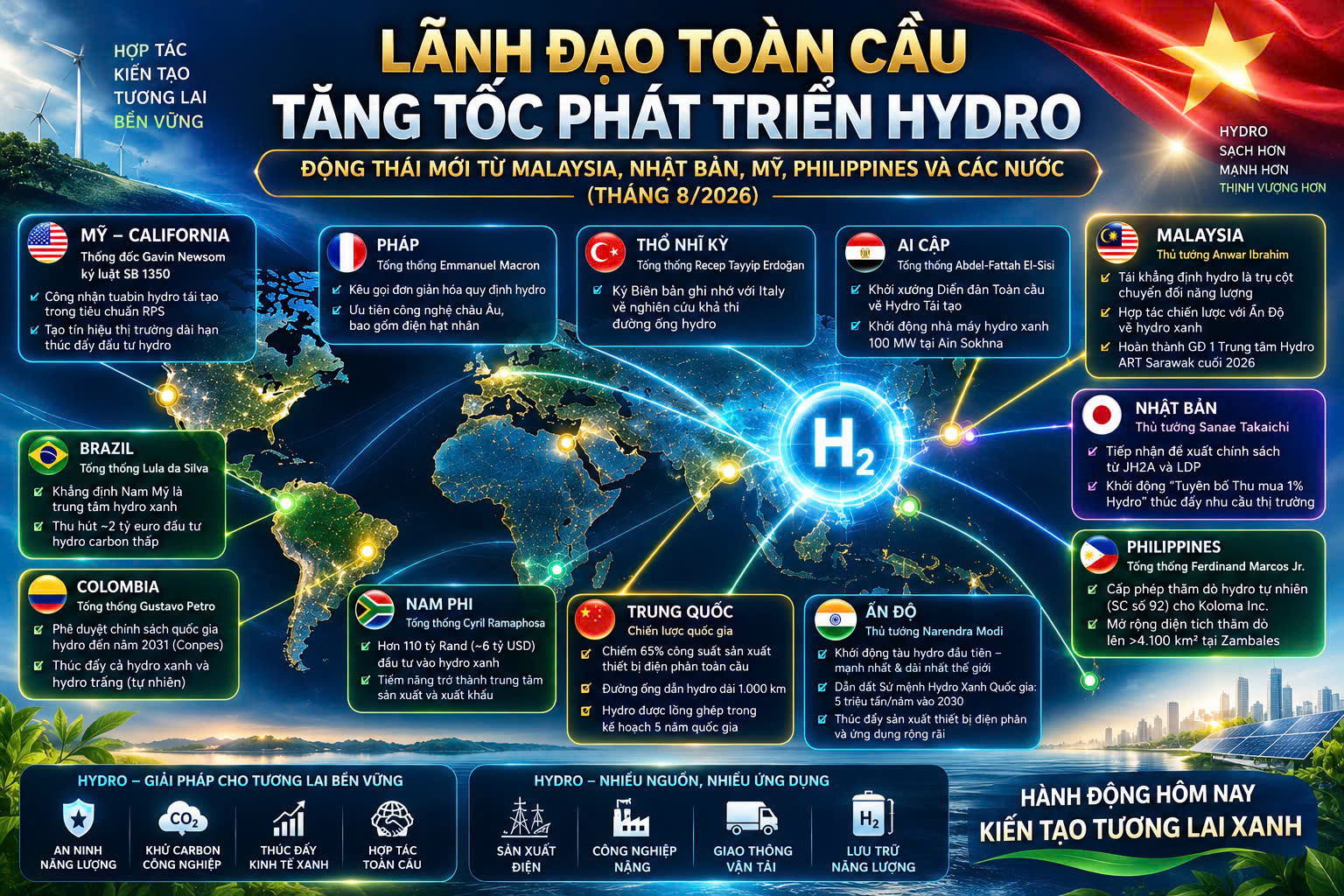
Malaysian Prime Minister Datuk Seri Anwar Ibrahim has reaffirmed his government's commitment to hydrogen as a cornerstone of the national energy agenda through key speeches and strategic developments.
-
Policy Directives and Speeches: At the recent ETCON 2026 (Energy Transition Conference), PM Anwar emphasized the critical need for Malaysia to transition from fossil fuels to hydrogen and electric vehicles (EVs). He warned against complacency, stating that failing to master these technologies would risk the nation falling behind. He is also scheduled to deliver a keynote address at Energy Asia 2025, a major regional energy forum.
-
Strategic Partnership with India: During a bilateral meeting with Indian Prime Minister Narendra Modi in February 2026, both leaders acknowledged the significant progress made by Malaysian companies like Petronas and Gentari in India's renewable energy and green hydrogen sectors, highlighting potential for deeper collaboration.
-
Specific Infrastructure Push: PM Anwar announced that Phase 1 of the Hydrogen Hub for the Autonomous Rapid Transit (ART) project in Sarawak is targeted for completion by the end of 2026. This project is a key component of Malaysia's National Energy Transition Roadmap (NETR).
2. Japan: Prime Minister Sanae Takaichi Receives Proposals and Launches Demand Creation Initiative
Prime Minister Sanae Takaichi has taken concrete steps to accelerate Japan's hydrogen society, focusing on both policy and market creation.
-
Receiving Policy Proposals: On May 28, 2026, PM Takaichi received a formal policy recommendation from the Japan Hydrogen Association (JH2A) and the Liberal Democratic Party (LDP)'s Hydrogen Society Promotion Taskforce. The proposal emphasizes hydrogen's role in enhancing energy security, industrial competitiveness, and achieving carbon neutrality.
-
Launching the "1% Hydrogen Procurement Declaration": Following this meeting, JH2A launched a new initiative aimed at expanding hydrogen demand. Under this declaration, member organizations commit to using hydrogen or related fuels for 1% of their procurement activities in three key areas: "transportation," "fuel," and "feedstock." This is expected to help establish a sustainable hydrogen value chain in Japan.
3. India: Prime Minister Modi and Government Accelerate the National Green Hydrogen Mission
Prime Minister Narendra Modi has made concrete commitments and spearheaded major initiatives, particularly in the transportation sector, demonstrating India's ambition to become a global leader in hydrogen technology.
-
Launching India's First Hydrogen Train: On July 17, 2026, PM Modi inaugurated India's first hydrogen-powered train on the Jind-Sonipat route in Haryana. He proudly declared it the world's most powerful hydrogen train with a 3,200 HP powertrain and the world's longest hydrogen train with 10 coaches.
-
Vision and Technological Edge: PM Modi emphasized that hydrogen train technology has only emerged globally in the last 7-8 years and only 3-4 countries operate them, yet India has already joined and made a breakthrough. He stated: "This hydrogen train is a successful example of Make in India, designed and manufactured by Indian engineers." He also framed it as a defining innovation for the 21st century in rail transport.
-
Energy Security Context: He highlighted the strategic importance of this shift, noting that nearly 99% of India's railway network has been electrified over the past 12 years, shielding the country from geopolitical supply disruptions like those seen in the Hormuz Strait.
Government and Ministerial Actions:
-
National Green Hydrogen Mission: Launched with a total budget of ₹19,744 crore (approx. $2.4 billion USD), the mission aims to achieve 5 million tonnes of green hydrogen production annually by 2030, create 6 million jobs, and attract over ₹8 trillion in investment.
-
Green Hydrogen Certification Portal: Union Minister for New and Renewable Energy, Shri Pralhad Joshi, launched the Green Hydrogen Certification Portal of India (GHCI) to enhance transparency and regulatory compliance.
-
Strategic Manufacturing Partnership: A key move is the strategic collaboration between Germany's thyssenkrupp nucera and state-owned Bharat Heavy Electricals Limited (BHEL) to manufacture alkaline electrolysers in India, reducing import dependence and strengthening the domestic supply chain.
-
Demand Creation and Pilots: Minister Joshi also confirmed that contracts have been awarded for 3,000 MW of electrolyser manufacturing capacity per year. Additionally, 12 pilot projects for 70 hydrogen-powered vehicles with a budget of ₹410.77 crore have been approved. Key offtake sectors include refineries, fertilizers, and steel.
4. United States (California): Governor Gavin Newsom Signs Law Expanding Renewable Hydrogen Role
California Governor Gavin Newsom has solidified the state's pioneering role in clean energy with a new legislative act.
-
Signing SB 1350 into Law: On June 29, 2026, Governor Newsom signed Senate Bill 1350 into law, effective immediately. The bill requires the California Energy Commission to recognize renewable hydrogen turbines within the state's Renewables Portfolio Standard (RPS).
-
Strategic Significance: This provides a long-term market signal, stimulating investment in renewable hydrogen production and infrastructure. Senator Jerry McNerney, the bill's author, stated: "We will not reach 100 percent renewable energy by 2045 if we only rely on those sources. SB 1350 adds green hydrogen into the mix." The state is also utilizing its Cap-and-Invest program to fund hydrogen infrastructure and fuel-cell trucks.
5. Philippines: President Marcos Grants Permits for Natural Hydrogen Exploration
President Ferdinand Marcos Jr. is advancing the country's energy diversification strategy by tapping into domestic natural hydrogen resources.
-
Signing Service Contract No. 92: In July 2026, President Marcos approved Service Contract (SC) No. 92, granting U.S.-based Koloma Inc. exclusive rights to explore for natural hydrogen in western Zambales province.
-
Expansion of Exploration: This is the third contract awarded to Koloma, expanding its total exploration area to over 4,100 square kilometers in Central Luzon and West Zambales, considered one of the most promising regions for natural hydrogen in Southeast Asia.
-
Strategic Goal: Energy Secretary Sharon Garin stated that the move aims to diversify energy sources and reduce reliance on imported fuel. If commercially viable, natural hydrogen could become a significant part of the country's future energy mix.
6. China: Market Leadership and National Strategy
While specific recent statements from top leaders were not identified in the latest news cycle, China's structural dominance in the hydrogen sector is clear and often referenced in global policy discussions:
-
The country accounts for 65% of global electrolyser manufacturing capacity.
-
It has built a 1,000-kilometre hydrogen pipeline.
-
Hydrogen is embedded in the national Five-Year Plan.
These three factors create a systemic advantage that is reshaping global hydrogen markets and supply chains.
7. Indonesia: President Prabowo's Vision for Energy Autonomy
Although President Prabowo Subianto has not personally spoken at a hydrogen event recently, his administration has demonstrated clear commitment through ministerial actions aligned with his national agenda.
-
Hydrogen as Part of "Asta Cita": Energy and Mineral Resources Minister Bahlil Lahadalia confirmed that hydrogen development is a key part of President Prabowo's Asta Cita (eight national goals), serving the twin objectives of energy independence and industrialization.
-
National Hydrogen Ecosystem: The government is actively building a national hydrogen ecosystem with 93 project initiatives across Indonesia, attracting investments of up to 32 trillion Rupiah. PLN (state utility) is operating 24 Green Hydrogen Plants (GHP). Indonesia is also partnering with Japan (JICA) to develop a bilateral roadmap for a hydrogen-ammonia society.
8. Brazil: President Lula da Silva Affirms South America's Green Hydrogen Superpower Status
President Luiz Inácio Lula da Silva has repeatedly asserted Brazil's and South America's exceptional potential in green hydrogen, while actively promoting policy actions and attracting international investment.
-
High-Level Strategic Vision: Speaking at the CELAC-EU summit in Brussels, President Lula declared emphatically: "Which part of the world can produce the green hydrogen that Europe needs? Exactly our dear South America." He emphasized this as a golden opportunity the region must seize to attract investment and development. In a separate interview in Manaus, he reaffirmed Brazil's immense potential in green hydrogen alongside wind and solar energy, stating "No country can compete with Brazil in this energy transition."
-
Attracting International Investment: At Hannover Messe 2026, the world's largest industrial fair, President Lula witnessed the announcement of approximately €2 billion in investments in low-carbon hydrogen and derivatives in Brazil, involving major corporations like Siemens and Thyssenkrupp. This move underscores Brazil's ambition to become a key link in the global green energy supply chain.
-
Strategic Partnership with Colombia: Following the directives of President Lula and his Colombian counterpart Gustavo Petro, the two countries approved a Joint Action Plan with 89 specific measures aimed at elevating bilateral relations to a Strategic Partnership. A key focus is the joint development of low-carbon hydrogen projects and decarbonization technologies, demonstrating the leadership of South America's two largest economies in shaping the region's hydrogen market.
9. Colombia: President Gustavo Petro Pushes Green and White Hydrogen with a Clear National Roadmap
President Gustavo Petro's administration has taken decisive steps in the final days of his term to establish a comprehensive policy framework for hydrogen, targeting long-term goals through 2031.
-
Pursuing Both Green and White Hydrogen: President Petro personally inspected the Coral project, expected to become South America's largest green hydrogen plant with a capacity of 800 tonnes per year in Cartagena. He emphasized the potential to export hydrogen via ammonia and produce green urea for agriculture. Concurrently, Energy Minister Edwin Palma, under the President's direction, announced a draft decree to allow exploration and exploitation of white (natural) hydrogen, opening a new pathway in the national energy strategy.
-
Approval of the National Roadmap (Conpes): In its final session before the end of the administration, the government approved the Conpes on national hydrogen policy – a critical document establishing 60 actions involving 27 state agencies, outlining a hydrogen development roadmap through 2031 with a planned budget of 86.424 billion pesos. This sends a powerful signal about the consistency and long-term nature of the strategy, regardless of the upcoming change in administration.
10. Other Key Global Leaders (Recent Highlights)
-
South Africa (President Cyril Ramaphosa): Emphasized Africa's potential to become a global hub for green hydrogen production and export, noting that over 110 billion Rand (approx. $6 billion USD) is being invested in the Northern Cape province.
-
Turkey (President Recep Tayyip Erdoğan): Attended a summit witnessing the signing of an MoU between Italy's Edison and Turkey's BOTAŞ to conduct a feasibility study for a hydrogen pipeline between the two countries.
-
Egypt (President Abdel-Fattah El-Sisi): Continues to champion green hydrogen, having launched the Global Forum on Renewable Hydrogen and initiating a 100 MW green hydrogen plant project at Ain Sokhna, a model for public-private partnerships.
-
France (President Emmanuel Macron): Criticized current EU green hydrogen regulations as overly complex, calling for simplification and prioritization of European technologies, including nuclear power, to accelerate deployment.
-
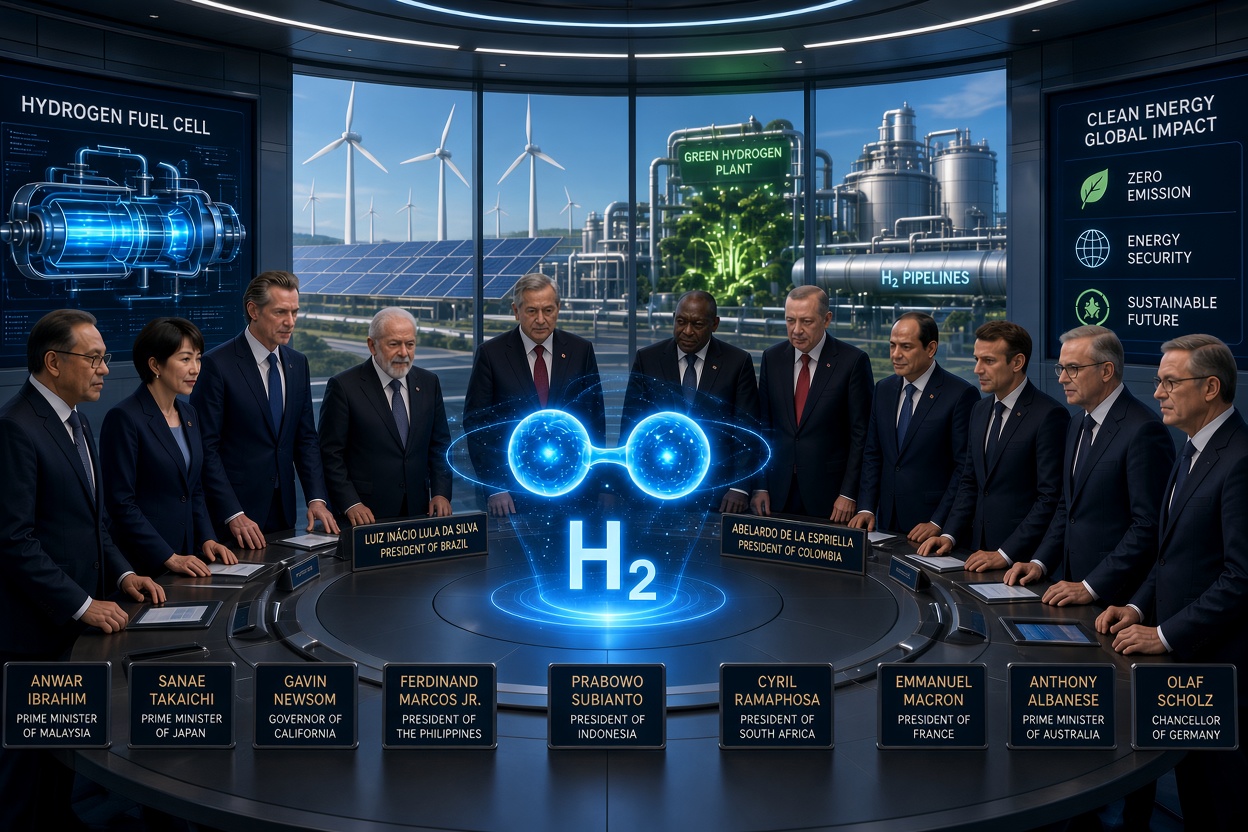
Australia (PM Anthony Albanese) and Germany (Chancellor Olaf Scholz): Australia passed a production tax credit for renewable hydrogen (2 AUD per kg). Germany continues to support the EU's REPowerEU target of producing 10 million tonnes of renewable hydrogen by 2030.
Conclusion
The recent wave of actions by global leaders paints a clear picture: hydrogen is no longer a distant vision of the future but a central pillar of contemporary energy and industrial policy. The diversity of approaches is striking—from Malaysia's focus on integrated infrastructure and Japan's market-making initiatives, to California's regulatory innovation, the Philippines' exploration of natural hydrogen, and China's strategic industrial dominance. India, under Prime Minister Modi's leadership, has demonstrated its ambition to lead with the ambitious National Green Hydrogen Mission and concrete steps in manufacturing and transport applications. Meanwhile, Latin America is emerging as a significant production hub, with Brazil and Colombia not only making bold statements about their green hydrogen ambitions but also backing them up with concrete investment plans and long-term regulatory frameworks. These moves are not isolated; they reflect a growing consensus that hydrogen is indispensable for achieving deep decarbonization in heavy industry, long-haul transport, and power generation, while also addressing critical concerns about energy security and economic competitiveness.
However, the path forward is not without challenges. As highlighted by leaders like President Macron and the South African administration, issues of regulation, cost (green premium), financing, and infrastructure standardization remain significant hurdles. The success of the hydrogen economy will depend on continued high-level political will, international cooperation to establish common standards, and innovative fiscal instruments that can unlock private investment without straining public budgets. The initiatives launched in recent weeks—from Japan's procurement declarations to the CIF's industrial decarbonization program—offer concrete models for overcoming these barriers. As we move towards the end of the decade, the decisions made and the partnerships forged today by these global leaders will fundamentally shape the competitiveness, sustainability, and geopolitical landscape of tomorrow's energy system. The race to build a hydrogen-powered future is well and truly underway.
References:
-
Malaysia (PM Anwar): Astro Awani, Bernama, Mangalore Today, Perdana Library (for NETR documents).
-
Japan (PM Takaichi): Japan Hydrogen Association (JH2A) press releases, LDP policy documents.
-
India (PM Modi): ANI News, The Hindu, The Indian Express.
-
India (Minister Pralhad Joshi): PIB (Press Information Bureau), Times of India, News On AIR, CNBC TV18.
-
India (International Partnerships): Hydrogen Insight, H2 Bulletin, Deutsche Börse.
-
USA - California (Gov. Newsom): American Public Power Association (APPA), Advanced BioFuels USA, Fresno Bee, RTO Insider.
-
Philippines (Pres. Marcos): Manila Standard, Inquirer.net, MetroTVNews.com.
-
China: Analysis from World Hydrogen Summit & Exhibition, reports on Chinese national strategy.
-
Indonesia (Pres. Prabowo): Kementerian ESDM (Ministry of Energy and Mineral Resources), Jawa Pos, RMOL.id (for GHES 2026).
-
Brazil (Pres. Lula): O POVO, VEJA, A Crítica, Agência Brasil, Investing.com.
-
Colombia (Pres. Petro): Valora Analitik, Radiocaribe.icrt.cu.
-
Other Leaders: CIF (Climate Investment Fund) announcements, COP27 statements, various energy ministry releases from South Africa, Turkey, Egypt, France, and Australia.