

From Plastic Waste to Clean Hydrogen: Vietnam’s Potential Feedstock Supply Equation
October 26, 2026 — Annie Nguyễn
Vietnam is facing a paradox: it generates approximately 1.8 million tonnes of plastic waste annually, yet only 27% is collected and recycled. The rest is mostly landfilled, incinerated, or leaked into the environment—with 0.28 to 0.73 million tonnes flowing into the ocean each year. Meanwhile, the global hydrogen industry is actively searching for new feedstocks that do not rely solely on water electrolysis and renewable energy. The question arises: can plastic waste—a pressing environmental issue—become a feedstock supply for clean hydrogen production in Vietnam?
The Scale of Vietnam’s Plastic Waste: Telling Numbers
According to international reports (World Bank, UNDP), Vietnam generates approximately 1.8 – 3.1 million tonnes of plastic waste each year, of which 280,000 – 730,000 tonnes (about 9–12%) leak into rivers, seas, and oceans. This places Vietnam among the top 5 countries globally for marine plastic pollution, according to a 2023 United Nations report.
Estimates vary on the exact ranking, but all confirm Vietnam’s position at the top. Some sources rank Vietnam 4th with about 0.28 million tonnes of plastic waste entering the ocean annually. Other sources record figures of 24,640 tonnes or 28,221 tonnes, depending on the estimation methodology. Despite the discrepancies, all point to one reality: Vietnam’s plastic leakage into the marine environment is significant and requires systematic management.
Notably, the current collection and recycling rate stands at only about 30–33%, largely driven by informal collection activities. This means the majority of plastic waste is still being wasted as a resource.
Technology: From Plastic Waste to Hydrogen
Technically, there are multiple pathways to convert plastic waste into hydrogen. According to scientific assessments, pyrolysis and gasification are the most mature technologies with the potential for industrial-scale deployment.
Pyrolysis decomposes plastics in an oxygen-free environment at around 500°C, producing oil, wax, and hydrocarbon-rich gas. This gas can then be processed via catalytic steam reforming (PCSR) or catalytic dry reforming (PCDR) to increase hydrogen yield.
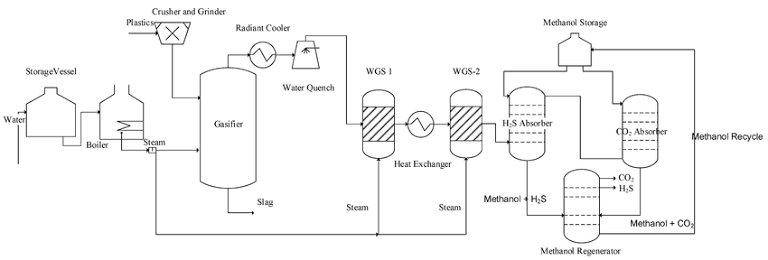
Gasification uses controlled steam or oxidants to produce synthesis gas (syngas), which then undergoes a water-gas shift reaction to extract hydrogen. When integrated with carbon capture and storage (CCS) , gasification can reduce emissions to 2–4 kg CO₂ equivalent per kg of H₂.
Emerging technologies include plasma gasification (achieving the highest hydrogen production rates in simulations), microwave-assisted pyrolysis, and alkaline thermal treatment—which can directly convert mixed plastics into high-purity hydrogen at lower temperatures.
Potential Calculation: How Much Hydrogen Can 1.8 Million Tonnes of Plastic Produce?
Studies on conversion efficiency show that hydrogen yield from plastic waste varies depending on the technology and plastic type. A study on plasma gasification recorded production rates of up to 1.2 kg H₂/second with a feedstock of 5 kg plastic/second. Another study on catalytic pyrolysis showed a yield of 250 kg H₂/tonne of feedstock, while mixed plastics achieved 0.29 kg H₂/kg of plastic.
Using a conservative figure—0.25 to 0.3 tonnes of H₂ per tonne of plastic waste—Vietnam’s 1.8 million tonnes of annual plastic waste holds the potential to produce between 450,000 and 540,000 tonnes of hydrogen. This is a significant figure: it represents a substantial portion of Vietnam’s current industrial hydrogen demand (mainly from fertiliser and refining) and could supply feedstocks for new applications such as chemicals, transport, or power generation.
However, it should be noted that this is a theoretical potential. In reality, conversion efficiency will depend on the plastic composition (mixed plastics are harder to process than sorted plastics), the scale and technology of the plant, and the collection rate—which currently stands at only about 27–33% of total generation.
Cost: The LCOH of Plastic-Derived Hydrogen
On costs, techno-economic studies indicate that the levelized cost of hydrogen (LCOH) from plastic waste can range from $2.18 to $3.46/kg H₂, depending on the specific technology and conditions. Some optimised scenarios—such as co-gasification of plastic with biomass or integrating CCS with carbon credits—could bring costs below $2/kg**. Emerging technologies are expected to achieve levels below **$2.5/kg.
For comparison, green hydrogen from electrolysis currently has significantly higher costs in many regions, while grey hydrogen from natural gas typically ranges around $1.5–2.5/kg depending on gas prices. This means that hydrogen from plastic waste can be a cost-competitive option, especially when accounting for the dual benefit of waste treatment.
In practice, several commercial projects are deploying this model. Protos Plastic Park in the UK, developed by Powerhouse Energy, uses distributed modular generation (DMG) technology to convert 25–35 tonnes of unrecyclable mixed plastic per day, producing around 2 tonnes of hydrogen per day. This serves as an example of a modular scale that can be replicated.
Significant Challenges
While the potential is clear, the path from plastic waste to clean hydrogen still faces numerous barriers.
First, the collection and sorting issue. Vietnam’s plastic collection rate is only about 27–33%, and the majority is high-value recyclable plastic. Mixed, hard-to-recycle plastic waste—the ideal feedstock for hydrogen production—is often discarded or leaked into the environment. To secure a stable supply, a systematic collection system is needed, including source separation and dedicated collection for non-recyclable plastics.
Second, technology stability. Issues such as catalyst degradation, tar formation, and emissions control remain technical challenges that must be resolved to ensure long-term, stable operation.
Third, carbon management. Although plastic-derived hydrogen may have a cost advantage, the process still generates CO₂. To be considered "clean hydrogen" under international standards, it requires the integration of CCS or other carbon capture solutions—which increases project cost and complexity.
Fourth, policy framework and certification. Plastic-derived hydrogen currently lacks a clear certification framework in Vietnam. Standards such as the EU's RFNBO or other low-carbon hydrogen certification mechanisms need to be studied and applied so that the product can participate in international markets.
Implications for Vietnam
VAHC wishes the hydrogen community and policymakers to consult this approach. Vietnam has a unique opportunity: to turn an environmental problem into an energy solution. Instead of focusing solely on water electrolysis—which requires large-scale renewable electricity infrastructure and high capital investment—hydrogen production from plastic waste could be considered as a complementary pillar in the national hydrogen strategy.
A three-step roadmap could be considered:
Step one, pilot a small-scale project (5–10 tonnes of plastic/day) in an area with a stable supply of plastic waste—for example, near major urban centres or industrial zones—to evaluate actual performance, operating costs, and hydrogen quality under Vietnamese conditions.
Step two, build an organised plastic waste supply chain, including partnerships with environmental companies, local authorities, and communities to ensure a stable supply for hydrogen projects. At the same time, establish a certification framework for renewable hydrogen from plastic aligned with international standards.
Step three, scale up and integrate with other hydrogen projects—for example, using plastic-derived hydrogen for refineries, chemicals, or transport—to create a diverse hydrogen ecosystem with multiple supply sources, reducing risk and increasing sustainability.
As international studies have shown, plastic-to-hydrogen is not just a waste treatment solution, but also a complementary pathway for producing clean hydrogen. With the potential to generate 450,000 to 540,000 tonnes of hydrogen per year from existing plastic waste, Vietnam has a solid foundation to turn its plastic waste challenge into a genuine energy opportunity.