

EVENT SUMMARY: "HYDROGEN HORIZONS: ADVANCING VIETNAM-FRANCE ENERGY COLLABORATION"
Date: March 31, 2026
Location: University of Science and Technology of Hanoi (USTH) – Hanoi, Vietnam
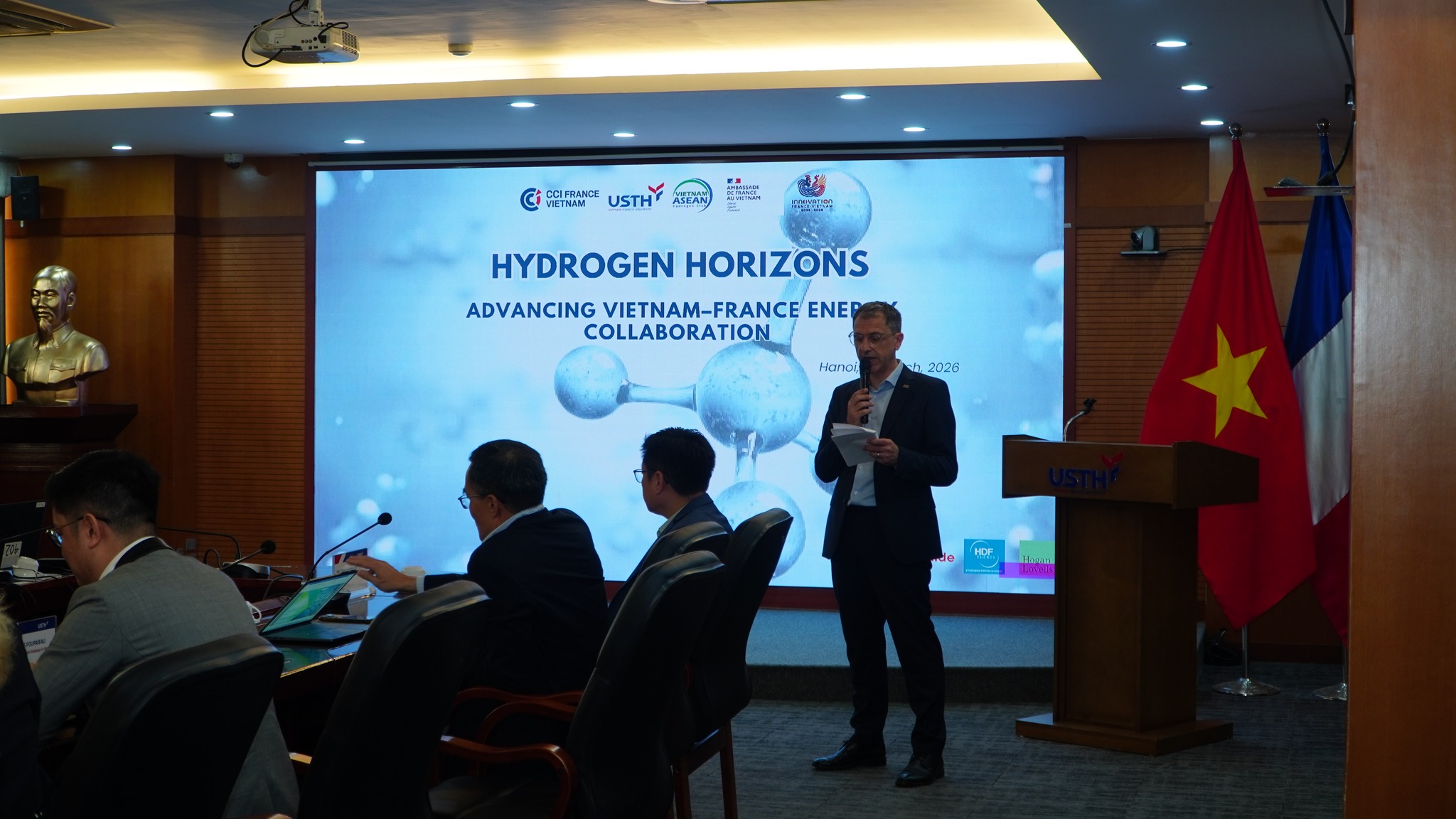

On March 31, 2026, the "Hydrogen Horizons: Advancing Vietnam-France Energy Collaboration" event took place at the University of Science and Technology of Hanoi (USTH) , a member of the Vietnam Academy of Science and Technology (VAST). The event marked a major milestone in realizing the strategic partnership between Vietnam and France in the field of renewable energy, specifically green hydrogen – an energy source expected to reshape the global energy landscape.
The event brought together leading experts, policymakers, investors, business representatives, and scientists from USTH, the Vietnam ASEAN Hydrogen Club (VAHC), HDF Energy, Air Liquide, CCI France Vietnam, and Hogan Lovells International LLP.

1. Strategic Context: Vietnam Already Has the Legal "Launchpad"
The event paid special attention to Decision 165/QD-TTg (issued on February 7, 2024), in which the Prime Minister approved "Vietnam's Hydrogen Energy Development Strategy to 2030, with a vision to 2050."
General Objective:
-
Develop a hydrogen energy ecosystem based on renewable energy, including production, storage, transportation (for both domestic use and export).
Specific Targets by 2030:
-
Production capacity: 100,000 – 500,000 tons/year.
-
Apply advanced technologies for green hydrogen production (electrolysis from renewables) and carbon capture (CCS/CCUS) for hydrogen from coal and natural gas.
-
Pilot hydrogen use in electricity generation, transportation, and heavy industry (steel, fertilizer, petrochemicals).

Targets by 2050:
-
Production capacity: 10 – 20 million tons/year.
-
Master green hydrogen production technologies; become a clean energy hub for the ASEAN region.
Science & Technology Actions under Decision 165:
-
Update global progress in renewable energy.
-
Focus research, application, and technology transfer on hydrogen energy.
-
Encourage energy groups/companies to invest in hydrogen R&D.
-
Train a qualified workforce, cooperate internationally, and attract experts.

Hydrogen as a National Strategic Technology:
Under Decision 1131/QD-TTg dated June 12, 2025, Electrolysis technology is listed under "Energy Technologies & Advanced Materials" – one of 11 national strategic technologies to be prioritized.
Additionally, the "Grand Opening of the Green Hydrogen Hub Vietnam" scheduled for October 23, 2026, at the Vietnamese-German University in Ho Chi Minh City was mentioned as a next step in building a practical hydrogen ecosystem.
2. USTH – A Pioneering Hydrogen Research Center
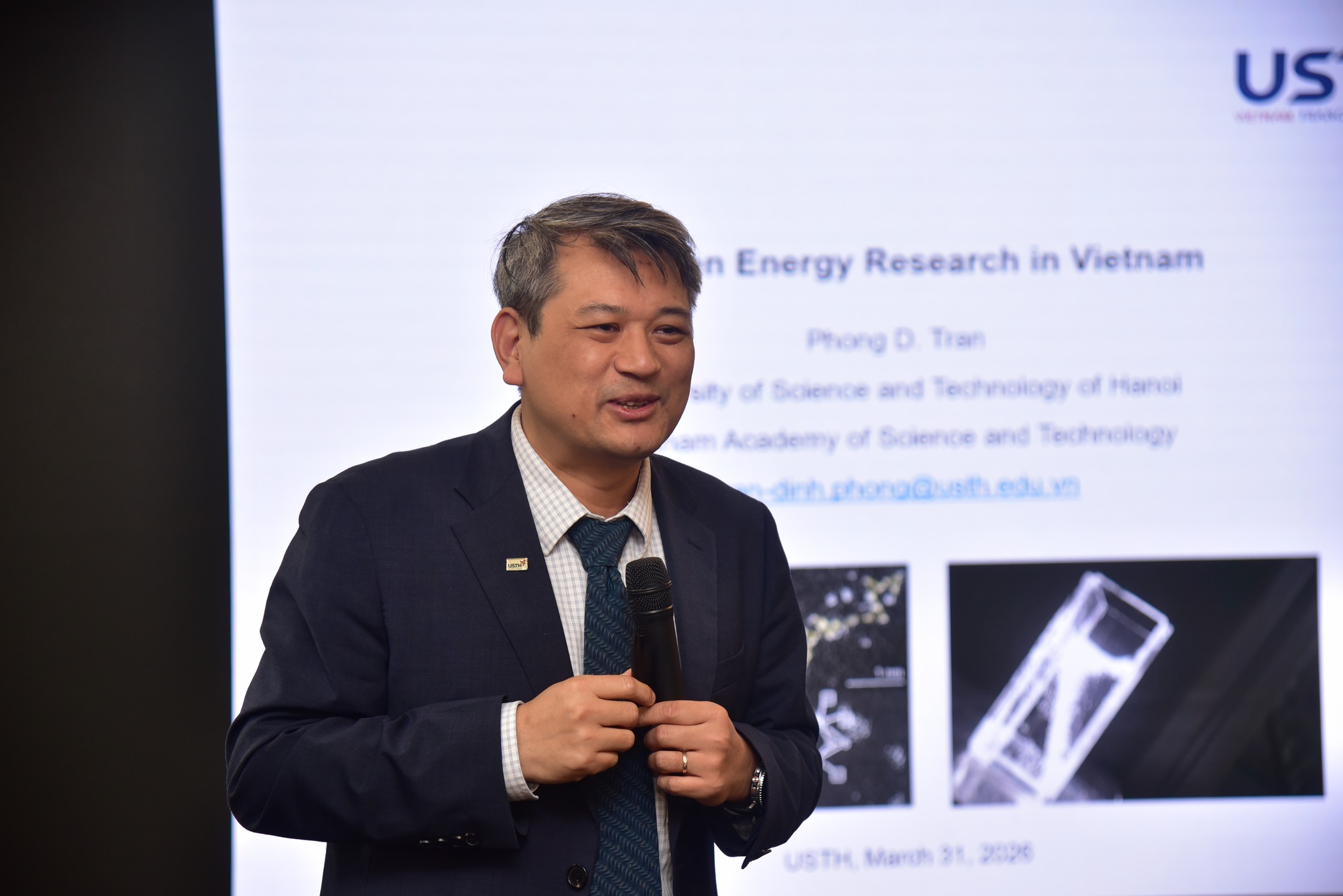
As the host and a key technical pillar of the event, USTH demonstrated its substantive, long-term research capacity and extensive international collaboration network in the hydrogen field. Led by Dr. Phong D. Tran (Head of the Center for Energy and Catalysis for Sustainable development – CECS), USTH affirmed its mission as "a bridge between fundamental science and practical technology."

2.1. Flagship Research: "Artificial Leaf" for Solar Hydrogen Production
The most notable highlight was the "Artificial Leaf" – a collaboration between USTH, CEA-Irig (France) , and LCBM/CNRS.
-
Principle: Uses a photovoltaic core (triple-junction silicon solar cell) combined with catalysts to split water directly under sunlight, producing hydrogen and oxygen without any external power source.
-
Published achievement (2022): Achieved 2% solar-to-hydrogen (STH) conversion efficiency under 1 Sun illumination, pH 7.0 phosphate buffer, leaf surface area of 1 cm².
-
Significance: One of the first demonstrations in Vietnam of decentralized, off-grid hydrogen production, opening applications for remote, rural, and island areas.

2.2. Research Infrastructure and High-Quality Human Resources
CECS Laboratory was established in July 2015 and currently has:
-
07 permanent lecturer-researchers + 01 lab secretary + 02 postdocs + 04 PhD students + 02 master students.
-
Over 40 alumni working in the USA, France, Germany, Poland, Australia, Japan, South Korea – forming a global network of Vietnamese hydrogen experts abroad.
-
Key equipment: Electrochemical workstations, gas analysis systems, solar simulators, spectrophotometers, and a PEM fuel cell test station along with electrolyzer durability testing equipment (operating at 2V).
2.3. Deep International Collaboration – CNRS Project 2025-2029
USTH has built a strategic collaboration network with leading domestic and international partners:
-
France: Dr. Vincent Artero (UMR 5249 – top expert in bio-inspired hydrogen catalysis), Prof. Catherine Amiens (UPR 8241), Prof. Gilles Lemercier (UMR 7312).
-
South Korea: Prof. Hyuksu Han (Hanyang University) – electrolysis technology.
-
Japan: Prof. Iratu Honma (Tohoku University) – battery materials.
-
Singapore: Dr. Chiam Sing Yang (IMRE @ ASTAR) – photoelectrochemistry.
-
Domestic: Prof. Nguyen Quang Liem (Institute of Materials Science, VAST), Prof. Luc Huy Hoang (Hanoi National University of Education), Dr. Luu Anh Tuyen (Vietnam Atomic Energy Institute – VINATOM).
Notably, USTH has just been awarded an international research project on hydrogen energy funded by CNRS (French National Centre for Scientific Research) for 2025-2029, involving 4 research groups and 26 researchers.
2.4. The Real-World Challenge: Device Durability
Alongside initial successes, USTH candidly pointed out the core challenge of the industry: the durability of electrolyzers and fuel cells. Unpublished data from the research group (Dam et al., 2025) shows that when operating a PEM electrolyzer at 2V in deionized water, performance degrades significantly over time, especially catalyst durability. This confirms USTH's next research direction: improving the durability of catalysts and proton exchange membranes – a common challenge for the global hydrogen industry.
2.5. USTH's Strategic Goal
Dr. Phong D. Tran stated: "Our goal is to engineer viable devices for exploiting solar energy – from the artificial leaf for solar-to-H₂ production to the fuel cell for H₂-to-electricity conversion. That is the complete loop for a sustainable hydrogen economy."
3. Market Reality: Strategy is Clear, but Execution is Not
Despite the approved strategy, all speakers agreed that the implementation pathway remains unclear.
Dr. Cao Thuy Oanh (VAHC representative) presented survey results from 930 enterprises across 14 provinces/cities (representing 41.1% of the nation):
-
58.5% of enterprises consider hydrogen important or very important in the next 10-20 years.
-
However, 44.5% have no plan to apply hydrogen, 19.3% are still considering, and only 36.1% have a plan.
-
Main reasons: High investment costs, high green hydrogen price, lack of storage and distribution infrastructure, and immature technology.
-
Conclusion: "Hydrogen is strategic – but not yet investable. Strategy is moving faster than reality."
Globally, hydrogen demand is ~100 million tons/year, mainly for ammonia production, oil refining, and chemicals. However, low-emission hydrogen accounts for less than 1% of global supply. Hundreds of projects have been announced, but only 6% have reached Final Investment Decision (FID) . Low-emission hydrogen investment reached ~$4.3 billion in 2024 and is expected to reach ~$8 billion in 2025 – still very modest compared to needs.

4. International Lessons: Europe, China, Japan
The event reviewed three typical strategic models from leading economies:
| Region | Core Strategy | Lessons for Vietnam |
|---|---|---|
| Europe | Market creation through policy: RED III (mandatory quotas), European Hydrogen Bank (subsidy mechanism), European Hydrogen Backbone (infrastructure planning). | Policy must create demand (offtake) , not just set production targets. Initial financial support is needed to offset high costs. |
| China | Cost reduction through scale of equipment manufacturing (world's largest electrolyzer capacity); combining industrial policy + local demonstration zones. | Scale drives cost reduction. Focus on developing domestic electrolyzer equipment manufacturing clusters. |
| Japan | Securing offtake through long-term contracts and risk-sharing mechanisms; early-stage subsidies to reach gasoline parity. | Must clearly define: Who is the offtaker? What is the hydrogen price? What is the risk-sharing mechanism? |
Summary: "Europe creates demand, China reduces cost, Japan builds trust." Vietnam needs to clearly define its role in this multi-role ecosystem: A hydrogen/ammonia port hub? A regional exporter? Or an industrial consumption market first?
5. Technology Solutions from French Corporations
5.1. HDF Energy – Renewstable®: Non-Interruptible Hydrogen Power

HDF Energy, a global pure player in hydrogen infrastructure, introduced its Renewstable® solution – a large-scale hydrogen power plant delivering baseload electricity 24/7, completely solving the intermittency of renewables (solar, wind).
-
Principle: Combines solar/wind farm + electrolysis system + hydrogen storage + multi-MW fuel cells.
-
Key benefits: Guaranteed baseload profile, grid stability services, energy independence, cost stability for 20+ years, local job creation and hydrogen skills development.
-
Global footprint: 5 regional offices on 5 continents, listed on Euronext Paris, 150+ global talents, $5 billion projects under development.
-
World's first multi-MW fuel cell production plant in Bordeaux, France (7,000 m², operational in 2024, 1 GW capacity by 2030, 500+ employees by 2030).

Potential in Vietnam:
-
Prospective projects: Phu Quoc Island (30 MW), Nam Du Island (5 MW), Ly Son Island, Tho Chu Island, Can Gio Island (HCMC)… with total investment of approximately $500 million.
-
Industrial zones: Stavian Quang Yen (Quang Ninh), Binh Son Refinery (Quang Ngai), Long Son Petrochemical (Quang Ngai), Nghi Son Refinery (Thanh Hoa).
-
Transport: Retrofitting old diesel locomotives (Hanoi–Haiphong line, Hue–Da Nang line) to hydrogen power; retrofitting ferries and inland waterway vessels.
5.2. Air Liquide – Comprehensive Hydrogen Infrastructure for Industry and Mobility
Air Liquide, a world leader in gases, technologies, and services, presented its vision for a complete hydrogen economy.
-
Two major goals: (1) Decarbonizing industrial processes (refining, metals, chemicals). (2) Sustainable transport.
-
Key mobility markets addressed:
-
Hydrogen buses: Zero tailpipe emissions, 10-minute refueling, extended range, quiet operation.
-
Hydrogen trains: Ideal for routes where catenary installation/maintenance is costly. World record: Stadler FLIRT H2 traveled 2,800 km on a single fill.
-
Hydrogen shipping & LH2: High energy density, maximizes cargo space, suitable for large ships and long distances.
-
Aviation: Collaborating with H2 Fly, Safran (Project BeautyFuel) on liquid hydrogen engines; developing airport hydrogen infrastructure (Hydrogen Airport with Groupe ADP).
-
Mining/off-road: Zero-emission pathway for ultra-class haul trucks, 24/7 operations.
-
Stationary power: Reliable backup power for hospitals, data centers, remote industrial sites.
-
-
Key enablers for heavy-duty market by 2030: Lowering hydrogen cost, building refueling infrastructure, supportive regulations.
Policy recommendation: A combination of solutions is needed to decarbonize different needs; a basin approach (localized hydrogen ecosystems) is essential to optimize costs.

6. Legal Framework: Opportunities and Challenges
Lawyer Duong Pham (Counsel, Hogan Lovells Hanoi) provided a detailed analysis of the current legal framework, especially the most recent regulations.
Key Legal Documents:
-
Law on Electricity No. 61/2024/QH15 (effective February 1, 2025): Formally defines green hydrogen; encourages renewable projects to combine with BESS or produce green hydrogen/ammonia for electricity generation.
-
Decree 58/2025/ND-CP (dated March 3, 2025) on Development of Renewable Energy and New Energy: Details incentives for power projects using 100% green hydrogen/ammonia.
-
Decree 56/2025/ND-CP (dated March 3, 2025) on electricity development planning.
-
Decree 57/2025/ND-CP (dated March 3, 2025) on Direct Power Purchase Agreements (DPPA).
-
Law on Investment No. 143/2025/QH15 (dated December 11, 2025): CIT incentives, import duty exemptions, land/water fee reductions for hydrogen projects.
-
Law on Chemicals No. 69/2025/QH15 (dated June 14, 2025): Hydrogen production is a priority industry.

Notable Incentives under Decree 58 (Article 6):
Applies only to projects producing electricity from 100% green hydrogen/green ammonia (produced from renewable energy), connected to the national grid, and First-of-a-Kind (FOAK) for the investor.
-
Sea area use fee exemption/reduction: 100% exemption during construction (up to 3 years), 50% reduction for the next 9 years.
-
Land use fee/land rental exemption/reduction: 100% exemption during construction (up to 3 years).
-
Guaranteed minimum offtake: At least 70% of contracted output during the loan repayment period (max 12 years) – a critical mechanism to improve bankability.
-
General incentives: Priority dispatch, preferential CIT (10%), import duty exemptions for equipment, access to green finance.
Remaining Legal Challenges:
-
Procedures to certify "FOAK" status are complex and require MOIT or government verification.
-
No specific pricing framework for hydrogen (LCOH) or for electricity generated from hydrogen.
-
Safety standards for high-pressure hydrogen storage and transport (explosion risks, material compatibility) are still under development.
-
Pure hydrogen production projects (as industrial feedstock, not for power generation) do not yet enjoy the special incentives of Decree 58.
7. Roadmap and Recommendations
At the end of the event, the Vietnam ASEAN Hydrogen Club (VAHC) proposed a 3-phase roadmap based on international lessons and the survey of 930 enterprises:
Phase 1: Kick-off Phase (2025–2030) – "No-Regret Pilots"
-
Finalize the legal framework, technical and safety standards; strengthen public awareness and communication.
-
Deploy 5–10 bankable pilot projects in: steel, fertilizers, food processing, refining (sectors already using grey hydrogen).
-
Develop 2–3 pilot port-based hydrogen/ammonia hubs.
Phase 2: Scale-up Phase (2030–2040) – "Clusters & Supply Chains"
-
Expand port-based hydrogen hubs; develop pipelines, storage systems, refueling infrastructure for industry and heavy transport.
-
Develop domestic supply chains for hydrogen equipment: electrolyzer components, storage tanks, compression systems, Balance of Plant (BoP).

Phase 3: Optimization Phase (2040–2050) – "Diversification & Export"
-
Diversify hydrogen pathways: green, blue, biomass, natural/white hydrogen.
-
Expand applications to agriculture (reducing plant oxidative stress, reducing chemical fertilizers) and residential (cooking, coffee roasting, ENE-FARM fuel cells).
-
Export hydrogen, green ammonia, e-fuels, and hydrogen-related technical services across ASEAN.
Financing and Cooperation Mechanisms:
-
PPP model: State invests in shared infrastructure (ports, pipelines, storage); private sector invests in electrolyzer plants and H₂/NH₃ production.
-
Link with carbon markets to monetize CO₂ reduction and improve project NPV/IRR; apply metrics such as LCOH and "well-to-power-plant" efficiency.
-
Early-stage price support: Experience from Canada shows that with 8h/day operation (weekdays) and 12-24h/day (weekends), a minimum hydrogen price of CAD 4.3–4.9/kg is needed to achieve IRR ~8% and NPV >0. Vietnam will also need early-stage support.
-
International financing sources: JCM (Japan), climate funds, EU/IEA/IRENA hydrogen infrastructure support programs.

8. Conclusion and Outlook
The "Hydrogen Horizons" event was not just a theoretical seminar but a strategic bridge between policy and practical projects, between laboratory research and large-scale industrial application.
The Overarching Message from All Speakers:
"Hydrogen is no longer a future option – it is now part of Vietnam's national energy strategy. But hydrogen is also a test of Vietnam's execution capability. We must shift from 'strategy on paper' to 'bankable projects on the ground'."
Strategic Opportunities for Vietnam:
-
Energy security: Reduce dependence on imported/transported diesel; increase local energy autonomy.
-
Grid reliability: Improve electricity stability in remote and island areas; support system balancing.
-
Decarbonization: Contribute to Vietnam's Net Zero 2050 commitment.
-
Industrial development: Build a domestic hydrogen value chain (skills, engineering capability, operations, local supply chain participation).
-
Export: Become a regional hub for hydrogen, ammonia, and e-fuel exports.
Next Steps:
-
Vietnam needs pilot projects to demonstrate hydrogen infrastructure feasibility in real-world settings.
-
HDF Energy is ready to play a leading role in scaling hydrogen projects, starting with feasibility studies, obtaining local authority approvals, and liaising with international financial institutions.
-
USTH continues its role as a research and high-quality training center, connecting top European laboratories with Vietnam's practical needs.
-
VAHC is committed to partnering with the Government on strategies and technical standards, connecting Vietnamese enterprises with international partners, and promoting pilot projects based on bankability, safety, data-driven approaches, and international best practices.
With abundant renewable resources, large industrial demand, government commitment, research capacity from USTH, and practical experience from French corporations like HDF Energy and Air Liquide, Vietnam is well-positioned to become an ASEAN hydrogen hub in the coming decade.
The event closed with warm wishes: "Joyeuses Pâques – Happy Easter 2026," symbolizing hope and a new beginning for Vietnam-France energy cooperation.

References: Presentations at "Hydrogen Horizons: Advancing Vietnam-France Energy Collaboration" (March 31, 2026) by USTH, VAHC, HDF Energy, Air Liquide, and Hogan Lovells.