
European Hydrogen Valleys and Asian Hydrogen Hubs: Models, Purposes, and Operations
July 22, 2026 by VAHC R&D
Introduction
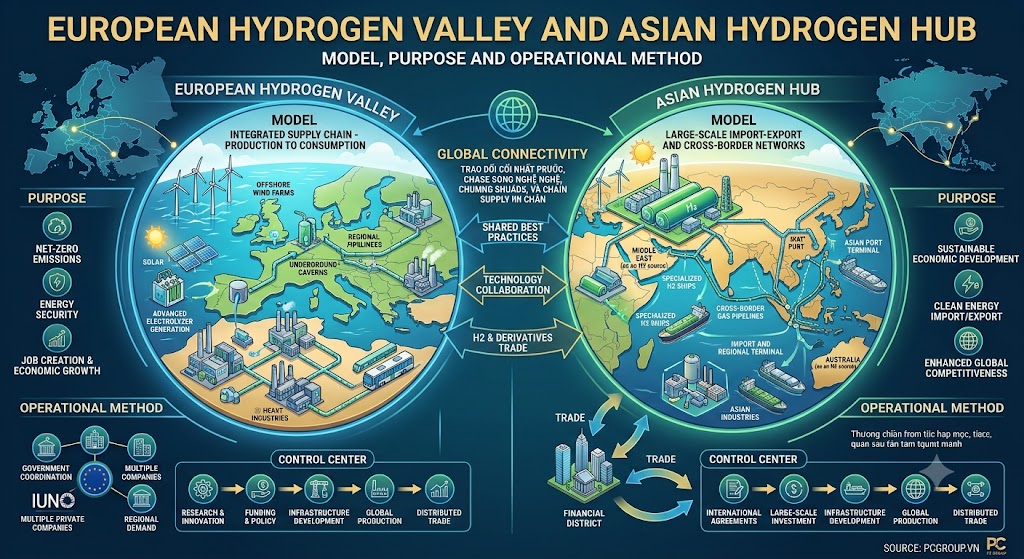
The concepts of "Hydrogen Valleys" and "Hydrogen Hubs" have become key models in the global clean energy strategy. While sharing the common goal of advancing the hydrogen economy, these two models reflect distinct approaches between Europe and Asia, stemming from different policy contexts, resources, and strategic priorities.
I. European Hydrogen Valleys
Purpose and Mission
Hydrogen Valleys are integrated hydrogen ecosystems that connect the entire value chain—from production, storage, and distribution to end-use applications—within a defined geographic region. The core objectives of this model are:
-
Driving industrial decarbonization: Focusing on hard-to-abate sectors such as steel, chemicals, cement, and heavy transport.
-
Creating anchored demand: Linking production with multiple offtakers to reduce investment risks and create momentum for scaling up.
-
Fostering cross-regional collaboration and innovation: Serving as a bridge between regions, countries, and stakeholders (industry, government, research institutes, civil society) following a "quadruple helix" model.
-
Implementing EU energy strategy: Operationalizing the goals of the European Green Deal and the EU Hydrogen Strategy toward climate neutrality by 2050.
How They Operate
European Hydrogen Valleys function as closed-loop ecosystems with three main components:
-
Production: Diversifying electrolysis technologies (PEM, SOEC) and bio-hydrogen production, typically linked to local renewable energy sources. Scale ranges from a few hundred kW to several tens of MW.
-
Infrastructure and Storage: Combining underground storage, trailers, and particularly repurposing existing natural gas pipelines to reduce costs.
-
End-use Applications: Targeting local industries (steel, chemicals) and specific regional applications (public transport, trucks, shipping).
Typical Examples:
-
North Adriatic Hydrogen Valley (NAHV): A cross-border project between Slovenia, Croatia, and Italy, with 34 partners, €375 million total investment, producing 5,000 tonnes of hydrogen per year from 17 pilot projects, creating 2,000 jobs.
-
HiWHyV Project (Sweden): A comprehensive commercial-scale hydrogen ecosystem with 9 strategic nodes, producing 4,000 tonnes/year, targeting chemical feedstock renewal and sustainable transport fuels.
-
LuxHyVal (Luxembourg): An ecosystem focused on industry (glass, metals) and mobility (buses, light trucks), applying Digital Twin technology for operational optimization.
Value to Communities
-
Economic: Attracting investment (each valley can mobilize hundreds of millions of euros), creating high-skilled jobs, and promoting local industrial cluster development.
-
Social: Raising community awareness about clean energy, developing workforce skills through training and education programs.
-
Environmental: Achieving significant local CO₂ emission reductions.
-
Policy: Serving as real-world laboratories for testing business models, regulatory frameworks, and financing mechanisms, which can then be replicated across Europe.
II. Asian Hydrogen Hubs (Japan, South Korea, China)
In Asia, the "Hydrogen Hub" model is strongly shaped by national strategies, often referred to as "hydrogen industrial clusters," "hydrogen parks," or "hydrogen economic belts." The approach differs markedly from Europe.
Purpose and Key Characteristics
-
National Strategy and Energy Security: Hubs are defined by national "hydrogen roadmaps," focusing on export, import, and global supply chain development, especially for energy-importing countries like Japan and South Korea.
-
Speed and Massive Scale: Projects are deployed rapidly with enormous industrial scale, driven by close coordination between governments and the private sector.
-
Diverse Supply Sources: Beyond "green hydrogen" (from renewables), Asian hubs also incorporate "blue hydrogen" (from natural gas with carbon capture) and imported hydrogen (e.g., as ammonia).
-
Technology and Manufacturing Leadership: Countries like China are becoming hubs for electrolyzer manufacturing and hydrogen mobility applications, while Japan and South Korea lead in fuel cell technology and commercialization.
How They Operate
The operation of these hubs reflects each country's specific advantages and strategies:
-
Japan: A strategic hydrogen importer. Focuses on building import infrastructure at ports like Yokohama to receive ammonia and liquid hydrogen, used for co-firing in power generation and for fuel cell vehicle development.
-
South Korea: Pursues a large-scale import market model with ambitious targets: 1,200 hydrogen refueling stations and 6.2 million fuel cell vehicles by 2040. Developing industrial hydrogen clusters in Ulsan and Busan as part of the national hydrogen economy roadmap.
-
China: A large-scale hydrogen producer with abundant renewable resources. Developing "hydrogen industrial parks" linked to renewable energy zones (e.g., Inner Mongolia). However, coal still dominates the energy mix, so scaling up green hydrogen production will take time.
III. Comparison: Hydrogen Valleys (EU) vs. Hydrogen Hubs (Asia)
| Criteria | Hydrogen Valleys (EU) | Hydrogen Hubs (Asia) |
|---|---|---|
| Characteristic | Integrated ecosystem, regionally oriented | Strategic industrial center, nationally/globally oriented |
| Primary Driver | Regional decarbonization, innovation, climate policy | Energy security, export/import, industrial growth |
| Hydrogen Source | Primarily Green Hydrogen (from renewables) | Diverse: Green, Blue, Imported (ammonia) |
| Scale and Speed | Smaller, phased deployment, locally anchored | "Gigawatt"-scale, rapid deployment driven by centralized direction |
| Infrastructure | Repurposing existing natural gas pipelines at continental scale | Focus on seaports for import and distribution (ammonia, methanol) |
| Examples | NAHV, HiWHyV, LuxHyVal | Chifeng e-ammonia cluster (China), Yokohama Port (Japan) |
| Challenges | Dispersed investment, complex approval processes, inconsistent regulatory frameworks across countries | Heavy reliance on fossil fuels, domestic demand for clean hydrogen still unstable |
IV. Conclusion and Implications
In summary, European Hydrogen Valleys represent a "bottom-up" model, region-centric, aiming to test and replicate integrated solutions for a sustainable future. Asian Hydrogen Hubs are more "top-down," shaped by national strategies, with ambitions to dominate global supply chains and ensure energy security.
Despite their differences, both models recognize the critical role of multi-stakeholder collaboration, private sector participation, and strong government support. The combination of Europe's "policy design capability" and Asia's "rapid and large-scale execution capability" will be key to realizing the global hydrogen economy in the coming decades.