


Electrification of Vietnam's Transportation Sector to 2050 – Challenges and Opportunities for Hydrogen-Powered Vehicles
October 1, 2026 by Annie Nguyen, VAHC Secretariat
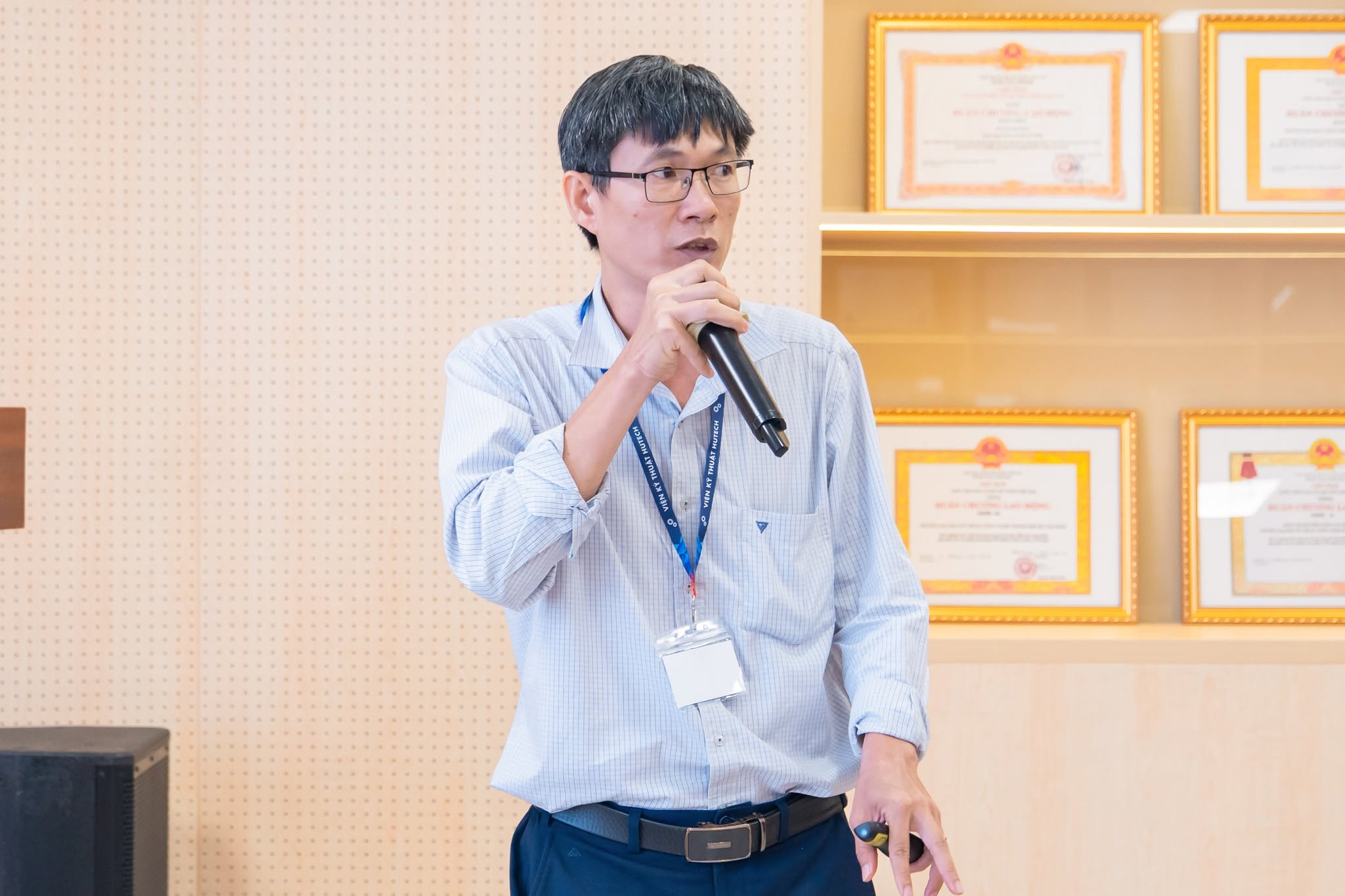
Speaker: Dr. Nguyen Van Giao, Director of the Electric Vehicle Technology Programme, HUTECH School of Engineering
Dr. Nguyen Van Giao opened with the global transport electrification landscape. He presented figures on EV share of new car sales in 2025: China 55%, Vietnam ~40%, Europe 28%, Global 25%, Southeast Asia ~20%. More than 20 million EVs were sold globally in 2025. He emphasised: "Battery EVs have reached major market scale, especially in passenger cars and urban mobility."
Vietnam's Electrification Landscape
Dr. Giao analysed Vietnam's electrification landscape. Vietnam is rising quickly in Southeast Asia's EV market. Current strengths are electric cars, taxis and urban buses. Specific figures: ~40% of new cars sold were EVs in 2025; 70.9% electric taxis as of June 2026; 23.1% electric buses as of June 2026. However, electrification of heavy trucks and tractors is still at an early stage – a strategic gap for hydrogen.
Transition Speed Differences Across Vehicle Segments
Dr. Giao analysed the transition speed differing significantly across vehicle segments in Vietnam. Reported data to June 2026: taxi 70.9%, buses 23.1%, reported total 6.1%. Charging infrastructure includes 15,024 charging points/stations, 5,331 fast chargers and 9,693 slow chargers, with 125/215 routes with charging. He emphasised: "Interprovincial charging infrastructure remains fragmented."
Environmental Impact of Small Vehicle Group
Dr. Giao emphasised an important fact: trucks and buses account for only about 2% of registered vehicle stock but cause about 65% of road transport emissions. This supports shifting focus from "personal EVs" to "commercial transport electrification".
Key Statistics
Dr. Giao presented key statistics: 70.9% Vietnam electric taxis; 23.1% electric buses; 47 electric tractors; 54% emissions from trucks; 20+ million global EVs in 2025; ~130,000 global FCEVs; >100 Mt global H₂ demand; ~1 Mt low-emission H₂. He emphasised: "BEVs are growing fast, but heavy-duty transport and clean H₂ still need a dedicated strategy."
Charging Infrastructure – Necessary but Not Sufficient
Dr. Giao analysed charging infrastructure: 5,331 fast chargers, 9,693 slow chargers, 4/21 rest stops with charging, 3–4 billion additional kWh/year by 2030. He emphasised: "For heavy trucks, the issue is not only 'having chargers' but power level, dwell time and station grid capacity."
Fuel Cell Vehicle Overview
Dr. Giao presented an overview of fuel cell vehicles (FCEVs), including comparisons with BEVs on efficiency, range, refuelling time and suitable applications.
Enabling Conditions in Vietnam
Dr. Giao pointed out that Vietnam is not starting from zero. Industrial hydrogen demand already exists with approximately 500,000 tonnes H₂/year currently produced, accounting for about 15% of Southeast Asian H₂ demand, equivalent to ~0.6 Mt H₂/year based on IEA share. He emphasised: "A reasonable strategy is to decarbonise existing industrial demand first, then expand to transport in clusters."
The Bottleneck is Trucks and Tractors
Dr. Giao emphasised the bottleneck is trucks and tractors – the segment where hydrogen deserves serious consideration. Figures: 3,893 reported electric trucks as of June 2026; 47 reported electric tractors as of June 2026. He emphasised: "Electric taxis have exceeded 70%, but electric tractors remain at pilot scale. Demand for heavy-duty solutions is still large."
Hydrogen Hubs – A Way to Reduce Market Risk
Dr. Giao proposed the hydrogen hub model – one H₂ source serving multiple users. Diagram: wind/solar → electrolysis → green H₂ → industry, trucks/buses, seaports, NH₃/e-fuel. He emphasised: "A hub creates enough demand to reduce investment risk for stations, pipelines, storage and H₂ transport."
Hydrogen Opportunities Not Limited to Road Vehicles
Dr. Giao noted that hydrogen opportunities are not limited to road vehicles. H₂-based fuels for shipping could become a large market: approximately 40% of Southeast Asia's H₂ and H₂-based fuel demand in the APS could come from shipping by 2035. For Vietnam, seaports can become links between green H₂, logistics and marine fuels. Value chain: H₂ → green NH₃/methanol/e-fuel → shipping and aviation.
Five Core Challenges
Dr. Giao listed five challenges to solve before scaling up: 01 Green H₂ cost; 02 Clean power for electrolysis; 03 350/700 bar refuelling stations; 04 Leakage/fire safety; 05 Committed off-takers. He cited IEA data: only about 20% of volumes in low-emission H₂ offtake agreements signed in 2025 were firm commitments.
Powertrain Configurations by Vehicle Group
Dr. Giao presented powertrain configurations by vehicle group. BEV: HV battery → inverter → motor; applications for motorbikes, cars, taxis, urban buses. HEV/PHEV: ICE + motor + battery; transition bridge for cars/SUVs. FCEV: H₂ → fuel cell → electricity → motor; buses, heavy-duty, long routes. H₂-ICE: H₂ → internal combustion engine; construction machinery, specialised heavy-duty use.
Three Technology Scenarios for Vietnam
Dr. Giao proposed three technology scenarios for Vietnam. Scenario A – High direct electrification: BEV dominates; limited H₂. Scenario B – BEV + selective H₂: H₂ for heavy-duty, ports and shipping. Scenario C – Strong H₂ development: low-cost green H₂, large infrastructure, complete standards. Key variables: battery cost, green H₂ cost, grid capacity, vehicle utilisation intensity and depot infrastructure.
No Single Technology Wins Everywhere
Dr. Giao emphasised: "No single technology wins everywhere. Choice depends on each operating case." BEV: high efficiency, expanding infrastructure, urban fit. FCEV: fast refuelling, long range, heavy fleet fit. Diesel: existing infrastructure, high emissions, transition pressure. He recommended: "Measure TCO and CO₂e/km on the same Vietnam routes before scaling."
Selecting Suitable Powertrain Configurations
Dr. Giao proposed selecting suitable powertrain configurations: BEV – main platform: motorbikes, cars, taxis, urban buses, light trucks. HEV/PHEV – transition technology: cars/SUVs where charging coverage remains limited. FCEV – selective pilots: long-route buses, heavy trucks, tractors, port logistics. H₂-ICE – specialised applications: construction machinery, specialised heavy-duty use, limited retrofit. He recommended for Vietnam: "BEV as the foundation; prioritise H₂ for heavy-duty, long routes, port hubs and specialised vehicles."
Truck Emissions Dominate
Dr. Giao presented Vietnam road transport GHG emissions by vehicle segment, 2020: trucks 54%, two-wheelers 28%, coaches 11%, passenger cars 6%, urban buses 1%. Key implication: "Effective decarbonisation should prioritise high fuel-consuming vehicles, not only vehicle counts."
From Pilots to Hydrogen Corridors
Dr. Giao proposed a three-stage roadmap. 2026–2030: Cluster-based pilots – intercity buses, logistics, port tractors. 2030–2040: Open selective corridors – connect H₂ hubs with depots and ports. 2040–2050: Integrated ecosystem – green H₂, NH₃/methanol, e-fuels. He emphasised: "Scale only after pilots prove economic performance and emission reductions."
Hydrogen Infrastructure Needs Suitable Corridors and Fleets
Dr. Giao emphasised: "Without regular fleet demand, H₂ stations are hard to utilise." Figures: 7,820 supported H₂ vehicles, 2026; 1,800 H₂ buses; ≤200 km EU H₂ station spacing. International lesson: "Synchronise vehicles, refuelling stations, fuel supply and standards."
Hydrogen Should Be Used Selectively
Dr. Giao proposed hydrogen should be used selectively, focusing on hard-to-directly-electrify segments. Motorbikes/passenger cars: BEV; very limited H₂. Taxis/urban buses: BEV as main option; H₂ pilots for specific routes. Light trucks: BEV feasible; limited H₂ advantage. Heavy trucks/tractors: BEV or battery swapping; FCEV worth testing. Ports/shipping: shore power, BEV; NH₃, methanol, e-fuels.
Six Priority Solution Groups for Vietnam
Dr. Giao proposed six priority solution groups: 1 Pilot H₂ truck/bus fleets on fixed routes. 2 Develop H₂ hubs at ports/industrial zones. 3 Standardise safety: storage, transport, 700 bar refuelling. 4 Certify kgCO₂e/kgH₂ for green hydrogen. 5 Measure TCO and CO₂e/km using operational data. 6 Link H₂ with NH₃, methanol and marine fuels.
FCEV Remains Very Small Compared with BEV
Dr. Giao compared commercial scale in 2025: ~130,000 global FCEVs at end-2025 versus 20+ million EVs sold in 2025 alone. He emphasised: "Hydrogen mobility should start with specialised fleets and freight corridors, not the mass market."
Hydrogen Does Not Replace Batteries – It Complements
Dr. Giao concluded: "Hydrogen does not replace batteries – it complements the hardest-to-electrify segments." One ecosystem: BEV for urban transport, H₂ for heavy-duty, e-fuels for sea/air. BEV: motorbikes, cars, taxis, urban buses – rapidly commercialised. H₂: heavy-duty, long routes, continuous operation – requires cluster-based pilots. e-Fuel: shipping, aviation, seaports – long-term opportunity to 2050. Strategic question: "Where should each kg of green H₂ reduce the most CO₂ at a reasonable cost?"
BEV Already Has an Advantage in Urban Segments
Dr. Giao emphasised: "BEV already has an advantage in urban segments. Hydrogen should not compete directly with every battery EV." Electric motorbikes: BEV. Passenger cars: BEV/PHEV – strong BEV fit. Taxi: BEV advantage. Urban buses: BEV feasible. Light trucks: BEV feasible. He emphasised: "Hydrogen should focus on the 'hard part': heavy-duty, long routes, seaports and shipping."
Two Pathways from Renewable Electricity to the Wheels
Dr. Giao compared two pathways. BEV: ELECTRICITY → BATTERY: renewable electricity → HV battery → motor → wheels; fewer conversion steps, suitable for urban use. FCEV: ELECTRICITY → H₂ → FUEL CELL: renewable electricity → H₂ → fuel cell → motor → wheels; faster energy replenishment, may fit heavy-duty use. He emphasised: "FCEV is still an EV – it differs in energy storage."
Five Barriers to Solve
Dr. Giao reiterated five barriers: 01 Green H₂ cost; 02 Clean power for electrolysis; 03 350/700 bar refuelling stations; 04 Leakage/fire safety; 05 Committed off-takers. IEA: only around 20% of volumes in low-emission H₂ offtake agreements signed in 2025 were firm commitments.
Conclusion
Dr. Giao concluded: "Hydrogen creates real value only when placed correctly within the electrification ecosystem." BEV for urban transport • selective H₂ for heavy-duty • e-fuels for sea and air. Core proposal: "Measured pilots, cluster-based development, green H₂ certification and data-based scaling."