

DR. DƯ VĂN TOÁN'S PRESENTATION: OFFSHORE HYDROGEN ENERGY STATUS - OPPORTUNITIES AND CHALLENGES
July 29, 2026, VAHC Secretariat
Overview
At the Hydrogen Energy Forum and the Future of Zero-Emission Industry held on July 29, 2026, in Hanoi, Dr. Dư Văn Toán from the Institute of Meteorology, Hydrology, Environment and Climate Change (Ministry of Agriculture and Environment) delivered an in-depth presentation on the current status of offshore hydrogen energy, along with an analysis of opportunities and challenges for Vietnam in this field.
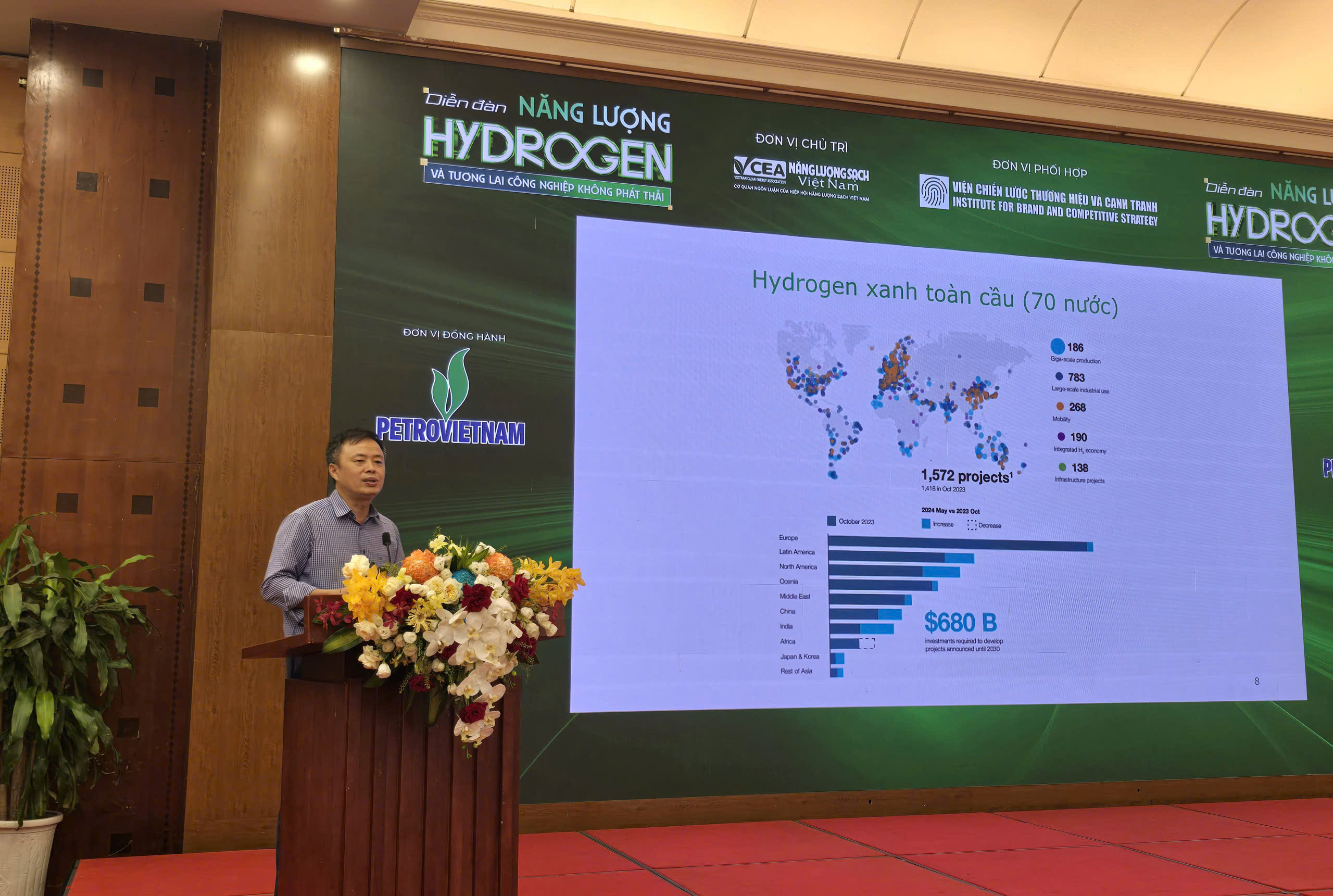
Dr. Du Van Toan speaking at the Conference
1. Global Context
Dr. Dư Văn Toán opened his presentation by emphasizing the global energy transition trend, with over 140 countries having committed to achieving net-zero emissions by mid-century. Vietnam has set its target for 2050, while regional peers have similar commitments: China (2060/2054), Indonesia (2060), and India (2070).
In this context, offshore renewable energy (wind, solar, tidal) is emerging as an essential component of the global transition to renewable energy. Integrating offshore wind with hydrogen production through electrolysis provides a strategic pathway to convert excess electricity into a storable and transportable form of energy, thereby mitigating grid congestion, curtailment, and intermittency challenges.
2. Global Offshore Hydrogen Status
According to Dr. Dư Văn Toán, offshore wind deployment is rapidly expanding worldwide:
Global Market Share: China held the largest share of installed offshore wind capacity globally at 49% in 2022. Other significant contributors include the United Kingdom (25%), Germany (14%), and the Netherlands (5%).
Europe: The EU set an ambitious Offshore Renewable Energy Strategy (2020) calling for 300 GW of offshore wind by 2050 (111 GW by 2030). Simultaneously, EU climate plans target 10 million tons/year of domestic renewable hydrogen production by 2030, rising to 33 million tons by 2040. As of 2021, Europe had installed 25 GW of offshore wind.
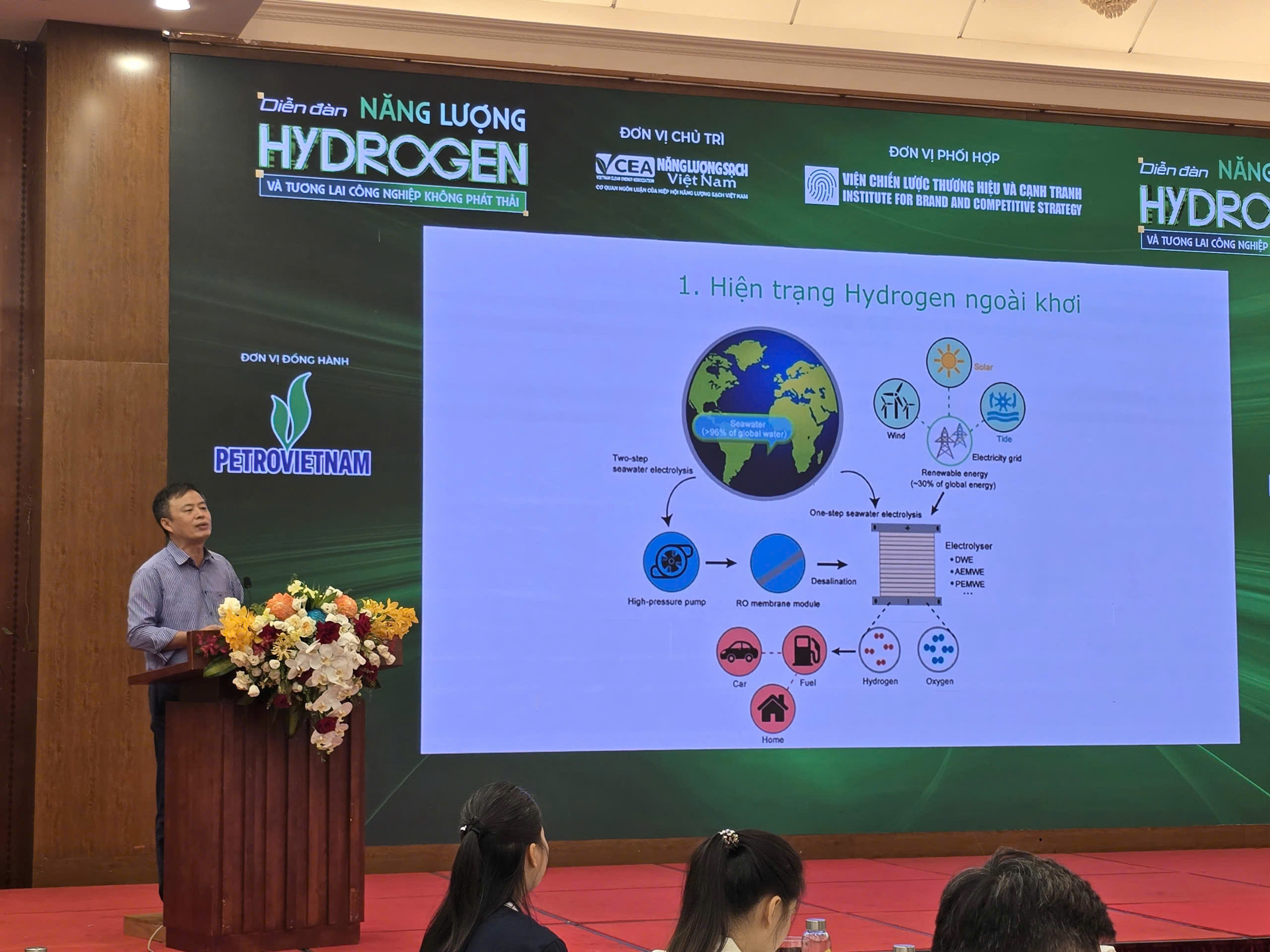
Notable Projects:
-
HOPE (Belgium): A 10 MW offshore PEM electrolysis pilot project targeting 4 tons of green H₂ per day by 2026, transported to shore via pipeline.
-
Sealhyfe (France): A 1 MW floating wind turbine prototype connected to integrated hydrogen production since 2022.
-
H2Mare (Germany): Siemens Energy/Gamesa initiative integrating offshore wind with hydrogen systems, expected to operate in 2026.
-
AquaVentus (Germany): A consortium planning up to 10 GW of offshore electrolysis by 2035.
-
Holland Hydrogen I (Netherlands): A 200 MW electrolysis plant near Rotterdam producing 60,000 kg of H₂ per day from offshore wind power.
-
ERM Dolphyn (UK): The world's first floating wind-to-hydrogen demonstration off Scotland, featuring a 2 MW floating wind turbine with onboard electrolysis and desalination.
United States: Targeting 30 GW of offshore wind by 2030. The Atlantic Shores offshore wind farm (New Jersey, 1.5 GW) plans to include a 10 MW green hydrogen pilot electrolyzer.
China: In 2025, China commissioned the world's first self-sufficient offshore hydrogen platform off Shandong province, integrating wind and solar energy with three electrolyzers, including a direct seawater electrolysis system to produce green hydrogen and convert it on-site to ammonia and methanol.
Japan: Targeting 10 GW of offshore wind by 2030 and 45 GW by 2040, along with a 10 million ton H₂ target by 2030 in its Basic Hydrogen Strategy.
South Korea: Rapidly expanding offshore wind with a 14 GW target by 2030 and a hydrogen roadmap of 6.2 million tons H₂ by 2030.
Australia: Approved its first offshore wind zones in 2024 with 12 GW capacity; the Hydrogen 2030 Strategy targets up to 15 million tons H₂/year.
3. Offshore Hydrogen Technology and Models
Offshore Wind Turbine Technology: Has diverged into two main types:
-
Fixed-bottom turbines: Deployed in water depths up to 50 m.
-
Floating turbines: Enable deployment in deep waters (>60 m) where fixed foundations are not feasible.
Turbine capacity has increased significantly, with state-of-the-art turbines now in the 12–15 MW class, and 15–20 MW prototypes under development.
Electrolysis Technology: A key highlight of the presentation was the comparison of electrolysis technologies for offshore applications:
| Technology | TRL | Characteristics | Offshore Suitability |
|---|---|---|---|
| Alkaline (AEL) | 9 | Low cost, simple design, slow response, liquid electrolyte | Limited; leakage and sloshing risks offshore |
| PEM (PEMEL) | 9 | High current density, fast response, compact design, high cost | Top priority for offshore projects |
| AEM (AEMEL) | 6–7 | Low cost, solid electrolyte, developing | Potential after durability is proven |
| SOEC (SOEC) | 7–8 | High efficiency (75–85%), requires 600–850°C | Least suitable; high-temperature complexity on uncrewed platforms |
Technology Conclusion: PEMEL is most suitable for offshore systems (including floating) due to its compact design, solid-state operation, motion tolerance, and fast load response. On floating systems, the priority order is clear: PEMEL is best suited, followed by AEMEL, while AEL is not recommended due to liquid electrolyte sloshing issues.
Offshore Wind-to-Hydrogen Integration Models:
Dr. Dư Văn Toán analyzed five main configurations:
-
Onshore Electrolysis: Turbines transmit power to shore via cables, with centralized onshore electrolysis. Advantages: easy maintenance, leverages existing infrastructure. Disadvantages: requires high-capacity cables, transmission losses.
-
Centralized Offshore Electrolysis: H₂ is produced on a platform within the wind farm and exported via pipeline. Reduces cable costs, overcomes grid constraints, but maintenance is complex and expensive.
-
Decentralized Offshore Electrolysis: Each turbine has its own electrolysis unit, collected via pipeline network. Eliminates need for large central platform but loses economies of scale.
-
Hybrid Offshore System: Both H₂ production and power export via cable. Dual revenue streams, operational flexibility but higher capital investment.
-
Hybrid Onshore System: Wind farm connected to grid, with a portion of power diverted to onshore electrolysis. Avoids offshore H₂ equipment, easy maintenance.
Storage and Transport: Hydrogen can be stored as pressurized gas, subsea storage, salt caverns, or converted to ammonia or LOHC (Liquid Organic Hydrogen Carriers). Battery storage can be combined with hydrogen production to create hybrid energy storage systems, enhancing reliability and efficiency.
4. Vietnam's Hydrogen Strategy and Offshore Wind Potential
Dr. Dư Văn Toán emphasized Vietnam's commitment through Decision No. 165/QĐ-TTg (2024), approving the Hydrogen Energy Development Strategy to 2030 with vision to 2050:
-
Hydrogen production capacity from renewable energy and processes with carbon capture: 100,000–500,000 tons/year by 2030, 10–20 million tons/year by 2050.
-
Development across the entire value chain: production, storage, transport, distribution, and utilization.
-
Encouraging use across all economic sectors, especially high-emission sectors.
-
Aiming to become a regional clean energy hub and exporter of renewable energy and green hydrogen.
Vietnam's Offshore Wind Potential: According to the revised Power Development Plan VIII (Decision 768), offshore wind capacity is targeted at 6,000 MW by 2030, 17,000 MW by 2035, and 139,000 MW by 2050. Vietnam's continental shelf has a technical potential of approximately 600 GW, with most areas in shallow waters suitable for fixed-bottom foundations, offering significant cost advantages for investment and hydrogen integration.
Priority Regions: Wind and hydrogen electrolysis projects will be concentrated in areas with excellent wind potential such as the South Central and Southern regions to optimize production costs.
5. Opportunities and Future Prospects
Dr. Dư Văn Toán identified several powerful opportunities that offshore wind-to-hydrogen integration offers:
Market and Economic Opportunities:
-
Offshore wind represents a vast, untapped renewable resource in many regions.
-
Large-scale, on-site clean hydrogen production for steel mills, chemical plants, refineries, and coastal transport hubs.
-
Offshore wind farms located away from population centers, reducing land-use conflicts.
-
Enhancing grid stability by converting surplus energy into hydrogen.
-
Access to large hydrogen markets in ammonia production, oil refining, steel manufacturing, and heavy transport.
-
Reducing dependence on imported fossil fuels, enhancing energy security.
Technology and Innovation Opportunities:
-
Electrolysis technology is rapidly improving with cheaper catalysts, higher current densities, and longer lifetimes.
-
Offshore-specific electrolyzer designs: compact modular systems, motion-tolerant, saltwater-resistant.
-
Next-generation turbines (15–20 MW+) and mass-producible floating foundations will reduce costs.
-
Integrating electrolyzers into turbine foundations or creating multi-functional "energy islands."
-
Direct seawater electrolysis could simplify and reduce production costs.
-
Application of AI, big data, and digital twins to optimize operations.
Policy and Regulatory Framework:
-
International organizations such as IRENA and IEA emphasize the role of green hydrogen.
-
The EU leads with clear targets and funding.
-
Funding programs such as the EU Innovation Fund, Germany's H2Global, and the US Hydrogen Shot are de-risking investment.
-
Standards and certification are being developed (DNV, ISO).
6. Challenges and Solutions
Dr. Dư Văn Toán identified four major challenges for offshore hydrogen development:
-
Cost: Hydrogen prices depend heavily on the cost of energy used for production (clean energy, natural gas). Some regions have comparative advantages due to wind/solar potential or cheap gas supply.
-
Water Availability: Despite desalination technology, freshwater-scarce countries like those in the Middle East will lose their advantage of cheap energy.
-
Upfront Capital Investment: Hydrogen production requires massive upfront investment in production and transport infrastructure. Private and FDI capital will flow to countries with strong financial commitment during the 2025–2030 period.
-
Legal Framework: To attract private and FDI capital, countries must establish a clear legal framework for the hydrogen economy.
7. Conclusion and Strategic Recommendations
Dr. Dư Văn Toán emphasized that integrating offshore wind into hydrogen production (OW2H) offers transformative opportunities for the future energy landscape. To realize this potential, the following steps are needed:
For Policymakers:
-
Set clear long-term targets.
-
Provide financial incentives and streamline permitting processes.
-
Maintain consistent policy signals, avoiding abrupt changes.
-
Harmonize standards and certification at national and international levels.
For Industry:
-
Establish cross-sector partnerships between wind developers, electrolyzer manufacturers, and offshore engineering companies.
-
Scale up production and supply chains ahead of time to drive faster cost reductions.
-
Adopt a phased project approach: pilot → demonstration → commercialization to manage risks.
Finally, OW2H should not be viewed in isolation but as an integral part of the broader energy transition, linking offshore renewables, hydrogen infrastructure, and industrial decarbonization strategies. National energy planners, industry, and end-users must coordinate to align the siting of wind farms, hydrogen production, and consumption hubs, preventing mismatches and optimizing value.