

Detailed Report on Presentations at the Workshop "Vietnam Hydrogen Economy – Connecting the Value Chain from Agriculture to Industry"
Date: 01/10/2026
By: Annie Nguyễn
Presentation 1: South Korea's Hydrogen Economy – Policy, Technology and Lessons for Vietnam
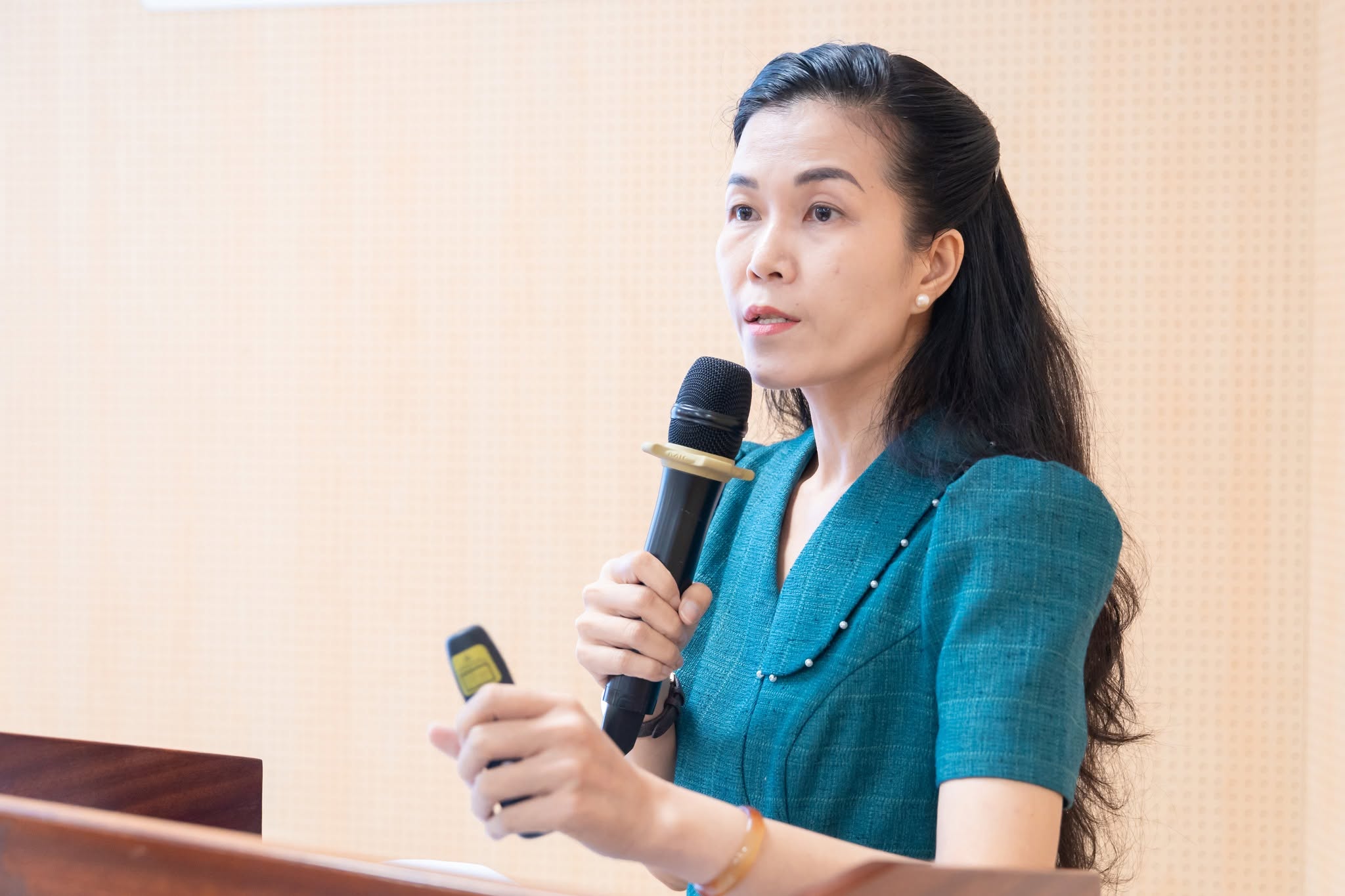
Speaker: Dr. Cao Thuy Oanh, Head of R&D at VAHC, Lecturer at Van Hien University
Dr. Cao Thuy Oanh opened her presentation by posing a central question: "Why has South Korea become the world's leading country in hydrogen consumption in transport?" She cited the International Energy Agency (IEA) in its Korea 2025 Energy Policy Review, which recognises South Korea as "the world's leading consumer of hydrogen in the transport sector." This is not a coincidence but the result of a methodical strategy spanning nearly 46 years.
Market Position and Scale
Dr. Oanh presented detailed figures: by 2024, South Korea had more than 37,000 fuel cell electric passenger vehicles (FCEVs), accounting for over 50% of the global FCEV passenger car fleet and nearly 40% of all FCEVs worldwide. The country also had nearly 1,700 hydrogen buses. By 2025, according to data from the Hydrogen Economy Information Portal, South Korea had approximately 46,586 hydrogen vehicles and 449 hydrogen refuelling stations – one of the densest refuelling infrastructure networks in Asia. These figures demonstrate impressive growth: in just one year, the number of hydrogen vehicles increased by more than 9,500.
Three-Pillar Institutional Framework
Dr. Oanh analysed South Korea's institutional framework comprising three main pillars. First, the Hydrogen Economy Promotion and Hydrogen Safety Management Act (Hydrogen Act) came into effect in February 2021 – the world's first comprehensive hydrogen law. It establishes the legal framework for industry, distribution and safety, and provides the basis for long-term support and systematic implementation. Second, the Clean Hydrogen Certification Scheme with a maximum emissions threshold of 4 kg CO₂-equivalent/kg H₂ on a well-to-gate basis. This certification is linked to eligibility to participate in the Clean Hydrogen Portfolio Standard (CHPS). Third, the Hydrogen Power Bidding Market was launched in 2023, with the clean hydrogen market beginning in 2024 using long-term contracts and accepting only hydrogen meeting specified emissions criteria. This mechanism creates stable and predictable demand for clean hydrogen producers.
Development Roadmap Across Phases
Dr. Oanh presented South Korea's hydrogen development roadmap across key phases. Phase 1980–2002: South Korea's first fuel cell research began at the Korea Institute of Energy Research (KIER) in October 1980. Throughout the 1990s, fuel cell research remained nascent with limited funding, a small research community and many technical challenges. In 1998, Hyundai established a dedicated fuel-cell development organisation, marking industry's entry. In 2000, Hyundai developed its first FCEV based on the Santa Fe.
Phase 2003–2005: On 22 August 2003, under President Roh Moo-hyun, the government held the Next-Generation Growth Engine Strategy Meeting at Cheong Wa Dae, identifying 10 next-generation growth industries, including future automobiles and next-generation batteries. Fuel cells, fuel-cell power systems and hydrogen energy were identified as strategic technologies and products. In 2004, the Ministry of Commerce, Industry and Energy established the Hydrogen & Fuel Cell Project Group with KIST as the implementing institution, engaging around 120 private companies in R&D. The focus began shifting from research to demonstration, deployment and commercialisation. On 3 March 2005, the Ministry presented President Roh Moo-hyun with a plan to develop a comprehensive master plan for the transition from an oil-based economy to a hydrogen economy. On 11 March 2005, at Cheong Wa Dae, President Roh Moo-hyun personally test-drove a hydrogen fuel-cell vehicle developed in South Korea. In September 2005, the Master Plan on Energy, Industry and Infrastructure was finalised and announced.
Phase 2006–2017: In 2006, Hyundai developed an in-house high-performance fuel-cell stack. During 2008–2012 under President Lee Myung-bak, although "Low Carbon, Green Growth" was prioritised, hydrogen was no longer promoted as a comprehensive "Hydrogen Economy" in line with the 2005 vision. However, hydrogen technology continued to advance. During 2013–2017 under President Park Geun-hye, hydrogen was not yet a national economic vision but technology, vehicles, infrastructure and the industrial ecosystem continued to grow. In 2013, the Hyundai Tucson ix Fuel Cell became the world's first mass-produced hydrogen fuel-cell vehicle with a 100 kW stack and 588 km driving range. In 2018, the Hyundai NEXO was launched with a 113 kW stack, 609 km range, and achieved the highest Euro NCAP 5-star rating for a hydrogen fuel-cell vehicle for the first time.
Phase 2018–2026: In 2018, under President Moon Jae-in, the South Korean government selected Data Economy, Artificial Intelligence and Hydrogen Economy as the three Strategic Investment Areas under its Innovative Growth Strategy. On 17 January 2019, the government announced the National Hydrogen Economy Roadmap with targets of 6.2 million FCEVs and 1,200 refuelling stations by 2040, led by six ministries: MOTIE, MOEF, MSIT, MOE, MOLIT and MOF. In April 2020, the Hydrogen Economy Commission was launched under the Prime Minister's chairmanship, with three vice-premiers and 12 ministries, local governments and the private sector participating (40 members in total). In February 2021, the Hydrogen Act came into effect. In 2021–2022, South Korea shifted towards clean hydrogen with standards and certification systems. In 2023–2024, it expanded the market with infrastructure and demand. In 2026, it moves towards a Sustainable Hydrogen Society.
Three Dedicated Governance Institutions
Dr. Oanh emphasised three dedicated institutions established under the Hydrogen Act. H2KOREA is responsible for hydrogen industry promotion. KOGAS (Korea Gas Corporation) is responsible for hydrogen distribution. KGS (Korea Gas Safety Corporation) is responsible for hydrogen safety. This structure ensures each stage of the value chain has a clear responsible focal point.
Hydrogen City Programme
Dr. Oanh introduced the Hydrogen City programme with 15 cities and counties across the country as of 2026, each with its own specialisation. Ulsan is a fully integrated hydrogen city leading the hydrogen industry, with existing industrial/by-product hydrogen sources, pipeline infrastructure, refuelling stations and industrial, mobility and building users. Pohang is linked to steelworks and hydrogen value chain clusters. Boryeong is a global leading hub city connected to the world's largest blue hydrogen production facility. Buan is a green hydrogen city linked to green hydrogen production facilities and energy self-sufficiency. Samcheok was selected for an R&D-oriented hydrogen city. Ansan, Ulsan and Jeonju-Wanju were selected as pilot hydrogen cities in late 2019. Yangju is a low-carbon, eco-friendly hydrogen city with a compact cluster model. Namyangju utilises bio-gas. Uljin is based on nuclear hydrogen production facilities. Gwangyang is linked to steelworks and logistics complexes. Pyeongtaek is a globally integrated hydrogen city combining urban, industrial and port functions. Dangjin is a blue hydrogen city based on green hydrogen and a self-sustaining resource model. Seosan leads energy innovation and industrial transformation. Gwangju Dong-gu utilises the waste incineration plant landfill. Yeongam uses the shipbuilding industry's unique resource cycle. Changwon is linked to local industry and regional innovation. Cheongju leads supply chain and resource circulation. Yeonsan is based on green hydrogen and sustainable transportation. Anseong is linked to military, industry and economy.
Lessons for Vietnam
Dr. Oanh concluded with important lessons for Vietnam. First, Vietnam should not copy South Korea's model but must understand the sequence of development. Technology can start a project, but demand makes it a market, and integration makes it an economy. Second, Vietnam needs to build institutions and markets properly, not just focus on technology. Third, the government's role is to enable and reduce risk, not to replace the market. Fourth, Vietnam needs a long-term roadmap with specific quantitative milestones and committed budgets. Fifth, Vietnam needs to build local ecosystems through the hydrogen city model. She emphasised: "No demand means no offtake, no offtake means no bankability, no bankability means no scale."