

VIETNAM'S NATIONAL HYDROGEN STRATEGY 2030: SUFFICIENT POWER SOURCES TO PRODUCE DOUBLE THE TARGET JUST BY SAVING ELECTRICITY LIKE MALAYSIA
October 20, 2026
Sang-ill Park, Chief Business Officer, Deepbrain Co., Ltd (Energy Chain)
According to Decision 165/QĐ-TTg, Vietnam's hydrogen energy development strategy sets a target for hydrogen production capacity from renewable energy and carbon capture processes to reach about 100,000 – 500,000 tons/year by 2030, with a vision to 2050 of 10 – 20 million tons/year. This is an ambitious target but completely surpassable if Vietnam learns from Malaysia in turning electricity savings into a strategic resource.
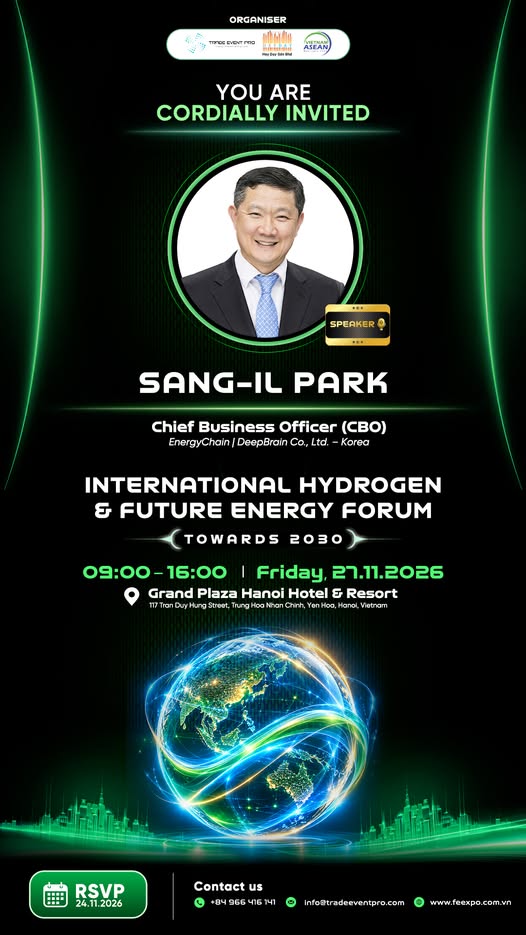
Mr. Sang-ill Park, Chief Business Officer of Energy Chain from South Korea, will have an important presentation session at the International Hydrogen and Future Energy Forum on November 27, 2026, at Grand Plaza Hanoi. Register to attend via the Link
What has Malaysia done? On August 11, 2026, Malaysia officially announced the National Energy Efficiency Action Plan and Policy 2026–2035 (NEEAP 2.0). The target by 2035 is to reduce 11.6% of total energy demand compared to the business-as-usual scenario, equivalent to cumulative savings of 85.24 billion RM (about 20.76 billion USD), cutting 26.1 million tons of CO₂, and attracting 36 billion RM in private investment. Notably, in the 2016–2025 period, Malaysia saved 60,886 GWh of electricity, exceeding the set target and saving about 4 billion USD for the economy. They view energy efficiency as "standard business practice" and a part of lifestyle.
Vietnam can do even better. Based on the revised Power Development Plan VIII, commercial electricity in 2030 is expected to reach 500.4 billion kWh. If Vietnam only needs to save 10% of electricity each year (equivalent to Malaysia's target), we will have:
Year 2027: saving 35.15 billion kWh, equivalent to ~703,000 tons of green hydrogen (converted at 50 kWh/kg H₂).
Year 2028: saving 38.84 billion kWh, equivalent to ~776,800 tons of H₂.
Year 2029: saving 42.92 billion kWh, equivalent to ~858,400 tons of H₂.
Year 2030: saving 50.04 billion kWh, equivalent to ~1,000,800 tons of H₂.
The total cumulative amount for the 2027–2030 period, the saved electricity reaches ~166.95 billion kWh, enough to produce ~3.34 million tons of green hydrogen – a gigantic number when placed next to the target of 500,000 tons/year by 2030.
What is worth mentioning is that the electricity savings of 2030 alone (50.04 billion kWh) is enough to create ~1,000,800 tons of H₂ – double the highest target of the National Hydrogen Strategy (500,000 tons) in the same year. In other words, if Vietnam maintains the pace of saving 10% of electricity per year like Malaysia, we will not only meet but also far exceed the 2030 hydrogen target, even without needing to build additional large-scale electrolysis plants.
Of course, to realize this scenario, Vietnam needs to screen production: prioritize high-tech projects with low energy consumption; gradually eliminate outdated, electricity-intensive facilities; while promoting digital transformation and smart energy management in industry, buildings, and households – exactly how Malaysia is implementing NEEAP 2.0.
TECHNOLOGY REFERENCE: KOREAN ENERGYCHAIN – A PROVEN 10%+ ELECTRICITY SAVING SOLUTION
To turn the target of saving 10% of electricity into reality, Vietnam does not need to "reinvent the wheel". Right in the region, there are already proven technology solutions, and one of them is present in Vietnam: EnergyChain of DeepBrain Co Ltd (South Korea), an official member of the Vietnam – ASEAN Hydrogen Club (VAHC) since September 2026.
EnergyChain is a smart energy management solution integrating three core components:
-
VVCF electricity-saving hardware (Variable Voltage Constant Frequency Transformer): Using a Toroidal core (ring-shaped) and mutual induction reactors, directly addressing the four causes of electricity waste: excessive supply voltage, high harmonics, phase imbalance, and low power factor. This technology solves the problem of "excess capacity" – the amount of electricity consumed exceeding actual demand because equipment is often designed with 1.2–1.5 times excess capacity to ensure stable operation.
-
Smart monitoring and analysis system: Collects electricity data in real-time via IoT module (NB-IoT), integrating artificial intelligence (AI) to forecast demand and optimize electricity usage.
-
Trusted data platform: Applying blockchain technology to store and verify electricity savings data, ensuring reliability for ESG reports and internal audits of enterprises.
Efficiency has been proven in South Korea: EnergyChain has successfully deployed for many major customers, including Korea Electric Power Corporation (KEPCO), Busan Port Authority, Busan Airport Corporation, Korean Standards Association, and Busan Technopark. The actual electricity saving rate reaches about 10% ± 3% – this number surprisingly matches the 10%/year target that Vietnam is aiming for.
In particular, EnergyChain signed multiple memorandums of understanding (MOUs) at the InnoEx 2025 exhibition in Ho Chi Minh City with a total value of more than 6.6 million USD, and is looking for partners in Vietnam to deploy demonstration projects in the power and manufacturing industries. Their business model is "value first, cost later" – not requiring enterprises to make a large initial investment, but relying on actual electricity savings to pay back.
Conclusion: The lesson from Malaysia shows that saving electricity is not only an energy security solution but also an economic lever creating abundant green hydrogen sources. And with the presence of technology solutions like EnergyChain – proven effective 10%+ in South Korea – Vietnam has enough tools to turn the 2030 hydrogen target from "difficult" to "very easy to achieve double". The only remaining issue is the deployment speed and determination to screen production.
#Hydrogen #TietKiemDien #EnergyChain #VVCF #NEEAP #Malaysia #NetZero #ChuyenDoiXanh #AnNinhNangLuong #VietNam2030