

Building a Green Finance Ecosystem at VIFC-HCMC and Perspectives on Hydrogen from VAHC
August 08, 2026
Annie Nguyễn, VAHC Secretariat
1. Context: The Climate Finance Gap and the Urgency to Act
At the Vietnam Green Finance Conference 2026, Associate Professor, Dr. Nguyen Huu Huan, Vice Chairman of the Executive Agency of the Vietnam International Financial Center in Ho Chi Minh City (VIFC-HCMC), delivered a significant presentation on the strategy for building a green finance ecosystem.
According to Dr. Huan, Vietnam is facing a massive climate finance need. The World Bank's Country Climate and Development Report (CCDR) shows that by 2040, Vietnam will need approximately $368 billion in additional investment to achieve its climate adaptation and mitigation targets. This figure is equivalent to about 6.8% of GDP per year, while current public resources only meet about 2% of GDP, making the mobilization of private and international capital a critical factor.
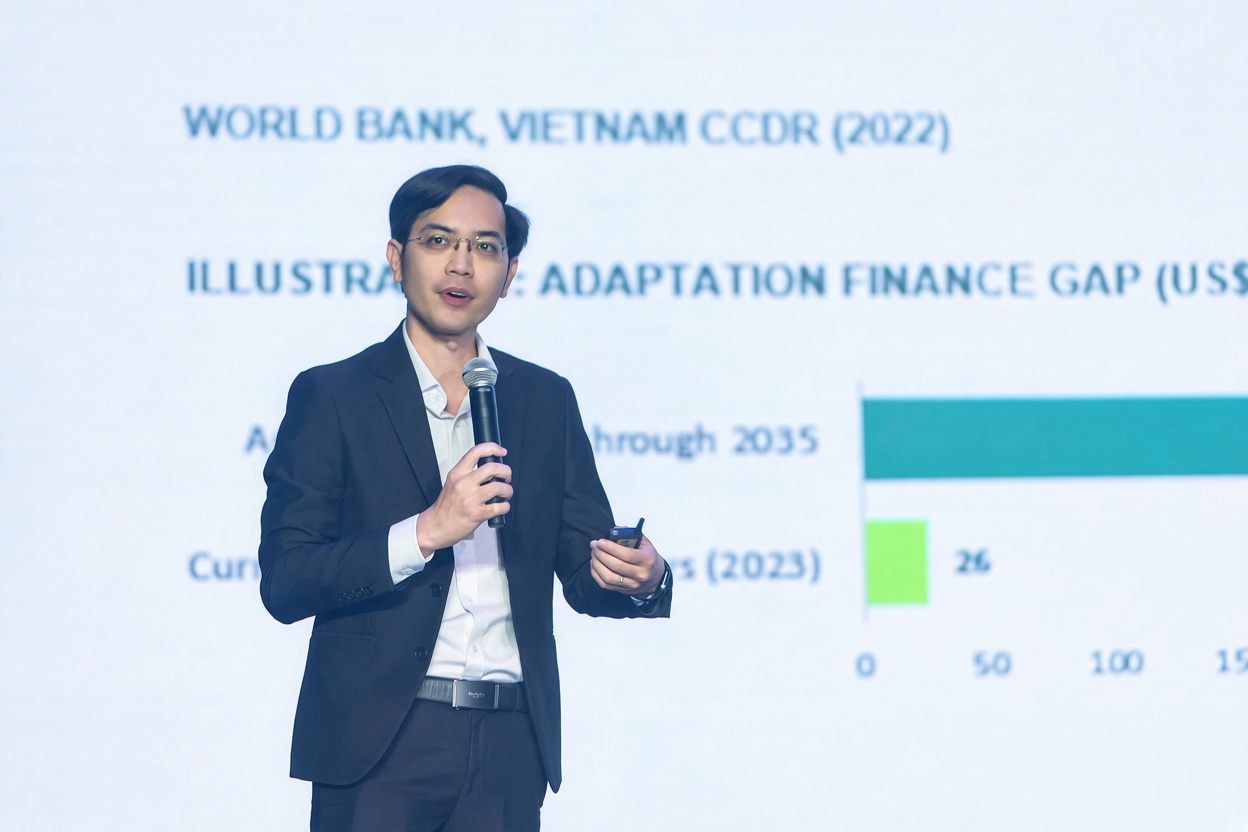
Associate Professor, Dr. Nguyen Huu Huan, Vice Chairman of the Vietnam International Finance Center-HCMC Executive Office (VIFC-HCMC), presented at the Conference.
2. VIFC-HCMC's Strategy: A Green Capital Conversion Hub
Dr. Huan emphasized that the challenge lies not only in the shortage of capital but also in the lack of bankable projects to absorb it. VIFC-HCMC is not merely a place to issue "green-labeled" financial products. Instead, the center positions itself as a "Green Capital Conversion Hub" – where companies' climate transition and sustainable development needs are converted into investable, measurable, guaranteeable, capitalizable, and cross-border tradable assets under the most stringent international standards.
The vision is for VIFC-HCMC to become Southeast Asia's leading green and transition finance hub for emerging markets by 2030.
3. Eight Market Gaps and the Roadmap for Action
In his presentation, Dr. Huan identified eight gaps in the green capital conversion chain and proposed prioritized solutions:
| Gap | Proposed Solution | Priority |
|---|---|---|
| 1. Project Preparation | Green Project Preparation Facility: feasibility studies, financial modeling, standardized contracts | 0-12 months |
| 2. Transition Finance | Pathway-based transition taxonomy; KPIs; step-up/step-down mechanisms; independent monitoring | 6-18 months |
| 3. Adaptation & Resilience | Adaptation bonds, resilience funds, parametric insurance, blue finance | 6-24 months |
| 4. Risk Sharing & Cost of Capital | Blended Finance & Guarantee Facility: first-loss capital, partial guarantees, FX hedging | 6-18 months |
| 5. Data, MRV & Assurance | Climate Data Utility connecting companies, banks, satellites, IoT, and independent auditors | 0-18 months |
| 6. Green Finance for SMEs | Supply-chain finance, data-linked loans, securitization, cluster-based guarantees | 12-30 months |
| 7. Liquidity & Asset Digitalization | Tokenized green bonds, market makers, repo, cross-listing | 12-36 months |
4. Flagship Initiatives
To realize this strategy, VIFC-HCMC will implement six flagship initiatives:
-
Set Standards: Develop a green and transition taxonomy for Vietnam.
-
Build Pipeline: Establish a Project Preparation Facility and pipeline of investment-ready projects.
-
De-risk: Set up blended finance and guarantee mechanisms.
-
Measure: Build data, MRV, and independent assurance systems.
-
Transact: Develop a green bond platform and digital financial products.
-
Scale: Enhance liquidity and connect with international investors.
In 2026, VIFC-HCMC targets 3-5 pilot transactions, with an expected $2-3 billion in green capital mobilized by 2027, and $10+ billion by 2030.
5. VAHC Perspective: Green Finance Ecosystem and Hydrogen Potential in Vietnam
VIFC-HCMC's strategy offers significant opportunities and insights for Vietnam's hydrogen sector:
First, a transition finance framework is key for hydrogen. Green hydrogen falls within the group of new energy sectors requiring large and long-term capital. VIFC-HCMC's priority to develop a transition finance taxonomy and framework will create the legal and financial mechanisms suitable for hydrogen projects, which are not yet covered by traditional green criteria.
Second, the Project Preparation Facility is essential to materialize hydrogen projects. Green hydrogen projects in Vietnam often face difficulties in the pre-investment phase due to a lack of feasibility studies, financial modeling, and standardized contracts. This facility will help hydrogen developers package projects to international standards, increasing access to capital.
Third, risk-sharing and cost-reduction mechanisms are particularly important for hydrogen. Green hydrogen production costs remain higher than fossil-fuel-based hydrogen. Blended finance, guarantees, and FX hedging instruments developed by VIFC-HCMC will help mitigate risks for hydrogen projects, attracting private capital and international investors.
Fourth, data and MRV platforms will enhance the credibility of hydrogen projects. Measurement, Reporting, and Verification (MRV) systems are key to demonstrating emission reduction effectiveness of green hydrogen projects, meeting the requirements of investors and international carbon credit initiatives.
In conclusion, VIFC-HCMC's comprehensive green finance ecosystem strategy, with a focus on green capital conversion and transition finance, creates a solid foundation to attract investment for green hydrogen projects in Vietnam. VAHC will continue to monitor and support connecting stakeholders to realize this opportunity.