

Assessing the Potential of Hydrogen Applications for Carbon Crediting in Vietnam's Agricultural and Environmental Sectors
July 29, 2026 by VAHC Secretariat
On July 29, 2026, at Ho Chi Minh City University of Natural Resources and Environment (HCMUNRE), the International Workshop on "Hydrogen Solutions for Agriculture, Environment, and Carbon Market" co-hosted by HCMUNRE and VAHC officially took place. The event brought together a large number of scientists, leading experts, domestic and international businesses, and diplomatic representatives from Japan, Malaysia, and South Korea. The workshop was organized to promote hydrogen applications in agriculture, environment, and carbon market development in Vietnam, while strengthening international cooperation in clean energy.
SPEAKER 2: DR. TRAN THANH TAM – DEPUTY HEAD OF RESEARCH & INTERNATIONAL RELATIONS, HCMUNRE
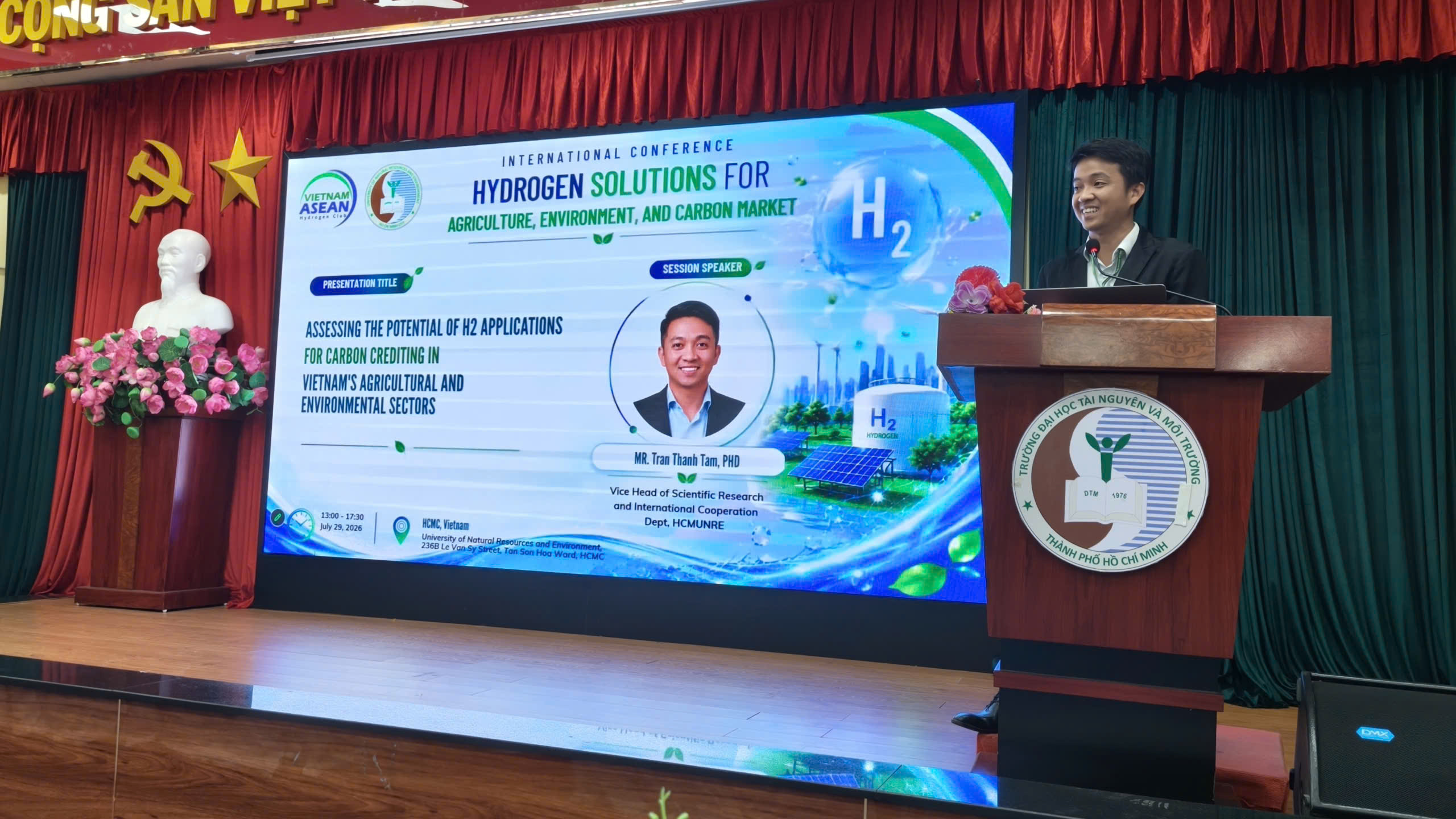
Topic: Assessing the Potential of Hydrogen Applications for Carbon Crediting in Vietnam's Agricultural and Environmental Sectors
Vietnam's Carbon Market Legal Framework
Dr. Tran Thanh Tam opened by introducing the current legal framework:
-
Law on Environmental Protection 2020 (Article 139): Established the legal mandate for carbon markets in Vietnam.
-
Decree No. 29/2026/ND-CP (February 2026): Provides detailed regulations on carbon markets and carbon credits, including validation, measurement, reporting, and verification (MRV).
-
Decision 165/QĐ-TTg (2024): Hydrogen Energy Development Strategy to 2030, vision 2050.
Dr. Tam emphasized these legal documents provide a solid foundation for integrating hydrogen into carbon crediting mechanisms, especially in agriculture and environment sectors.
Three Main Hydrogen Application Models for Carbon Credit Creation
Model 1: Green Ammonia Replacing Grey Ammonia in Fertilizer Production
The Problem:
-
Vietnam's nitrogen fertilizer industry consumes approximately 2 million tons/year.
-
Traditional nitrogen fertilizers use Grey Ammonia produced via Steam Methane Reforming (SMR).
-
Emissions: ~2.05 tCO₂/t NH₃.
Solution:
-
Use renewable energy (wind, solar) to power water electrolysis systems.
-
Produce Green Hydrogen, then synthesize into Green Ammonia (Haber-Bosch process).
-
Technology: PEM or Alkaline electrolysis.
Vietnam Scale Simulation:
-
Replacing 30% of nitrogen fertilizer consumption (~600,000 tons) with Green Ammonia.
-
Emission reduction: 1.23 million tons CO₂/year.
-
Carbon credit standards: CDM AM0012, Gold Standard.
-
Production emission reduction: 95-97%.
Model 2: Hydrogen-Rich Water (HRW) in Rice Cultivation
The Problem:
-
Vietnam's paddy rice cultivation (approximately 4 million hectares) is a major methane (CH₄) emission source.
-
Rice methane emissions account for about 8-10% of total agricultural GHG emissions.
-
Cause: Anaerobic microorganisms decomposing organic matter under flooded conditions.
Solution:
-
Use Hydrogen-Rich Water (HRW) in irrigation.
-
Mechanism: HRW stimulates methanotrophic bacteria (methane-oxidizing), suppresses anaerobic methanogenesis.
-
HRW changes soil microbial communities, promoting bacteria that use methane as carbon and energy source.
Emission Reduction:
-
40-50% of field methane emissions.
-
Equivalent to ~2.16 tCO₂-eq/ha/season.
Carbon Credit Standards:
-
VCS VM0042 (Improved Land Management)
-
GS AWD (Alternate Wetting and Drying)
Additional Benefits:
-
Research by Wu et al. (2020) showed HRW helps rice plants better resist abiotic stress.
-
Rice yield increase of 5-10% (based on HCMUNRE trial results, 2025).
Economic Analysis for HRW Model on 10,000 ha Scale:
| Parameter | Low Carbon Price ($10/tCO₂) | High Carbon Price ($25/tCO₂) |
|---|---|---|
| Area | 10,000 ha, 2 crops/year | 10,000 ha, 2 crops/year |
| Carbon Credits | 43,200 tCO₂/year | 43,200 tCO₂/year |
| Carbon Revenue | $0.432 million/year | $1.080 million/year |
| Rice Yield Increase | $3.840 million/year | $3.840 million/year |
| Payback Period | 5.8 years | 4.2 years |
| IRR | 14.5% | 21.8% |
Model 3: Biogas Methanation from Livestock Waste
The Problem:
-
Vietnam's livestock sector generates large amounts of organic waste.
-
Biogas from livestock waste contains 30-50% CO₂, reducing calorific value and causing emissions when burned or released.
-
CO₂ emissions: ~1.0 tCO₂/t biogas.
Solution:
-
Use green hydrogen to methanate CO₂ in biogas.
-
Sabatier reaction: CO₂ + 4H₂ → CH₄ + 2H₂O.
-
Convert CO₂ to biomethane (CH₄), increasing fuel value and creating carbon credits.
Emission Reduction:
-
100% CO₂ recovery in biogas.
-
Equivalent to ~1.0 tCO₂/t biogas.
Carbon Credit Standards:
-
CDM ACM0022
-
Gold Standard CCU
Additional Benefits:
-
Increased fuel value (biomethane has higher energy value than biogas).
-
Reduced odor and effective livestock waste treatment.
Integration Roadmap to 2050
Dr. Tam presented a long-term roadmap:
| Phase | Target | Key Activities |
|---|---|---|
| 2026-2028 | Pilot | Establish standards, legal framework; pilot 3 models |
| 2029-2035 | Expansion | Scale up successful models; commercial application |
| 2036-2050 | Comprehensive development | Contribute to Net Zero 2050 target |
Policy Recommendations
Dr. Tam made specific recommendations:
-
MARD and MONRE should coordinate to establish carbon accounting standards and emission reduction factors for agricultural hydrogen, complying with Decree No. 29/2026/ND-CP.
-
Develop a national science and technology program on hydrogen applications in agriculture.
-
Establish public-private partnerships to mobilize investment resources for hydrogen projects in agriculture.
-
International cooperation to access advanced technology and carbon finance.