

Ammonia-Consuming Sectors in Vietnam and Their Clean Hydrogen Conversion Potential
July 9, 2026 | VAHC Secretariat
Beyond the fertilizer industry, ammonia (NH₃) is used in various industrial sectors in Vietnam. This article consolidates ammonia demand across these sectors, converts it to clean hydrogen equivalent, and assesses the transition potential within the national hydrogen strategy.
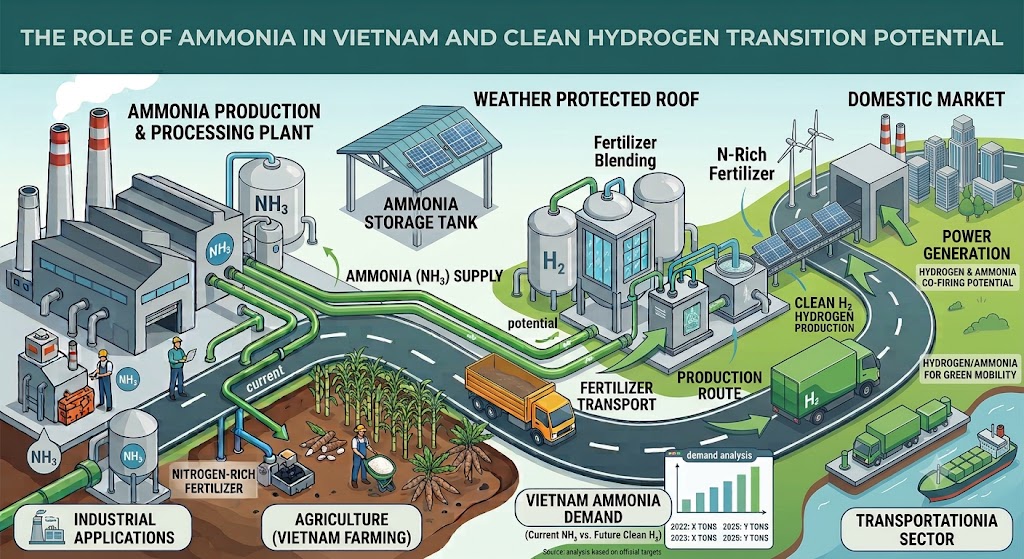
1. Summary of Ammonia Demand and H₂ Conversion
| No. | Sector | NH₃ (million tons/year) | H₂ equivalent (million tons/year) | Notes |
|---|---|---|---|---|
| 1 | Fertilizer | 2.0 – 2.6 | 0.35 – 0.46 | 80-85% of total demand |
| 2 | Chemicals & Synthesis | 0.3 – 0.4 | 0.05 – 0.07 | Nitric acid, petrochemicals, syngas |
| 3 | Mining (explosives) | 0.08 – 0.09 | 0.014 – 0.016 | Coal, construction stone |
| 4 | Textiles | 0.05 – 0.10 | 0.009 – 0.018 | Fiber processing, dyeing |
| 5 | Industrial Refrigeration | 0.03 – 0.05 | 0.005 – 0.009 | Cold storage, food processing |
| 6 | Oil & Gas / Refining | 0.02 – 0.05 | 0.004 – 0.009 | Treatment, desulfurization |
| Current Total | ~2.5 – 3.2 | ~0.44 – 0.56 | ||
| Power Co-firing (future) | 5.0 – 10.0 | 0.88 – 1.76 | PDP VIII target | |
| Marine Fuel (future) | 0.5 – 1.0 | 0.09 – 0.18 | 2050 forecast |
Conversion ratio: 1 ton H₂ ≈ 5.67 tons NH₃ (based on Haber-Bosch synthesis).
2. Detailed Sectoral Ammonia Consumption
2.1. Fertilizer Industry
-
Products: Urea, ammonium nitrate, DAP, NPK
-
NH₃ consumption: 2.0 – 2.6 million tons/year
-
H₂ equivalent: 0.35 – 0.46 million tons/year
-
Characteristics: Stable demand, 80-85% market share
2.2. Chemical Industry & Synthesis
-
Products: Nitric acid, acrylonitrile, caprolactam, syngas, methanol
-
NH₃ consumption: 0.3 – 0.4 million tons/year
-
H₂ equivalent: 0.05 – 0.07 million tons/year
-
Characteristics: Feedstock for chemical value chains
2.3. Mining Industry (Explosives)
-
Products: Ammonium nitrate, ANFO
-
NH₃ consumption: 0.08 – 0.09 million tons/year
-
H₂ equivalent: 0.014 – 0.016 million tons/year
-
Characteristics: Serving coal and stone mining
2.4. Textile Industry
-
Applications: Fiber processing, dyeing
-
NH₃ consumption: 0.05 – 0.10 million tons/year
-
H₂ equivalent: 0.009 – 0.018 million tons/year
2.5. Industrial Refrigeration
-
Applications: Cold storage, food processing, breweries
-
NH₃ consumption: 0.03 – 0.05 million tons/year
-
H₂ equivalent: 0.005 – 0.009 million tons/year
2.6. Oil & Gas / Refining
-
Applications: Desulfurization, acid neutralization, treatment
-
NH₃ consumption: 0.02 – 0.05 million tons/year
-
H₂ equivalent: 0.004 – 0.009 million tons/year
3. Future Potential Applications
3.1. Ammonia Co-firing in Coal Power Plants
-
Potential scale: 5.0 – 10.0 million tons NH₃/year
-
H₂ equivalent: 0.88 – 1.76 million tons/year
-
According to PDP VIII: Green ammonia expected to contribute 25,800 MW by 2050
3.2. Marine Fuel
-
Potential scale: 0.5 – 1.0 million tons NH₃/year
-
H₂ equivalent: 0.09 – 0.18 million tons/year
-
IEA forecast: Global ammonia demand could reach 223-250 million tons by 2050
4. Clean Hydrogen Market Size from Ammonia
| Scenario | NH₃ (million tons/year) | H₂ (million tons/year) |
|---|---|---|
| Current (all sectors) | ~2.5 – 3.2 | ~0.44 – 0.56 |
| Conservative growth (2030) | ~3.5 – 4.5 | ~0.62 – 0.79 |
| High growth (2050) | ~8.0 – 14.0 | ~1.41 – 2.47 |
5. Implications for the National Clean Hydrogen Strategy
-
Market diversification: Industries create a diverse green ammonia consumption market, reducing dependency on a single sector.
-
Significant scale: Current ammonia demand equals 0.44 – 0.56 million tons H₂/year, representing 88-112% of the 2030 green hydrogen production target (0.1 – 0.5 million tons).
-
Large growth potential: Power co-firing and marine fuel could increase demand by 2-4 times post-2030.
-
Competitive advantage: Vietnam can leverage abundant renewable resources (solar, wind) to produce green hydrogen at competitive costs.
-
Integration recommendation: Develop a green ammonia transition roadmap for 2025-2050 with specific targets for each sector, starting with fertilizer and chemicals, then expanding to power generation and marine transport.