
A Study on Implementing Green Hydrogen Projects in Vietnam
October 1, 2026 by VAHC Secretariat, Annie Nguyen
Speaker: Dr. Tran Nguyen Trong Nguyen, President and Founder of Kenzen Consulting Co Ltd, presented at Vietnam Hydrogen Workshop on September 30, 2026
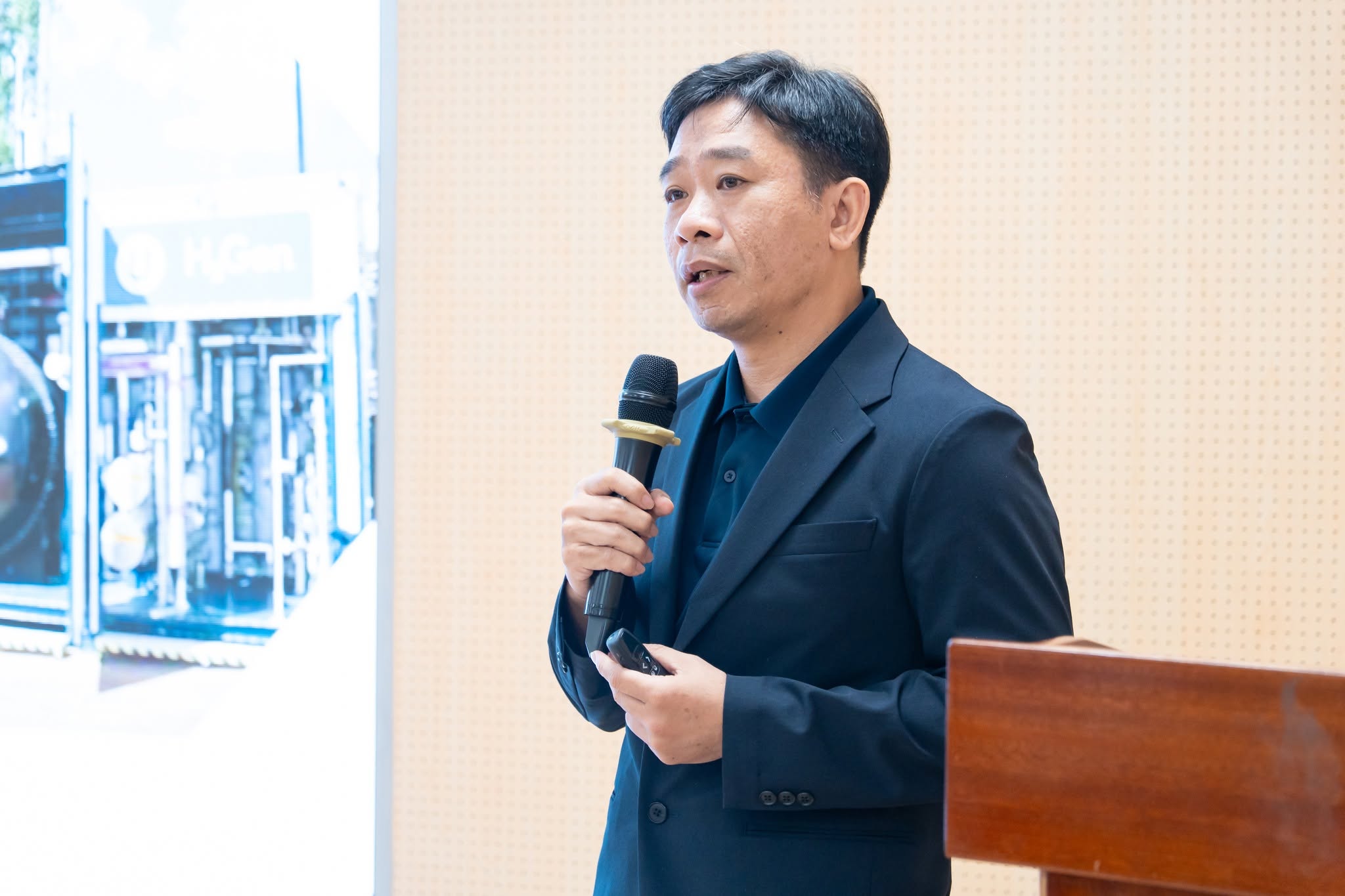
Dr. Tran Nguyen Trong Nguyen opened with an introduction of himself and Kenzen Consulting. He holds a PhD and Master of Science in Electrical Engineering from Yokohama National University (Japan). He worked at Obayashi Corporation Japan (2013–2016) and Obayashi Vietnam (2016–2023), before founding Kenzen Trading and Consulting Co. Ltd. in 2023 as CEO. Kenzen operates in two main areas: M&E work project management, and consulting to support Japanese companies investing and implementing projects in Vietnam. He has consulted on several green hydrogen projects, including hydrogen production systems from solar power, integrated hydrogen aquaculture systems, and smart agricultural solutions using renewable energy.
Green Hydrogen Value Chain
Dr. Nguyen analysed the green hydrogen value chain comprising three main stages. Production: from wind and solar power, through electrolysers, producing hydro and oxy. Transportation: by pipe, by vehicle or by ship, with storage means such as hydrogen and oxygen tanks. Consumption: electricity and fuel for fuel cell electric vehicles and industrial applications.
Reasons for Global Hydrogen Project Cancellations
Dr. Nguyen cited analysis of 52 hydrogen projects cancelled worldwide over the past 18 months. Main reasons include: policy and market uncertainty (38%) – the highest proportion, reflecting instability in policy commitments and market signals; funding (27%) – projects unable to arrange necessary financing; missing offtake (16%) – no customers committed to purchasing products; costs (7%) – production costs higher than expected; permitting/bureaucracy (7%) – complex and lengthy legal procedures; technological barriers (4%) – technology not mature enough; and missing infrastructure (2%) – lack of transportation and distribution infrastructure. He also mentioned that 1.88 GW of EU hydrogen projects withdrew from H2 Bank auctions (2025–2026) and over 50 hydrogen projects were publicly cancelled in 2025.
Vietnam's Renewable Energy Potential
Dr. Nguyen presented figures on Vietnam's renewable energy resources: total potential over 1,000 GW, of which 650 GW wind energy and 380 GW solar energy. He cited the mean wind speed at 100m map and the technical solar potential map of Vietnam. Notably, of the more than 21,000 MW of renewable energy installed by 2022, 4,736 MW had not yet been connected to the grid to sell electricity to EVN. He emphasised this is a valuable resource for green hydrogen production, especially when combined with export potential to Japan – a market with high domestic hydrogen production costs and which has set targets to import cheaper hydrogen fuel from other countries.
Dr. Nguyen also presented examples of solar and wind farms in Vietnam: a 49.5 MW solar power farm in Quang Tri Province, a 50 MW wind power farm in Ninh Thuan Province, and a 210 MW solar power farm in An Giang Province. He emphasised Vietnam's enormous potential in utilising unused renewable energy sources to produce green hydrogen and green ammonia.
Reasons for Cooperating with Japan
Dr. Nguyen analysed reasons for cooperating with Japan. Japan's demand: Japan's domestic hydrogen production cost is so high that Japanese authorities have set targets to import cheaper hydrogen fuel from other countries. Vietnam's strength: especially utilising unused renewable energy to produce green hydrogen and NH₃, with future potential to exploit 1,000 GW of renewable energy. He cited a regional map showing Vietnam's geographical position near Japan and South Korea, creating logistics advantages over more distant suppliers such as Australia.
Japanese Funding Organisations
Dr. Nguyen introduced Japanese funding organisations. Ministry of the Environment of Japan with the Joint Crediting Mechanism (JCM) – through the Forum promoting business engagement in JCM towards readiness for Vietnam's carbon market, held in Hanoi on 22 July 2025. NEDO (New Energy and Industrial Technology Development Organization) – a national agency supporting technology development to address energy and global environmental problems, with approximately 1,463.1 billion yen in funding allocated in FY2024, Japan's largest incorporated administrative agency. JBIC, JICA and NEXI – financial and export credit insurance organisations supporting infrastructure investment and technical cooperation.